Tampilkan postingan dengan label walt staples. Tampilkan semua postingan

Rabu, 04 Januari 2012

Watching the Space Race: The World Got Smaller

by Walt Staples

Note from Karina:  This one should have posted on the 30th. Hope you've been enjoying the walk down Memory Lane with Walt.  We'll resume the normal schedule of  "Watching the Space Race" next week, with Walt's posts resuming Jan 7 and going on Saturdays until he runs out of events.  (He'll never run out of interesting things to say.) 

There are few things as exasperating as receiving orders to break off an operation just as you're ready to take the other guy in the flank. Unfortunately, when Aunt Geneva called your name from the backdoor, an immediate truce ensued. This July afternoon in 1962 was no different. I dropped the muzzle of my weapon of choice, a .45 Thompson submachine gun—one of the finest examples of Mattel's firearms production—and told Tommy Huddleston I'd see him later.

I wasn't sure why my Aunt wanted me. We'd had dinner; it was sometime after two and supper was usually at six. I'd learned during the summer that I stayed with them, that she and my Uncle Jack were very punctual folks.

She was drying her hands on her apron as I stepped up on the porch. “Come on in; there's going to be something on television we need to see.” This was a bit out of the ordinary. Usually, in the afternoon we might watch the “Channel 10 Matinee for an Afternoon” together, but that came on at two and the cat clock on the kitchen wall showed a few minutes until three.

“What's on?”

Her answer nonplussed me. “Pictures from Europe.” I raised an eyebrow (a bad habit for an eleven-year-old when dealing with adults). Reading my mind, she continued, “No, I don't mean pictures like we usually see. I mean live pictures, not on film. They're going to be showing pictures of what's going on right now, this minute. They're sending them through that satellite, Telstar.”

The two of us settled on the couch. At three sharp, we entered the world of real-time international TV. An American TV news anchorman (at this point, I frankly can't remember whether it was NBC's Chet Huntley or CBS's Walter Cronkite—or both) welcomed the viewers. I remember seeing an American Flag, the Statue of Liberty, and—I think—Mount Rushmore. This was replaced by a tweedy gentleman who said in a plummy BBC accent that he was speaking from Brussels. The picture switched to Paris and the Eiffel Tower. The broadcast closed, as I remember, with a shot of the huge white bubble that enclosed the antenna in Andover, Maine. Interestingly, the pictures from the American side were crystal-clear (at least as judged for that time), but the pictures from Europe rippled as if seen through heat waves or water. The pictures we watched were in living black and white—whether they were broadcast in color or not, I don't know; my aunt and uncle, like most at that time, owned a black and white set (it wasn't until 1964 that my father bought a RCA color console model—the local TV repairman had to study a week and a half before he could adjust the colors that had been scrambled on the trip from the store in Roanoke over the mountains into the wilds of West Virginia—he didn't charge us because of the learning opportunity). [If anyone reading this knows whether or not the broadcast was in color, I'd appreciate them leaving the answer in the “Comments.”]

*

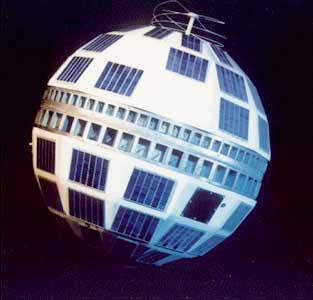
Telstar 1 was owned by AT&T and developed by Bell Labs (part of the Bell Telephone System--”Ma Bell”). It was lofted by a NASA Delta rocket which limited its size to a 34.5 inch (87.6 cm) sphere.  The satellite turned the scales at around 170 pounds (77kg). It was powered by solar cells producing a staggering 14 watts and was spin-stabilized.

Telstar first broadcast a picture on 11 July 1962, a nonpublic “Is this thing working?” broadcast. The first public broadcast, the one my aunt and I marveled over, was on 23 July 1962 at 15:00 EDT. As it was in a non-geostationary orbit, unlike the norm for communications satellites these days, Telstar 1 was only above the horizon for 20 minutes during each 150 minute orbit.

Telstar 1 established several firsts besides being the first rebroadcasting telecommunications satellite. It was also the first privately owned payload launched by NASA . It was the first satellite, to my knowledge, to have a song named for it (Joe Meek's instrumental which is on the first record I bought with my own money, “The Ventures Play Telstar and the Lonely Bull”--which I'm listening to as I write this). It's also the first satellite to have a soccer ball named for it, Adidas's design for the FIFA World Cups competitions—the black and white one that most of us in the U.S. think of when the word, “soccer ball,” is mentioned.

Telsar 1 continued in service routing TV, telephone, and fax and data traffic until a number of its transistors were fried by Van Allen Belt radiation excited by high-attitude detonations during both American and Soviet nuclear testing. It first went off the air in early December of 1962, was resuscitated a month later, and finally died on 21 February 1963. At last word, Telstar 1 is still orbiting the Earth, a victim of the Cold War.

Selasa, 27 Desember 2011

Watching the Space Race: An Orb in Space

by Walt Staples


I must admit to a disgusting family trait—we're morning people. I was actually awake and alert when I saw the balloon floating in space that warm August 1960 morning. I was up at my usual 05:00, had eaten breakfast (found the dinosaur in the cereal box—same one as in the last three), and was waiting for Sunrise Semester to come on TV. The Friday before, a photo of a huge silver balloon in a hanger was shown on NBC's Huntley and Brinkley (I forget which one did the story). Across the front was “N.A.S.A.” in equally huge letters—they didn't lose the periods until years later. According to the report, a radio signal had been bounced off the balloon, Echo 1. Standing in the darkness of our backyard, I watched the horizon over the small pine thicket. After some 15 or 20 minutes, a bright point of light, about the magnitude of Aldebaran (0.87) crawled into sight. I watched until it disappeared over the ridge of Colonel Coon's roof across the street. Then I went back in and watched part whatever of a lecture on the Peloponnesian War—I think—before getting ready for the bus to summer day camp.

                                                                        *

Project Echo involved the launching of a self-inflating mylar balloon into LEO (Low Earth Orbit—100 to 1,240 miles/160 to 2000 km). Upon reaching orbit, the balloon would inflate and ground stations would send microwave signals to it, and the signals would be reflected back to another ground station.

What is referred to as Echo 1 was actually Echo 1A. The original Echo 1 was lost on 13 May 1960 when the Air Force Thor-Delta lofting it missed orbit because the attitude control of its upper stage went sour. Not a way for a launch vehicle to impress on its debut flight. At 09:39 GMT, on 12 August 1960, another Thor-Delta got 'er done and put the latest incarnation of Echo 1 into orbit. (That day in August 1960 was a particularly hazardous day for birds. At 13:00 GMT, an Air Force Atlas suborbital test was also launched from Cape Canaveral; followed at 18:28 GMT by a test of the Polaris submarine-launched missile by the Navy from their end of the Cape. Meanwhile, the Air Force was launching a Kiva-Hopi sounding rocket from the Pacific Missile Range on California's Point Arguello*. On the other side of the world, the Soviets were test-firing a R-12 Dvina medium range ballistic missile from what would later be renamed “Baikonur Cosmodrome,” Kapustin Yar.)

Once in orbit, the balloon inflated to its full 100 foot (30.5 meter) diameter. A signal was sent up to it from JPL in Pasadena and bounced down to the Bell Laboratories in Homdel, New Jersey. Echo 1's silver surface was used to bounce TV, radio, and transcontinental and intercontinental telephone signals. Because of its large sail-area and tiny mass—about 90 pounds (180 kilos)--the solar wind had a noticeable effect on it. The larger Echo 2 (135 feet/41.1 meters) was successfully orbited aboard a Thor-Agena on 25 January 1964. Echo 1 reentered on 24 May 1968, while its sibling deorbited on 7 June 1969.

What was not mentioned at the time was another part of the missions. The pair of balloons were used to more accurately fix the location of Moscow to aid in targeting for ICBMs.

I remember standing in line at the East Springfield, Virginia, Post Office that December so that I could buy the commemorative First Class stamp the Post Office had issued on 15 December. First Class postage at the time was a whopping four cents—something my father grumped about quite regularly (the year before, it had skyrocketed from three cents).


* Another thing of interest about Point Arguello is that in 1923, seven U.S. Navy destroyers (part of a 14 ship formation on a speed run from San Francisco to San Diego) piled into the point at flank speed in fog. 23 crewmen were lost in the sinkings.

Selasa, 20 Desember 2011

Watching the Space Race: Well, One Worked

by Walt Staples

Note from Karina:  My kids are on Christmas holidays, and I just finished writing Neeta Lyffe, Zombie Exterminator 2:  I Left My Brains in San Francisco, so it's the perfect time for a break.  Walt, meanwhile, has so been enjoying his trip down memory lane, he's got several posts done for "Watching the Space Race."  So for the next couple of weeks, you can join him in remembering the "Glory Days" of space travel.  Enjoy!


It was two days after my ninth birthday that NBC's Chet Huntley announced yet another Pioneer mission failure. This time the third stage and the Pioneer lunar orbiter (Pioneer P-3, fifth in the series) were stripped off of the Atlas-Able launch combination by the slipstream after its aerodynamic shroud (read nosecone) was shredded. At the time, this didn't particularly upset me. Watching American efforts since Vanguard had taught me that most American launches go wrong—it was like me and spelling tests.

The watching the early Pioneer program was rather like watching the progression of Commanders of the Army of the Potomac during the War Between the States/American Civil War (“Our own beloved General George Mead is now Commander; the fifth if you keep count as they go by.” – Buster Kilrain in the movie, “Gettysburg”). Unfortunately, this fifth Pioneer launch was a dud just as were the previous four. NASA would have to launch an eighth before they found their George Mead.

Four months later, something weird happened at Cape Canaveral. At 13:00 GMT on 11 March 1960—a Pioneer launch actually worked. Pioneer 5 (eight in the series), known to us kids as the “paddle-wheel satellite,” was inserted into a solar orbit by its Thor-Able launch vehicle.

We referred to the 75 pound (34 kilo) satellite as the “Paddle-wheel Satellite” for good reason. Protruding from its 26 inch (66 cm) diameter sides were what could only be described as four “paddles.” The paddles in reality were solar arrays to power the four science packages on board. The  four packages consisted of an instrument to detect charged solar particles, a magnetometer to measure magnetic fields of both of Earth and those in interplanetary space, a cosmic ray detector, and a micrometeorite impact detector. The solar cells were so few that collected data had to be saved and sent to Earth in four 25 minute spurts spread over 24 hours. The signals were received at England's Jodrell Bank Observatory (a place familiar to Dr. Who fans) and the Air Force's Hawaii Tracking Station at Kaena Point on Oahu (originally built for the Discovery/Corona program of reconnaissance satellites). The last data was received on 30 April 1960 and the last signal of any kind was received at Jodrell Bank on 26 June 1960 when Pioneer 5 was 22.5 million miles (36.2 million km) from Earth.

The results from the instrumentation was mixed. Magnetic fields were successfully measured, as was cosmic radiation and particles from solar flares. Unfortunately, the micrometeorite counter was overwhelmed with hits.

Two more lunar Pioneer missions returned to the project's accustomed trend with failures. The last being Pioneer Z, on 15 December 1960, when the upper stage of its Atlas-Able failed.

The early Pioneer program, whether attempting to put up a lunar orbiter, solar orbiter, or lunar flyby, was a reasonably consistent string of disasters, marred only by its single success. As one English friend put it, “I think it just shows the sheer bloody-mindedness of you Yanks.” (I prefer to think of it as being “firm and steadfast of purpose.”) The “Pioneer” name would later be resurrected for a wildly successful series of interplanetary probes that would launch between 1965 and 1978.

Sabtu, 17 Desember 2011

Watching the Space Race: Hidden Under the Tree

by Walt Staples

If you are the U.S. Air Force and you need to hide a spy satellite and its 95 foot (29 m) long launch vehicle from the KGB, where would you stash it? In 1959, the answer was: in plain sight under the Christmas tree of nearly every nine-year-old boy in America.

It was the day after Christmas, 1959, and times were good. We'd moved north from the Shenandoah Valley to the Virginia suburbs of Washington the year before. With the military building like crazy, there was enough steady ironwork that my father was able to live at home, and my mother had a job at the five-sided puzzle palace next to the Potomac. The trend for me that Christmas revolved around the Cold War and things airborne, the two major gifts being a Steve Canyon Jet Fighter Helmet and a Jet Interceptor Fighter Cockpit. Among the lesser--but still very appreciated--gifts were several model kits. This is where I and my parents colluded with the CIA and the Air Force in their security subterfuge, as one of the kits was a plastic model of the Discoverer weather satellite and its Thor-Agena launch vehicle.

*

The Corona program was a CIA “black” operation that used satellites launched by the Air Force for photo reconnaissance and electronic signals intelligence gathering (ELINT). The Air Force also provided in-flight recovery of the reentry capsules or “film buckets.” Discoverer was the “cover” for the secret program. This continued until 1962, when the Discoverer program was officially retired with Discoverer 38 and all flight activities moved over into total secrecy. The Corona program finally ended in 1972.

Development of Corona began in 1956 as the Discoverer program. From 1958 to 1969, The equipment was manufactured at Lockheed's Hiller Aircraft facility in Palo Alto. After that production was moved to Lockheed's Sunnyvale plant.


An interesting wrinkle of the program was the preferred method of recovery. A specially equipped U.S. Air Force C-119 “Flying Boxcar,” using a trapeze, would snatch the film bucket in midair as it descended after reentry. The bucket would then be brought aboard the aircraft through the open rear cargo doors between the tail booms. If the aircraft missed the catch and the film bucket hit the water, a time-delay device would allow it to float long enough for the Navy to recover it or, failing that, would sink it before anyone else could grab it.

Corona/Discoverer was declassified by President Bill Clinton starting in 1992.

Thinking back to that Second Day of Christmas, Boxing Day, or Feast of Stephen (as you prefer), it makes a body feel good to know that at the tender age of nine, I was aiding in my country's defense as I opened the supposed weather satellite kit's box and surveyed the white plastic parts.

Sabtu, 10 Desember 2011

Watching the Space Race: Why All of the Sudden?

by Walt Staples


The Sputnik I and II, Vanguard I, and Explorer I launches all hit around the end of 1957--beginning of 1958. Why? Even at the advanced age of seven, it never occurred to me that this was a nexus in history. At that age, things just happened with little or no rhyme or reason. The only things you could depend on were Santa Claus, the Easter Bunny, and the Tooth Fairy—everything else was up for grabs.  About all a kid could do was enjoy the good parts and try to keep their head down through the bad. I was really only aware that suddenly rockets seemed to be popping out of the woodwork as the Americans and Soviets tried to outdo each other.


The reason for this somewhat unsightly scramble was that both the U.S. and the U.S.S.R. had pledged to join just about every other country in the world in taking part in the International Geophysical Year (IGY), an 18 month period that would encompass research on the Earth sciences. The only two major  countries that didn't take part in the IGY were the Republic of China (Taiwan) and the Peoples Republic of China (the mainland), who were too busy trying to kill each other at the time to worry about minor matters such as the Earth and what made it tick.

One of the main thrusts of the IGY was research revolving around the polar regions. True to the IGY's roots in the periodic International Polar Year scientific efforts, Antarctica was the scene of intense collaboration involving around 68 scientific organizations. For those of us following from the sidelines through TV, radio, newsreels, newspapers, and magazines such as Life and Look, it was pretty much accepted as a seamless continuation of the Navy's Operation Deep Freeze (the first two, Deep Freeze I and II, 1955-57), the building up of bases, stores, and equipment for the coming studies.

Aside from the two Sputnik orbital launches and the Vanguard misstep, there were 92 successful or attempted suborbital launches in support of the IGY from July 1957 to the end of the year, and, in 1958, 6 successful orbital missions out of 28 tries and 133 successful or attempted suborbital launches. Most of the suborbital launches were small sounding rockets such as the Aerobee and Britain's Skylark (the latter launched from Woomera, in South Australia). It's thought that some of the Soviet launches may have been in support of the IGY, but, as is often the case at that time, things start getting murky once one moves east of the Fulda Gap.

1958 also ushered in a number of failed efforts to launch exploratory probes to the moon. The Americans were ahead of the Soviets in blowing up lunar probes, with their first unsuccessful try at sending Pioneer 0 to the moon in August. The Soviets weren't able to lose their first lunar probe, Luna E-1 1 (NASA designation Luna 1958A), until September. Pioneer 1 and Luna E-1 2 (NASA designation Luna 1958B) were lost the same day, 11 October. The pain continued with Pioneer 2's failure to reach the moon in early November.

While the IGY was wildly successful with such discoveries as the Van Allen Belt, the corpuscular nature of radiation from the solar wind, and the non-space related evidence for the theory of Continental Drift provided by the discovery of the mid-ocean ridges, one question still stumped the American people--the why of an 18 month year eluded just about everyone not actually involved. Even the characters of Walt Kelly's popular comic strip, “Pogo,” seemed equally bemused, as Howland Owl and Churchy the turtle wonder if it meant the imposition of the ten-and-a-half-day week. I think my father summed up the feelings of many when, having just watched several heavy-hitters of science trying to explain it to “Today Show” host Dave Garroway, he quietly remarked, “I'm not totally sure some of those folks are from this planet.”

For more information:  http://www.nationalacademies.org/history/igy/

Sabtu, 03 Desember 2011

Watching the Space Race: Finally! America Enters the Race with Explorer

by Walt Staples
Finally!

The TV picture was crystal clear—which by today's standards means it was grainy and in living black and white. The thing that caught the eye was the spinning cylinder at the top of the rocket, just below the last stage. That one side was painted white and the other black made it seem to almost blink. Black chevrons running between a pair of black bands encircling the second stage screamed that the launch vehicle was a product of Wernher von Braun's Redstone Arsenal shop (I didn't know it at the time, but the Army did this with their domesticated V2s and later American made rockets that they launched from White Sands so they could study the rockets' roll pattern). The night scene on the TV lit up as flame billowed up around the lower part of the rocket. Rather than tiredly falling over and exploding as in the previous launch attempt of an American satellite, the Army's rocket rose slowly into the dark sky. Explorer I was on it's way. We were in space!

*

Explorer's launch was a bright spot in the winter of my family's discontent. The launch occurred near the cusp of 31 December-1 February 1958 (22:48 EST, 31 December and 03:48 GMT, 1 February). At the time, I was safely in bed (when you're seven, you have to put up with such ridiculous hours as a 20:00 bedtime—thank you, WSLS-Channel 10 for the early news on Saturdays). The Wednesday before, my mother and I put my father on a Piedmont DC-3 to Corning, New York. He'd given up trying to make ends meet working for a Roanoke exterminator and Corning Glass was the closest anyone was erecting steel. We'd get to see him for a weekend every three months.

Explorer's launch had an electric effect on Americans. Suddenly, we were in the race. The jokes stopped...mostly, and people were eager to scan the papers for stories about spaceflight. For us kids, Christmas came twice in 1958. As far as we were concerned, the Army was ten feet tall! (The Navy returned to our good graces when Monogram Models' 1/48th scale F4U Corsair appeared on drugstore shelves that spring—you just can't stay mad at a service that flew such a neat airplane.) Proof that America had entered the Space Age came Christmas 1958 when Marx Toys' Cape Canaveral playset pushed aside their Dinosaur Land playset from under the tree.

At the time, everyone knew the Explorer launch vehicle as the “Jupiter-C,” an outgrowth of the Army's Redstone nuclear-capable ballistic missile. To the illuminati, it was actually designated the Juno 1 to distinguish it from the original Jupiter-C which was used in 1956 and 1957 for suborbital flights as a re-entry vehicle testbed.

The Explorer satellite, itself, was shaped like a mini-rocket rather than a ball like its predecessors, weighing in at about 31 pounds (14 kg), and was produced by the Jet Propulsion Lab (JPL), a truly wonderful place.

One of the things the Army was keeping under its helmet was that the data on cosmic ray strikes they were receiving from Explorer wasn't adding up. Instead of the nice steady rate of comic ray strikes they expected, when the satellite was at about 300 miles (500 km), Explorer received the expected hits; when it rose to 1,250+ miles (2,000+ km), it said there were no hits at all. It wasn't until the launch of Explorer III that a team under Dr. James Van Allen at the University of Iowa tumbled to what was going on—the Earth's magnetic field had a pair of belts of charged particles trapped in space and the detector was swamped at the higher altitude. These belts were christened the “Van Allen Belt” for some reason. (Oh, and Explorer II? It failed to reach orbit when it was launched on 5 March 1958, so we don't like to talk about it.)

A second thing under that helmet was that, supposedly, von Braun and the Army were ordered in 1956 by the White House not to attempt to orbit a satellite. President Dwight D. Eisenhower wanted the first satellite orbited by a squeaky-clean civilian rocket. After the civilian bird (built by the Naval Research Laboratory) laid an egg, Washington burnt up the phone lines to Huntsville looking to get something—anything--into orbit. And orbit they did.

Sabtu, 26 November 2011

Watching the Space Race: A Pratfall to the Stars

by Walter Staples
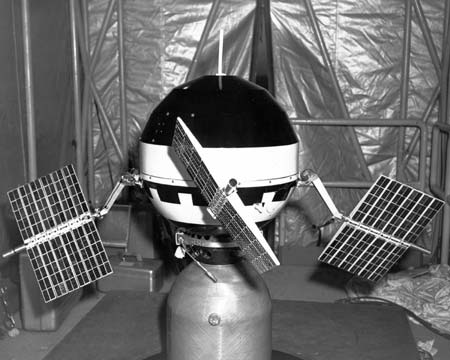
This is tagged as Vanguard 2.  Couldn't find Vanguard 1 photo. --Karina

The scene on the little Admiral portable TV was a graded mixture of grays punctuated by details of black and grayish white given a greenish cast by the sunglasses I wore. The bedroom itself was dim with the shades drawn that Friday forenoon. Why sunglasses in a darken room? I was down with a case of the German measles and Dr. Greer at the clinic said it was the only way I could watch TV.

It had been a lousy fall so far. In the Shenandoah Valley, it seemed to be raining constantly, even when it wasn't. There was no iron work for my father. According to him, it was President Eisenhower’s fault somehow—being six, going on seven, the reasons were kind of beyond me—something to do with Stevenson losing the year before. My birthday a few days before Thanksgiving had been okay, but this year my father failed to get a deer. But the very worst happened in the early parts of October and November—the Soviets had put not one, but two Sputniks into orbit! The second even carried a dog named Laika (the adults were careful not to mention to us kids that hers was a one-way trip). But today it was all going to turn around. About noon, Eastern time, America was launching her first satellite!

The Vanguard rocket on the screen looked more like a #2 pencil than a proper rocket like those flown by Rocky Jones: Space Ranger and Tom Corbett: Space Cadet. It lacked the streamlined bullet shape and flaring tail fins ending in landing shocks that anyone who'd watched “Destination Moon” knew were required for a true spaceship. But Vanguard was going work in spite of its lack. We knew it would. Best of all, it wasn't a war rocket like the Reds had used—it was civilian through and through (at that age, it didn't really occur to us kids to wonder why the Navy was building and launching a civilian rocket).

The TV broadcast cut into the countdown. I called to my mother, in the other room, that they were going to launch the rocket. In return, I received a, “That's nice, dear.” I shrugged. The ways of adults are many and strange. The countdown progressed, “...T-minus ten-nine-eight-seven-six-five-four-three-two-one-zero-Fire.” And fire it did. A great boiling ball of flame engulfed the lower half of the rocket, which fell over as its nose cone came off, and totally disappeared in a larger fireball. Time stopped. Apparently, the TV announcer was frozen just as was I. His silence stretched.

I don't remember what came next that soggy 6th of December in 1957. It didn't really matter anymore.

*

Project Vanguard was one of three programs in the running to loft the first American satellite. The Army was pushing its Explorer program to launch using a modified Redstone ballistic missile. The Air Force was pitching a program using their as then unbuilt Atlas missile. The Navy's Vanguard used an outgrowth of an atmospheric sounding rocket, the Viking. As the White House was unsure just how the Soviets were going to react to an American satellite passing overhead every 90-some minutes, it was decided to go for a launch system without the merest hint of military development in its linage. Vanguard got the nod as the least warlike.

The mission of Vanguard TV3 (or, as we knew it at the time, Vanguard I) was three-fold officially: Put a satellite in orbit for the International Geophysical Year, do at least one experiment while in orbit, and be successfully tracked from the ground while in orbit. Its unofficial mission was to ameliorate our looking like fools before the world.

The reaction of the American public, once it got over its collective cringe at Vanguard's failure live on TV within the 48 U.S. states (our ability to make fools of ourselves live on TV broadcast all over the world would come later with Telstar—a event five years in the future), was a combination of wry humor and a determination to get it right next time.

The gallows humor took the form of jokes such as:

            “How does a Cape Canaveral countdown go?”
            “...5-4-3-2-1-oh, hell!”

Even in the 1961 movie comedy “One, Two, Three,” an East German character when asked why he wants to build rockets for the Russians answers, “Because with Russian rocket, Mars! Venus! Jupiter! With American rocket, Miami Beach!”

The determination to succeed was signaled when concerns about the launch vehicle's bloodlines were cast to the winds and Wernher von Braun and the Army came up to bat.
Related Posts Plugin for WordPress, Blogger...