Tampilkan postingan dengan label NASA trip to moon. Tampilkan semua postingan

Selasa, 27 September 2011

Junk in Spaaaaace!

Somehow, I don't think those free crack repair places are up to this job.
Last week, we talked about space junk, how much there is and why it's a problem.  I think the photo above kind of sums that up.  This is the seventh shuttle mission's windshield after getting hit by pea-sized debris at about 15,000 miles per hour.  And you thought hitting a bird with your car was bad!

LDEF.  Kind of looks like a trailer in space, doesn't it?
Fortunately, space junk does not act like the common animal who just has to cross the road in front of that big shiny thing. However, satellites do get hit by miniscule stuff all the time.  NASA sent up a satellite to study this problem--the LDEF.  It was hit millions of times in eight years in orbit, but stayed operational.  (Some of the impacts could only been seen through an electron microscope, to give some perspective.)

So we can agree this is not an optimal situation.  In truth, for the most part, active satellites and space missions are relatively safe.  But the problem is increasing.  In fact in less than three years, the amount of space debris increased by 50 percent, mainly because of two incidents:  the Chinese testing of an anti-satellite weapon, and the crash of an Iridium satellite with a defunct Russian Satellite that together added nearly 5000 pieces of trackable space junk.  (from High Frontier article in Feb 2010)  So what do we do now--and what will we do later--about this problem?

1. Shields.  We need these anyway because of all the naturally occurring space debris--micrometeoroids and dust.  The most common shielding, as I'd mentioned before, are thin strips of aluminum or other material.  The reason these work is because of the speed it's hitting.  When the debris hits, there's so much energy in the force that it  flares into plasma and spreads across the shield.  Thus, you can use a lighter material, and have more layers, and it protects as well as the heavy material.
Here's a shield being tested at NASA.  It uses Kevlar

2. Avoidance.  Air Force Space Command tracks the orbital debris that's bigger than two inches.  (Rob did this for awhile.)  They put out reports and warn NASA and others when a piece of debris looks to be in danger of hitting a functioning satellite.  A more accurate space radar, called the "Space Fence" is in development to better track even smaller pieces of debris.  Of course, other nations do this as well...but we do it best.  (Here's a link to Space Command's website, but it's a 2006 page, so the data is OLD.)
3. Get out of the way!  Satellites, manned vehicles and even the ISS have maneuvering power and fuel planned for collision avoidance maneuvers.  NASA, for example, uses a 1 mile by 30 mile by 30 mile "pizza box" zone around the shuttle.  If something is going to enter that zone, they plan for a maneuver.  Problem is, while it only takes a couple of hours to plan a move on the shuttle, it takes 30 hours to plan and execute one by the ISS if they need the Russian rockets.  (Remember in July, Atlantis nudged it out of the way while docking.)  If they can't plan in time, they prep for collision and hang out in the Soyuz escape pods until the all clear.
4.  Clean up!  This is the one we're working on now.  There are several ideas for cleanup of space junk., and we'll hit on those in another blog.

Jumat, 16 September 2011

Events in Spaaaace!

In the news...

Blue Origin's spacecraft failed during a test launch on September 2.  It didn't get a lot of news, in part because Blue Origin isn't being especially public about its endeavors yet.  The spacecraft was to go suborbital on this flight, and at 45,000 feet started going unstable and they had to destroy it.  Blue Origin is one of the commercial space industries vying to supply the ISS and to promote manned spaceflight.  It was founded by Amazon CEO Jeff Bezos.  (Glad to see those millions are going to something.)  http://www.space.com/12824-blue-origin-private-spaceship-rocket-failure.html
Sometimes a cigar...is a rocket?
NASA Astronauts to return today:  (Note, this was written on 9/14).  So there will be three astronauts on the ISS until the Russians send up a crew on November 12.  I'm not sure when the next three are going up, but the remaining crew is supposed to come down in the end of November.  http://www.space-travel.com/reports/Three_ISS_crew_members_scheduled_to_return_on_Friday_999.html
(From right) Commander Andrey Borisenko and Flight Engineers Alexander Samokutyaev and Ron Garan
Star Ripping Its Planet Apart.  'K, the "Death Star" reference is a stretch, IMHO, but it's very cool that we can see so far so well that we can tell that this star's magnetic field is tearing the planet apart.  Check out the video:  http://tv.ibtimes.com/real-life-death-star-found-frying-nearby-planet/1899.html

Oh, Look.  NASA isn't getting out of the rocket business after all:  The Obama Administration has unveiled its plans to build a huge liquid fueled rocket.  http://www2.timesdispatch.com/news/2011/sep/14/nasa-unveils-giant-new-rocket-design-ar-1308453/  Now NASA says they want this to get to Mars and the asteroid belt, but I'm going to have to get some explanation on this because...

1.  Didn't Obama cancel a rocket program already in development?
2.  Didn't Obama say they were going to leave the space lift side to commercial interests and let NASA concentrate on developing technologies and furthering space exploration?  (Note this rocket is going "back to the future" with current technology.)
3.  Given NASA's track record on cost overruns and, well, the history of CANCELING programs in motion, is it really a good idea to have the government start producing a rocket that is, by nature, even more complex than the one they just scrapped because of production trouble and cost overruns?  Especially when it's "scheduled" to begin TEST launches in 6 years--plenty of time for the next president to come in and slash it.
Chicks dig giant rockets...but not government programs!
I'll be doing some research on solid, liquid, and hybrid fueled rockets for the blog later.


Minggu, 11 September 2011

NASA Launches Mission to Gravity Map the Moon

This week's "current" event comes from NASA, which launched its GRAIL mission on September 10. Here's a video of the launch. It's awesome to watch, and I love the sound of the rocket engines. (Frankly, that's my favorite part of being in the Air Force, too; living on or near a base and hearing the jet engines. Air Power--rrroawr!)


GRAIL stands for Gravity Recovery and Interior Laboratory, and really what NASA hopes to do is make a gravity map of the moon. GRAIL consists of two satellites that will fly the exact same orbits, one following the other. As the composition of the moon changes, whether because they are overflying a mountain or something beneath the surface is more massive than the stuff around it, one satellite's orbit will be affected slightly. By recording the differences, they'll be able to better figure out the composition of the moon.


Scientists believe this can also help us understand other planets as well; sadly, the video doesn't really say what or how. However, the key lies in the fact that the moon has no atmosphere, so it holds an accurate history of the past 4.5 million years of our universe. If we know what's inside the moon, we know what's been around, when and what it did. For example, did you know the moon isn't round? It actually has a bump on the far side. In fact, there's one theory that earth had two moons once upon a time and that one hit the other. A gravity map might shed some light on this and other questions.

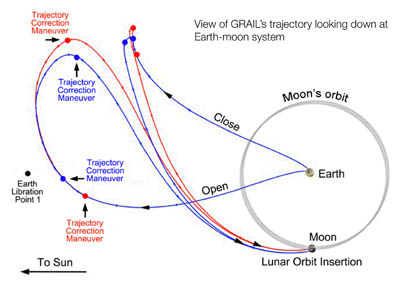
My friend Virginia (and that's her actual name this time) asks, "Why are they taking months to get there? Are they driving?" Those who remember the Apollo missions know that we got to the moon in a matter of days, but the GRAIL probes will take three and a half months.

Are we there yet?


Not driving, but they are trying to save on fuel. Unlike when you drive on earth, the direct route from A to B isn't always the most fuel-efficient. That's partly because as the satellites are moving, so is their target, but mostly because you want to be able to slow down and get into orbit. Slowing down takes a lot of fuel, and the spacecraft don't have it. So they make use of a nifty astronomical feature called a LaGrange point.

The LaGrange point is a kind of null space, gravitationally. If you put something there, it will stay there. So NASA is using that to help slow the satellites down. I couldn't find a good explanation for how this works, but my guess is that it gives the ships time to coast, and they can make fewer course changes and don't have to use as much power to slow down to get into lunar orbit. Also, it takes a less powerful rocket to send something up to the LaGrange point than it does to get to the moon.

The other thing it does is give the satellites time to "out-gas." Gas gets caught in the spacecrafts, even on the molecular level, and will sublimate in vacuum. They need the satellites to do this first to make sure they get accurate readings when mapping the moon. You can find fuller details here: http://www.spaceflightnow.com/delta/d356/preview.html.

For further reading:
http://science.nasa.gov/missions/grail/
http://moon.mit.edu/objectives.html
http://www.spaceflight101.com/grail-mission-design-timeline.html
Related Posts Plugin for WordPress, Blogger...