When it came to colonizing the New World, the governments of Europe had a big role in support, but when it came down to it, it was the commercial businesses and private citizens that ensures a permanent presence. If we're going to have the same kind of success in space, we need to have the same kind of participation, but it seems many people have forgotten that. Thus, let me present three reasons I see why we cannot leave space exploration to the government:
#1 The government has other priorities. Let's face it, the government has gone waaay beyond what the founding fathers intended, and we have a huge deficit and a lot of conflict as a result. What's the government's job in space, then? I'd suggest it's pretty much the same as it is on Earth--protecting the rights and freedoms of its citizens. Step one is establishing a presence in space--a permanent, sustainable presence. Just like with colonization of the New World, that doesn't mean only government employees or government-funded exhibitions, however. It does mean being ready to support even defend its citizens who go fare beyond the Earth. (Sorry, Space is for Peace supporters--I want space to be peaceful, too, but not every nation is going to support that, and if they challenge our presence, we'll need government presence to defend us. And that can be diplomatic as well as military.) However, government role is support of space endeavors and the rights of its citizens in space--not taking on the whole manned space program itself.
#2 Governments are more swayed or stymied by public opinion. Sure, commercial companies need to have a good image, but frankly, as long as they are pleasing their customers, the rest of the world can take their business elsewhere. Governments, unless they're totalitarian and can do what they please, thank you very much, can be swayed by opinions like this one: End Space Exploration Now. And in fact, our government HAS been swayed by opinions like this, which is why the space program has had such rocky fits and starts. Unless space exploration can directly "feed the hungry children" or cut unemployment by several percentages (I don't think they'd be satisfied with anything less) or solve the deficit or whatever the political crisis du jour is, it will not get a gung-ho kind of support we got when first putting a man on the Moon. Without gung-ho support that crosses political parties, we're not going to get a long-lasting coherent government space program.
#3 Governments aren't big on innovation. Yes, I know it's one of NASAs missions to promote new technology, but as a counter, may I present a space shuttle that had to be decommissioned because they couldn't find parts, a bomber fleet in which today's pilots are literally flying their grandfathers' airplanes, a fighter program that might be canceled because Congress won't fund it... Or let's talk cost overruns because of the way the contracting system works in the government. Or maybe how a new administration can kill a program media res and replace it with his own great idea...which may or may not survive the next election.
The fact is, the government isn't interested in profit or product the way a commercial industry has to be. So when it comes to technological programs, they are looking as much at will it make jobs and promote themselves or their party as will it create a product that will get the job done--and then how to create the next one to do it cheaper, easier or more safely. I'm not trying to put down NASA or government contractors like Lockheed Martin, but they are at the mercy of the political system, which really is more conducive to road repair than rocket building.
Government has a role in space exploration. It can do some things commercial industries, especially fledgling ones, can't. However, if we want a real, sustained presence outside the atmosphere, it will take more than the government.
Tampilkan postingan dengan label manned space. Tampilkan semua postingan
Tampilkan postingan dengan label manned space. Tampilkan semua postingan
Jumat, 16 Desember 2011
Jumat, 02 Desember 2011
thoughts on Manned Space #2: Find the Water
Curiosity is on its way, with the mission of analyzing rocks along the Gale crater for signs of organic (carbon-based) compounds. It’s unique in that it’s a change from NASA’s usual Mars missions, which usually sought water or evidence of water.
We’re starting to find lots of evidence of water on other celestial bodies, from Mars to the moons of Jupiter to far-off planets. This is promising if we ever want to reach beyond our own planet, much less the solar system. But just what’s the big deal about water?
Most obviously, we need water in order to survive—to drink, to cook, to wash. It’s both a universal solvent and a catalyst for a lot of chemical reactions, so it’s important for experiments as well as daily living. Water is also useful as rocket fuel—seriously!
Quote
Unfortunately, it’s also bulky and heavy—important factors when thinking about launching things into space. Right now, we do everything we can to reduce the amount of water we carry off the Earth into space—from the space shuttle’s creation of water as a byproduct of making electricity to recycling all water on the International Space Station—right down to the urine and sweat in the air. Even the moisture in your fellow astronaut’s bad breath gets captured, collected and cleansed for you to drink later. (All good arguments for finding other sources, if you ask me.)
A much longer term concern is removing water from this planet to service life on other planets.I think Douglas Adams summed up the problem best in Hitchhiker's Guide to the Galaxy:
The Earth's atmosphere keeps water locked into a continuous system—remember fourth grade science? Other planets with less atmosphere don’t have that. In fact, there’s a theory that part of the reason Mars no longer has surface water is that it all sublimated into space. So we have to be careful, even with the water we find, to make sure we don’t lose it. (Which goes back to the recycling. Don’t think about where the water’s been.)
Naturally, water is also one of the primary indicators of biological life, and while we might not find little green men, we are more likely to find little green microbes and other small life that can live in extreme conditions. (Called Extremophile life, and you can find it on earth, too—even in nuclear waste!) This could be a boon, if we can find and cultivate native food sources, or a bomb, if we come across something dangerous to humans. (Remember the Andromeda Strain? The trailer is hokey, but I saw it again last week while doing research. Still a freaky movie worth watching, even fourty years later!)
So finding indigenous sources of water is another vital step toward establishing a manned presence off the earth. That we have found it is a promising sign. Now, we need to figure out how to best to harvest, protect and use it.
In the meantime, I'm thirsty. Time to get a drink.
We’re starting to find lots of evidence of water on other celestial bodies, from Mars to the moons of Jupiter to far-off planets. This is promising if we ever want to reach beyond our own planet, much less the solar system. But just what’s the big deal about water?
Most obviously, we need water in order to survive—to drink, to cook, to wash. It’s both a universal solvent and a catalyst for a lot of chemical reactions, so it’s important for experiments as well as daily living. Water is also useful as rocket fuel—seriously!
Quote
Driven by a need to use a fuel that can be produced on water-bearing planets and pressured by environmentalists, researchers are working to develop a new type of rocket fuel, made of a frozen mixture of water and “nanoscale aluminum” powder with the thickness of 80 nanometers, that could be easily manufactured on the moon, Mars or any other planet having water on it.
The aluminum powder, aka ALICE, can be used to launch the rockets into their orbit, fuel long-distance space missions and generate hydrogen for the fuel cells, says Steven Son, an associate professor of mechanical engineering at Purdue University, who is working with NASA, the Air Force Office of Scientific Research and Pennsylvania State University to develop ALICE, used earlier this year to launch a 9-foot-tall rocket.
“ALICE might one day replace some liquid or solid propellants, and, when perfected, might have a higher performance than conventional propellants,” said Timothee Pourpoint, a research assistant professor in the School of Aeronautics and Astronautics. It’s also extremely safe while frozen because it is difficult to accidentally ignite,” he added.
If you've not seen Rocket City Rednecks, they're worth a watch!
A much longer term concern is removing water from this planet to service life on other planets.I think Douglas Adams summed up the problem best in Hitchhiker's Guide to the Galaxy:
After a while, the style settles down a bit, and it starts telling you things you actually need to know, like the fact that the fabulously beautiful planet of Bethselamin is now so worried about the cumulative erosion caused by over 10 billion visiting tourists a year that any net imbalance between the amount you eat and the amount you excrete whilst on the planet is surgically removed from your body weight when you leave. So every time you go to the lavatory there, it's vitally important to get a receipt.
The Earth's atmosphere keeps water locked into a continuous system—remember fourth grade science? Other planets with less atmosphere don’t have that. In fact, there’s a theory that part of the reason Mars no longer has surface water is that it all sublimated into space. So we have to be careful, even with the water we find, to make sure we don’t lose it. (Which goes back to the recycling. Don’t think about where the water’s been.)
Naturally, water is also one of the primary indicators of biological life, and while we might not find little green men, we are more likely to find little green microbes and other small life that can live in extreme conditions. (Called Extremophile life, and you can find it on earth, too—even in nuclear waste!) This could be a boon, if we can find and cultivate native food sources, or a bomb, if we come across something dangerous to humans. (Remember the Andromeda Strain? The trailer is hokey, but I saw it again last week while doing research. Still a freaky movie worth watching, even fourty years later!)
So finding indigenous sources of water is another vital step toward establishing a manned presence off the earth. That we have found it is a promising sign. Now, we need to figure out how to best to harvest, protect and use it.
In the meantime, I'm thirsty. Time to get a drink.
Jumat, 25 November 2011
Thoughts on Manned Space: #1 Follow the Money
Human exploration has sometimes had lofty goals: spreading the Word of God, forging a better life for oneself or others. But when it comes down to it, the biggest drive for getting on a ship and sailing into the great unknown, where there may be dragons, is the thought that there might be some treasure along with the dragons.
Most of us living in the New World today are here because the gamble paid off. The Spanish found gold. The English, tobacco and other crops. There was money in the New World, not easy to get, but enough to make it worth the time, hassle and expense. Governments, then individuals, followed the money and were rewarded for their efforts.
That's been one of the reasons the exploration and colonization of space has been so frustratingly slow. We're not finding the money.
The thrilling space race of the '50s and '60s was in many ways fueled by fear and national pride, as Walt notes in his Saturday blog about Sputnik. However, once, we achieved our goal of making it to the moon first, and finding nothing of great economic value, American interest turned back to itself. Imagine if Columbus had only come back with a few interesting rocks and the promise of nothing more.
We've gotten a lot of terrific spin off technologies from the space program--from drink powder to water purification, airplane de-icing to artificial limbs. However, these are the result of our quest for space, not what we've found there. In Colonial terms, it's like justifying New World exploration because we're building better ships. Looked this way, it's probably not a big surprise the NASA can't seem to hold onto a coherent plan of action for manned space for more than a few years. The government wants them to encourage technologies and provide jobs as much (or more) than actually getting us outside the atmosphere.
Here's the conundrum, though: unlike colonization on earth, even if we find some gold/tobacco equivalent in space, it could end up costing more to bring home that we'd get in profit. So what do we do?
* Seek alternate means of financing our efforts. One of those is Space Tourism. Virgin Galactic is already tapping into this market and has 400 customers signed up and waiting for their suborbital rides on Spaceship Two--$200,000 for a week of training and FOUR MINUTES at zero gravity. Even the government has made use of tourists: in 2001, millionaire Dennis Tito paid $20 million to be the first space tourist on the International Space Station, and there have been several others since. Much as the OWS people hate it, the people in the world with gobs of cash to burn on "frivolous" pursuits are often the ones that support programs that further mankind.
* Make space cheaper. That's one of the driving reasons for encouraging private space industry, IMHO. Companies that are not government dependent need to learn to do things effectively and inexpensively in order to stay afloat. SpaceX, for example, says their Falcon Heavy will launch packages 30 times cheaper than the Delta IV, and an independent study by NASA and the Air Force said that if NASA were to have built the Falcon 9, it would have cost three times what it cost SpaceX.
* Find the Money! Asteroid mining. Space real estate. Biomedical engineering might be a source...but not if we get rid of privatized medicine, alas. Even spinoffs, but they can't be the main focus. Columbus discovered the New World on three little ships, not the top of the line. The Space Shuttle ran for 30 years, until NASA was finding spare parts on ebay. Perhaps if we hadn't kept scrapping the programs for its replacement in order to update the technology, we might not be depending on Soyuz right now.
Sometimes, people romanticize the exploration of space as the next colonization move for man. However, if it's going to work, we have to follow a lesson of the past and follow the money.


 |
| Me indica el dinero! |
That's been one of the reasons the exploration and colonization of space has been so frustratingly slow. We're not finding the money.
The thrilling space race of the '50s and '60s was in many ways fueled by fear and national pride, as Walt notes in his Saturday blog about Sputnik. However, once, we achieved our goal of making it to the moon first, and finding nothing of great economic value, American interest turned back to itself. Imagine if Columbus had only come back with a few interesting rocks and the promise of nothing more.
We've gotten a lot of terrific spin off technologies from the space program--from drink powder to water purification, airplane de-icing to artificial limbs. However, these are the result of our quest for space, not what we've found there. In Colonial terms, it's like justifying New World exploration because we're building better ships. Looked this way, it's probably not a big surprise the NASA can't seem to hold onto a coherent plan of action for manned space for more than a few years. The government wants them to encourage technologies and provide jobs as much (or more) than actually getting us outside the atmosphere.
 |
| Parliament has canceled construction on the Elenor-class ships, which critics say, is not only fraught with cost overruns, but uses technology from not later than the 1630s... |
Here's the conundrum, though: unlike colonization on earth, even if we find some gold/tobacco equivalent in space, it could end up costing more to bring home that we'd get in profit. So what do we do?
* Seek alternate means of financing our efforts. One of those is Space Tourism. Virgin Galactic is already tapping into this market and has 400 customers signed up and waiting for their suborbital rides on Spaceship Two--$200,000 for a week of training and FOUR MINUTES at zero gravity. Even the government has made use of tourists: in 2001, millionaire Dennis Tito paid $20 million to be the first space tourist on the International Space Station, and there have been several others since. Much as the OWS people hate it, the people in the world with gobs of cash to burn on "frivolous" pursuits are often the ones that support programs that further mankind.
* Make space cheaper. That's one of the driving reasons for encouraging private space industry, IMHO. Companies that are not government dependent need to learn to do things effectively and inexpensively in order to stay afloat. SpaceX, for example, says their Falcon Heavy will launch packages 30 times cheaper than the Delta IV, and an independent study by NASA and the Air Force said that if NASA were to have built the Falcon 9, it would have cost three times what it cost SpaceX.
* Find the Money! Asteroid mining. Space real estate. Biomedical engineering might be a source...but not if we get rid of privatized medicine, alas. Even spinoffs, but they can't be the main focus. Columbus discovered the New World on three little ships, not the top of the line. The Space Shuttle ran for 30 years, until NASA was finding spare parts on ebay. Perhaps if we hadn't kept scrapping the programs for its replacement in order to update the technology, we might not be depending on Soyuz right now.
Sometimes, people romanticize the exploration of space as the next colonization move for man. However, if it's going to work, we have to follow a lesson of the past and follow the money.


Selasa, 08 November 2011
Slow downs for Orbital's Taurus 2 and Cygnus Debuts
Well, it looks like Orbital is going to have to push off their planned launches of the Taurus 2 rocket carrying their Cygnus capsule until late February or early March. The problem, they say, is not with the rocket or capsule, but the fact that the new launch facilities are not ready. Here's the full article from Space news.
Wallops Island has been a launch base for NASA since 1959. NASA tested the Mercury space capsules from Wallops Island before taking them to Cape Canaveral and putting astronauts in them. However, it's mission has been suborbital and small spacecraft missions. In 1998, the Virginia Commercial Space Flight Authority created the Mid-Atlantic Regional Spaceport in order to support commercial space flights with two medium-to-heavy lift launch pads. In order to support Taurus 2, some improvements needed to be made. The Virginia Commercial Space Flight Authority was doing those, and (as seems to happen with everything involving a government or construction operation) they ran behind schedule. Apparently, the big problems were some rework on the launch mount and the cleaning of propellant and pressurization tanks that were not properly maintained throughout the year. The work was to have been done by October 24, but it looks like final certification and handoff to Orbital will be in January instead.
Support structures are very important for the space industry, and they have to have the same level of perfection that the rockets and capsules do. Unlike planes that in a pinch can take off and land on any reasonable surface, rockets need a lot more support in order to not only launch safely, but to also meet their objective in orbit. So it's frustrating to again see delays, but with so many cogs in the machine, you have to expect some. Orbital is already doing work on the Taurus to prepare for the eventual launch, so they aren't in a holding pattern. They also have a lot of other missions to accomplish, and are getting more contracts for launching satellites for national military and commercial interests and international telecommunications.
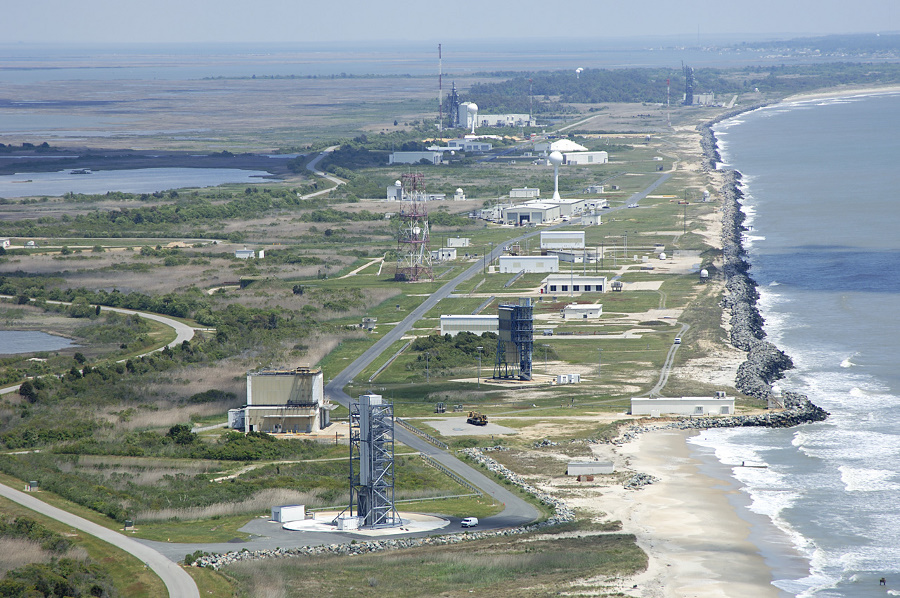 |
| Wallops Island, photo courtesy of NASA |
Wallops Island has been a launch base for NASA since 1959. NASA tested the Mercury space capsules from Wallops Island before taking them to Cape Canaveral and putting astronauts in them. However, it's mission has been suborbital and small spacecraft missions. In 1998, the Virginia Commercial Space Flight Authority created the Mid-Atlantic Regional Spaceport in order to support commercial space flights with two medium-to-heavy lift launch pads. In order to support Taurus 2, some improvements needed to be made. The Virginia Commercial Space Flight Authority was doing those, and (as seems to happen with everything involving a government or construction operation) they ran behind schedule. Apparently, the big problems were some rework on the launch mount and the cleaning of propellant and pressurization tanks that were not properly maintained throughout the year. The work was to have been done by October 24, but it looks like final certification and handoff to Orbital will be in January instead.
 |
| Orbital's launch site on Wallops Island, from the Orbital website |
Support structures are very important for the space industry, and they have to have the same level of perfection that the rockets and capsules do. Unlike planes that in a pinch can take off and land on any reasonable surface, rockets need a lot more support in order to not only launch safely, but to also meet their objective in orbit. So it's frustrating to again see delays, but with so many cogs in the machine, you have to expect some. Orbital is already doing work on the Taurus to prepare for the eventual launch, so they aren't in a holding pattern. They also have a lot of other missions to accomplish, and are getting more contracts for launching satellites for national military and commercial interests and international telecommunications.
Jumat, 14 Oktober 2011
Junk in Spaaace 3--DVD Series Review: Planates
I'm recovering from the MuseOnline Conference this week--what a great time, and you have to give commercial space some credit for it, because we had people from around the world in the forums and chats, something not possible without satellites. So, for the third installment of this series, I thought I'd do something fun.
Eventually, we're going to have people in space, which means trash and trashmen. It could be that once we are out there on an everyday basis, it might be more efficient to have humans collect the space junk and either send it into a destructive deorbit, collect it, or fix it. Would you be a garbage man if it meant getting to go into space? It's an important job, but how much respect would you get?
That's the topic for the Japanese science fiction anime, Planates.
Rob got this on netflix late one night many years ago, and I have to admit, the first time, I wasn't interested. We gave it a second try a couple of months later and I was hooked. This is a very believable and entertaining show about a young woman who wants to be in space, but didn't do so well in her class, so she ends up on the trash detail. The characters are hilarious--there's no wonder they are the laugh of the station--yet they take their job very seriously--and show some surprising compassion and depth of character. (I'm thinking of the episode with the memorial plaque, specifically, but won't tell more because it would be a spoiler.) I liked it so much that I also got the manga (Japanese graphic novels) that carry the story in more depth.
You can buy it on amazon, or rent it on netflix.
Not that I should need to say this, but I bought this series and am reviewing it because I liked it. I was not paid nor given free stuff.
Eventually, we're going to have people in space, which means trash and trashmen. It could be that once we are out there on an everyday basis, it might be more efficient to have humans collect the space junk and either send it into a destructive deorbit, collect it, or fix it. Would you be a garbage man if it meant getting to go into space? It's an important job, but how much respect would you get?
That's the topic for the Japanese science fiction anime, Planates.
Rob got this on netflix late one night many years ago, and I have to admit, the first time, I wasn't interested. We gave it a second try a couple of months later and I was hooked. This is a very believable and entertaining show about a young woman who wants to be in space, but didn't do so well in her class, so she ends up on the trash detail. The characters are hilarious--there's no wonder they are the laugh of the station--yet they take their job very seriously--and show some surprising compassion and depth of character. (I'm thinking of the episode with the memorial plaque, specifically, but won't tell more because it would be a spoiler.) I liked it so much that I also got the manga (Japanese graphic novels) that carry the story in more depth.
You can buy it on amazon, or rent it on netflix.
Not that I should need to say this, but I bought this series and am reviewing it because I liked it. I was not paid nor given free stuff.
Langganan:
Postingan (Atom)
