Tampilkan postingan dengan label NASA. Tampilkan semua postingan

Selasa, 27 Desember 2011

Watching the Space Race: An Orb in Space

by Walt Staples


I must admit to a disgusting family trait—we're morning people. I was actually awake and alert when I saw the balloon floating in space that warm August 1960 morning. I was up at my usual 05:00, had eaten breakfast (found the dinosaur in the cereal box—same one as in the last three), and was waiting for Sunrise Semester to come on TV. The Friday before, a photo of a huge silver balloon in a hanger was shown on NBC's Huntley and Brinkley (I forget which one did the story). Across the front was “N.A.S.A.” in equally huge letters—they didn't lose the periods until years later. According to the report, a radio signal had been bounced off the balloon, Echo 1. Standing in the darkness of our backyard, I watched the horizon over the small pine thicket. After some 15 or 20 minutes, a bright point of light, about the magnitude of Aldebaran (0.87) crawled into sight. I watched until it disappeared over the ridge of Colonel Coon's roof across the street. Then I went back in and watched part whatever of a lecture on the Peloponnesian War—I think—before getting ready for the bus to summer day camp.

                                                                        *

Project Echo involved the launching of a self-inflating mylar balloon into LEO (Low Earth Orbit—100 to 1,240 miles/160 to 2000 km). Upon reaching orbit, the balloon would inflate and ground stations would send microwave signals to it, and the signals would be reflected back to another ground station.

What is referred to as Echo 1 was actually Echo 1A. The original Echo 1 was lost on 13 May 1960 when the Air Force Thor-Delta lofting it missed orbit because the attitude control of its upper stage went sour. Not a way for a launch vehicle to impress on its debut flight. At 09:39 GMT, on 12 August 1960, another Thor-Delta got 'er done and put the latest incarnation of Echo 1 into orbit. (That day in August 1960 was a particularly hazardous day for birds. At 13:00 GMT, an Air Force Atlas suborbital test was also launched from Cape Canaveral; followed at 18:28 GMT by a test of the Polaris submarine-launched missile by the Navy from their end of the Cape. Meanwhile, the Air Force was launching a Kiva-Hopi sounding rocket from the Pacific Missile Range on California's Point Arguello*. On the other side of the world, the Soviets were test-firing a R-12 Dvina medium range ballistic missile from what would later be renamed “Baikonur Cosmodrome,” Kapustin Yar.)

Once in orbit, the balloon inflated to its full 100 foot (30.5 meter) diameter. A signal was sent up to it from JPL in Pasadena and bounced down to the Bell Laboratories in Homdel, New Jersey. Echo 1's silver surface was used to bounce TV, radio, and transcontinental and intercontinental telephone signals. Because of its large sail-area and tiny mass—about 90 pounds (180 kilos)--the solar wind had a noticeable effect on it. The larger Echo 2 (135 feet/41.1 meters) was successfully orbited aboard a Thor-Agena on 25 January 1964. Echo 1 reentered on 24 May 1968, while its sibling deorbited on 7 June 1969.

What was not mentioned at the time was another part of the missions. The pair of balloons were used to more accurately fix the location of Moscow to aid in targeting for ICBMs.

I remember standing in line at the East Springfield, Virginia, Post Office that December so that I could buy the commemorative First Class stamp the Post Office had issued on 15 December. First Class postage at the time was a whopping four cents—something my father grumped about quite regularly (the year before, it had skyrocketed from three cents).


* Another thing of interest about Point Arguello is that in 1923, seven U.S. Navy destroyers (part of a 14 ship formation on a speed run from San Francisco to San Diego) piled into the point at flank speed in fog. 23 crewmen were lost in the sinkings.
Selasa, 06 Desember 2011

Here's you chance to be an astronaut!

Serioiusly!  NASA has opened up applications for astronauts.  Get the details here:  http://astronauts.nasa.gov/.


You have until January 27, so brush up those resume's now.

There's no guarantee that as an astronaut, you'll actually go into space.  Instead, you get to go around doing PR work for NASA, along with lots of ground-based work.  In fact, do you know what they call astronauts who never get off the Earth?
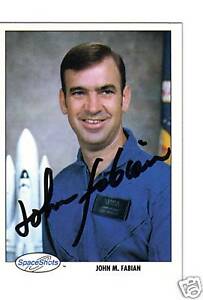
Incidentally, people will be applying via the military as well.  Rob's already getting the forms from the manpower folks. He wants to be the next Fabian in Space.

Not a penguin.
Me, I'm fine on terra firma.

Selasa, 29 November 2011

NASA Mars rover "Curiosity" launched Nov 26!

As I'm sure most of you know, NASA had a successful launch of the Mars Rover, Curiosity, and it is on its way to the Red Planet.  It's a bit of bright news in light of the troubled launch of the Russian probe, Phobos-Grunt, which was supposed to check out one of the moons.  (They were able to briefly contact the probe from an Australia station last week, though, and have hopes of getting it moving again.  Incidentally, Russia is now thinking that maybe they could hitch a ride with us or Europe next time.  Let's hope we'd give them good luck and not get their bad.)

Curiosity will land on August 5 or 6, 2012, and have a Martian-year-long mission, about 98 Earth weeks.  It's main purpose is the look for life or the possibility of life--either indigenous or supporting human colonization.  It has 10 instruments to study the land and the atmosphere, with four objectives (taken from the NASA press package):

The mission has four primary science objectives to meet NASA’s overall habitability assessment goal:
• Assess the biological potential of at least one target environment by determining the nature and inventory of organic carbon compounds, searching for the chemical building blocks of life and identifying features that may record the actions of biologically
relevant processes.

• Characterize the geology of the rover’s field site at all appropriate spatial scales by investigating the chemical, isotopic and mineralogical composition of surface and near-surface materials and interpreting the processes that have formed rocks and soils.

• Investigate planetary processes of relevance to past habitability (including the role of water) by assessing the long timescale atmospheric evolution and determining the present state, distribution and cycling of water and carbon dioxide.
• Characterize the broad spectrum of surface radiation, including galactic cosmic radiation, solar proton events and secondary neutrons.
Curiosity will not be looking for life itself.  It's not equipped to detect biological processes or to analyze (or recognize) fossils.  (Though I imagine that if it were to photograph some, there'll be some people screaming about it at NASA/JPL!)

Curiosity will be tooling around the Gale Crater, which was chosen after looking at over 30 different sites and years of debate.  This video gives the reasons why they selected it.

Congratulations, NASA and good luck, Curiosity!

For more reading:  http://www.jpl.nasa.gov/news/press_kits/MSLLaunch.pdf
http://www.jpl.nasa.gov/news/fact_sheets/mars-science-laboratory.pdf

Selasa, 25 Oktober 2011

SpaceX Meets Next Milestone for Manned Space Flight

Big congrats to SpaceX for getting NASA approval on its launch abort system for the Dragon manned capsule!

The launch abort system gives the astronauts an "abandon spaceship" option should there be a problem during launch.  The Apollo capsules had one; the shuttles did not.  NASA is requiring that all manned capsules in its COTS program have such a system, and with good reason.


The nice thing about the Dragon's abort system is that it works from launch to orbit, which is better than ever done before.  Basically, the capsule itself is the escape system, so if something goes wrong with the big candle it's sitting on, they can disengage from the rocket.  However, if things go smoothly, those same engines will give them a nice soft landing on Earth or whatever celestial body they choose.

This was the next stage in their preparation to send astronauts to the International Space Station, as well as other venues, such as Mars (which is founder Elon Musk's eventual goal) or other stations.  What I've not been able to find online is a timeline for when the new system will be manufactured and put to practical tests.  So far, NASA has only approved the designs, which is an important step, but just one.  I think the goal is 2015; I'm hoping they can do it earlier than that, but there's a lot to consider, including government bureaucracy.

From Popular Mechanics, which awarded them a breakthrough award.


One thing I'm hoping, is that the different space industries are talking about standardizing airlocks.  this about what a pain and expense that will be if everyone's is just different enough that other ships won't fit.
Related Posts Plugin for WordPress, Blogger...