When it came to colonizing the New World, the governments of Europe had a big role in support, but when it came down to it, it was the commercial businesses and private citizens that ensures a permanent presence. If we're going to have the same kind of success in space, we need to have the same kind of participation, but it seems many people have forgotten that. Thus, let me present three reasons I see why we cannot leave space exploration to the government:
#1 The government has other priorities. Let's face it, the government has gone waaay beyond what the founding fathers intended, and we have a huge deficit and a lot of conflict as a result. What's the government's job in space, then? I'd suggest it's pretty much the same as it is on Earth--protecting the rights and freedoms of its citizens. Step one is establishing a presence in space--a permanent, sustainable presence. Just like with colonization of the New World, that doesn't mean only government employees or government-funded exhibitions, however. It does mean being ready to support even defend its citizens who go fare beyond the Earth. (Sorry, Space is for Peace supporters--I want space to be peaceful, too, but not every nation is going to support that, and if they challenge our presence, we'll need government presence to defend us. And that can be diplomatic as well as military.) However, government role is support of space endeavors and the rights of its citizens in space--not taking on the whole manned space program itself.
#2 Governments are more swayed or stymied by public opinion. Sure, commercial companies need to have a good image, but frankly, as long as they are pleasing their customers, the rest of the world can take their business elsewhere. Governments, unless they're totalitarian and can do what they please, thank you very much, can be swayed by opinions like this one: End Space Exploration Now. And in fact, our government HAS been swayed by opinions like this, which is why the space program has had such rocky fits and starts. Unless space exploration can directly "feed the hungry children" or cut unemployment by several percentages (I don't think they'd be satisfied with anything less) or solve the deficit or whatever the political crisis du jour is, it will not get a gung-ho kind of support we got when first putting a man on the Moon. Without gung-ho support that crosses political parties, we're not going to get a long-lasting coherent government space program.
#3 Governments aren't big on innovation. Yes, I know it's one of NASAs missions to promote new technology, but as a counter, may I present a space shuttle that had to be decommissioned because they couldn't find parts, a bomber fleet in which today's pilots are literally flying their grandfathers' airplanes, a fighter program that might be canceled because Congress won't fund it... Or let's talk cost overruns because of the way the contracting system works in the government. Or maybe how a new administration can kill a program media res and replace it with his own great idea...which may or may not survive the next election.
The fact is, the government isn't interested in profit or product the way a commercial industry has to be. So when it comes to technological programs, they are looking as much at will it make jobs and promote themselves or their party as will it create a product that will get the job done--and then how to create the next one to do it cheaper, easier or more safely. I'm not trying to put down NASA or government contractors like Lockheed Martin, but they are at the mercy of the political system, which really is more conducive to road repair than rocket building.
Government has a role in space exploration. It can do some things commercial industries, especially fledgling ones, can't. However, if we want a real, sustained presence outside the atmosphere, it will take more than the government.
Tampilkan postingan dengan label commercial space. Tampilkan semua postingan
Tampilkan postingan dengan label commercial space. Tampilkan semua postingan
Jumat, 16 Desember 2011
Jumat, 09 September 2011
Abandon the ISS? Maybe not

When you talk to people about manned space, they usually think of two things: the space shuttle and the International Space Station (ISS). (Check out the newscast from 1981! I was a Freshman in high school. Wow. Got to love the reporter comment at 1:30: "It seems like NASA is just one giant acronym." er...)
Now the shuttle has retired after 30 years of hauling, and without a viable American replacement ready, space-lovers are nervous. (The commercial replacements are expected to be manned-ready around 2015. SpaceX with its Dragon capsule and Boeing with the CST-100 are the closest, I believe, though Sierra Nevada, and Blue Origin are also working on their own versions.) However, at least the ISS was still operating, right?
Then the Russians lost the Soyuz and the space world went into a spin. The Russians were set to keep the ISS manned and resupplied with it's Soyuz capsules, which they launch from their Progress rockets. However, the last mission--the first after the shuttle retirement--had problems. The rocket's third stage failed, and the capsule ended up in crashing in Siberia. Since then, the news has been proclaiming that we'd have to abandon the ISS.
Now, however, it looks like that's not as likely as we'd thought. The Russian space agency, Roscosmos says they found the problem--a clogged fuel line--and are checking their other rockets for the problem. They're of course also calling for tighter quality control, which should be a big duh. However, according to the commission's report (quoted in Universe Today), this defect was an accident. So, it looks like they will be able to get a new team up in time.
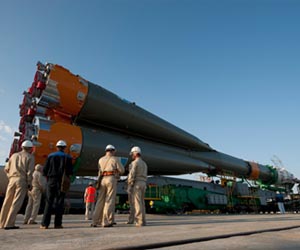 |
| Ouch! Our bad--we fix soon! |
Here's the schedule as near as I've been able to piece it together:
*There are 6 crewmen on the ISS right now. Three are to come home September 16. That's a week later than planned, and they are using one of the emergency Soyuz vehicles on the station. I believe the reason they are coming down then and not just hanging around is that the Soyuz capsules have a "shelf life" and if they wait any longer, they risk the capsule malfunctioning on return.
* The other three crewmen--an American (Mike Fossum), a Russian (Sergie Volkov) and a Japanese (Satoshi Furukawa), are planning on staying until mid-November.
* There are two scheduled Soyuz flights for October 8 and Oct 26. They might move these up to test fixes to the Progress Rocket.
So if the test flights go well, we might be able to get astronauts to the ISS in time to keep it manned.
What happens if we don't? NASA ground control is looking to see what shut down procedures they need to do to keep the station safe and ready for astronauts once the Progress rockets are ready. The crew on the ISS are making video tutorials for the systems in case they don't get to brief the next crew. (Frankly, this sounds like it should have been SOP to me, anyway.) So, it looks like we might lose some experiments that need watching, and if anything malfunctions and no one is there to fix it, we could have problems, but the station itself will be there, waiting and ready for brave men and women to call it home again.
One thing I'm not sure about and have not seen addressed is what impact this will have on the commercial space side. SpaceX is supposed to send an unmanned Dragon capsule up on Nov 30 as it's next step toward becoming a viable supporter of the station, but if no one is there to get it, I don't think they can launch. It's too bad they aren't a little closer to manned. From the utter lack of silence about them jumping in to "rescue" the station, I'm guessing that even Elon Musk doesn't feel ready to fly humans just yet. It's too bad. What a story that would have been!
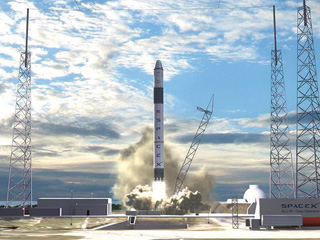 |
| Dragon to the rescue! Maybe in a couple of years... |
For More Info:
Selasa, 06 September 2011
Shuttle Moves Out; Others Move In
Once a week, I plan on summarizing a current event article about space. Since we were talking about the industry still being alive and well, I thought this article fit nicely: "At Florida Spaceports, Commercial Operators Prepare To Move In," Space News, August 19, 2011.
Space X is setting up housekeeping at Cape Canaveral, upgrading an old Delta II processing hanger to launch thier Falcon Nines. They've renamed it Hangar X. (Got a theme going.) They'll also tune up a payload processing and integration facility for the Dragon capsule. They have a goal of launching 12 rockets a year by 2015. That's pretty ambitious, not just for the logistics but also finding the business. But how cool would that be?
There's also talk of Boeing taking up residence in some of the facilities to service their own Crew Space Transport capsule. (They need naming lessons from SpaceX.)
So while the Shuttle program has ended, new programs begin. The question is now: How soon, folks? How soon until Cape Canaveral is launching humans again?
 |
| Ground breaking ceremonies for SpaceX’s new Falcon 9 rocket launch facilities at Space Launch Complex 40, Cape Canaveral, Florida. (from left) Thad Altman, Florida State Representative; Jeff Kottkamp, Florida State Lt. Governor; Elon Musk, Founder and CEO, Space Exploration Technologies; Brigadier General Susan Helms, Commander, 45th Space Wing, United States Air Force; Lynda Weatherman, Brevard County Economic Development Commission CEO/President; Steve Koehler, President of Space Florida; Janet Petro, Deputy Director NASA Kennedy Space Center; Patricia Grace Smith, FAA Associate Administrator for Commercial Space Transportation; Steve Cain, NASA Kennedy Space Center COTS project manager. Credit: Jim Campbell, Aero-News Network. Photo and names taken from SpaceX website. |
Space X is setting up housekeeping at Cape Canaveral, upgrading an old Delta II processing hanger to launch thier Falcon Nines. They've renamed it Hangar X. (Got a theme going.) They'll also tune up a payload processing and integration facility for the Dragon capsule. They have a goal of launching 12 rockets a year by 2015. That's pretty ambitious, not just for the logistics but also finding the business. But how cool would that be?
There's also talk of Boeing taking up residence in some of the facilities to service their own Crew Space Transport capsule. (They need naming lessons from SpaceX.)
So while the Shuttle program has ended, new programs begin. The question is now: How soon, folks? How soon until Cape Canaveral is launching humans again?
Senin, 05 September 2011
Yes, Virginia, There is a Space Industry
 |
| What could be more representative of the American space program? Yet it is so much more! |
When I told one of my friends that I was creating a blog about the space industry, she asked, "Is there a space industry after Obama killed NASA?"
First, let's assume for this article, we're talking about manned space and exploration, rather than the thriving industry of putting satellites into orbit so we can get better cell phone reception.
She's referring to Obama's 2010 budget proposal that cancelled the Constellation program, which was supposed to replace the space shuttle and eventually get us to the moon (2020.) Here's an article in Discovery about it. And another in Scientific American. This might indeed seem a death knell for space, or at least for manned space, but there are several things to consider.
First, the Constellation program was already overbudget and experiencing a lot of technical problems. (Universe Today reported in Feb 1, 2010, "Also, its estimate costs through 2015 have risen from $28 billion in 2006 to $44 billion today.") There was also doubts about it being able to meet its deadlines of manned flight by 2015 and the moon by 2020.
What about the shuttle? It was simply at the end of its life. The technology was so old, that to repair the shuttle, NASA was having to search the Internet for spare parts. President Bush actually canceled the shuttle program because we couldn't physically support the craft any longer.
However, at the same time that President Obama called for the cancellation of the program, he recommended increasing NASA's budget for it to concentrate on other things--increasing the life of the ISS, promoting innovation and technologies, and exploring further on. As columnist Phil Plait said, "NASA can concentrate on what it should: innovation, pushing the limits, paving the road. Once the road is laid, let others use it."
So, are there others to use the road? Let's start with the fact that the ISS is International, and other nations have been servicing it, including the European Space Agency and the Russians, who are--or rather were--flying the astronauts to the station when the Shuttle wasn't. (They recently had trouble with their Soyuz capsules, and now we're not sure we will keep astronauts on the station--weep!--but that's another story.) So the space industry as a whole will continue, even if NASA died, which it isn't.
In addition, American commercial space is growing--and Obama has given it a nice void to fill. There are already many companies striving to fulfill the dream of manned space:
- Armadillo Aerospace (suborbital focused)
- Bigelow
- Blue Origin (suborbital focused)
- Boeing
- Orbital
- Sierra Nevada Corp
- Space X
- United Launch Alliance (serves the military; not sure they're looking at manned)
- Virgin Galactic (suborbital focused)
(Rob gave me this list. If we missed any, let me know.) There are also a lot of budding industries to build the craft, make the fuel, create the engines, etc.
Later this week, I'll share an article about how some of these companies are already moving into Cape Canaveral (or negotiating to). But for now, the answer to my friend's question is, "Yes, Virginia, there still is a space industry."
 |
| The SpaceX Dragon spacecraft after its test mission. |
Langganan:
Postingan (Atom)
