CHAPTER XVIII -- THE PASSENGER OF THE ATLANTA
If this astounding news, instead of flying through the electric wires, had simply arrived by post in the ordinary sealed envelope, Barbicane would not have hesitated a moment. He would have held his tongue about it, both as a measure of prudence, and in order not to have to reconsider his plans. This telegram might be a cover for some jest, especially as it came from a Frenchman. What human being would ever have conceived the idea of such a journey? and, if such a person really existed, he must be an idiot, whom one would shut up in a lunatic ward, rather than within the walls of the projectile.
The contents of the dispatch, however, speedily became known; for the telegraphic officials possessed but little discretion, and Michel Ardan's proposition ran at once throughout the several States of the Union. Barbicane, had, therefore, no further motives for keeping silence. Consequently, he called together such of his colleagues as were at the moment in Tampa Town, and without any expression of his own opinions simply read to them the laconic text itself. It was received with every possible variety of expressions of doubt, incredulity, and derision from every one, with the exception of J. T. Maston, who exclaimed, "It is a grand idea, however!"
When Barbicane originally proposed to send a shot to the moon every one looked upon the enterprise as simple and practicable enough— a mere question of gunnery; but when a person, professing to be a reasonable being, offered to take passage within the projectile, the whole thing became a farce, or, in plainer language a humbug.
One question, however, remained. Did such a being exist? This telegram flashed across the depths of the Atlantic, the designation of the vessel on board which he was to take his passage, the date assigned for his speedy arrival, all combined to impart a certain character of reality to the proposal. They must get some clearer notion of the matter. Scattered groups of inquirers at length condensed themselves into a compact crowd, which made straight for the residence of President Barbicane. That worthy individual was keeping quiet with the intention of watching events as they arose. But he had forgotten to take into account the public impatience; and it was with no pleasant countenance that he watched the population of Tampa Town gathering under his windows. The murmurs and vociferations below presently obliged him to appear. He came forward, therefore, and on silence being procured, a citizen put point-blank to him the following question: "Is the person mentioned in the telegram, under the name of Michel Ardan, on his way here? Yes or no."
"Gentlemen," replied Barbicane, "I know no more than you do."
"We must know," roared the impatient voices.
"Time will show," calmly replied the president.
"Time has no business to keep a whole country in suspense," replied the orator. "Have you altered the plans of the projectile according to the request of the telegram?"
"Not yet, gentlemen; but you are right! we must have better information to go by. The telegraph must complete its information."
"To the telegraph!" roared the crowd.
Barbicane descended; and heading the immense assemblage, led the way to the telegraph office. A few minutes later a telegram was dispatched to the secretary of the underwriters at Liverpool, requesting answers to the following queries:
"About the ship Atlanta— when did she leave Europe? Had she on board a Frenchman named Michel Ardan?"
Two hours afterward Barbicane received information too exact to leave room for the smallest remaining doubt.
"The steamer Atlanta from Liverpool put to sea on the 2nd of October, bound for Tampa Town, having on board a Frenchman borne on the list of passengers by the name of Michel Ardan."
That very evening he wrote to the house of Breadwill and Co., requesting them to suspend the casting of the projectile until the receipt of further orders. On the 10th of October, at nine A.M., the semaphores of the Bahama Canal signaled a thick smoke on the horizon. Two hours later a large steamer exchanged signals with them. the name of the Atlanta flew at once over Tampa Town. At four o'clock the English vessel entered the Bay of Espiritu Santo. At five it crossed the passage of Hillisborough Bay at full steam. At six she cast anchor at Port Tampa. The anchor had scarcely caught the sandy bottom when five hundred boats surrounded the Atlanta, and the steamer was taken by assault. Barbicane was the first to set foot on deck, and in a voice of which he vainly tried to conceal the emotion, called "Michel Ardan."
"Here!" replied an individual perched on the poop.
Barbicane, with arms crossed, looked fixedly at the passenger of the Atlanta.
He was a man of about forty-two years of age, of large build, but slightly round-shouldered. His massive head momentarily shook a shock of reddish hair, which resembled a lion's mane. His face was short with a broad forehead, and furnished with a moustache as bristly as a cat's, and little patches of yellowish whiskers upon full cheeks. Round, wildish eyes, slightly near-sighted, completed a physiognomy essentially feline. His nose was firmly shaped, his mouth particularly sweet in expression, high forehead, intelligent and furrowed with wrinkles like a newly-plowed field. The body was powerfully developed and firmly fixed upon long legs. Muscular arms, and a general air of decision gave him the appearance of a hardy, jolly, companion. He was dressed in a suit of ample dimensions, loose neckerchief, open shirtcollar, disclosing a robust neck; his cuffs were invariably unbuttoned, through which appeared a pair of red hands.
On the bridge of the steamer, in the midst of the crowd, he bustled to and fro, never still for a moment, "dragging his anchors," as the sailors say, gesticulating, making free with everybody, biting his nails with nervous avidity. He was one of those originals which nature sometimes invents in the freak of a moment, and of which she then breaks the mould.
Among other peculiarities, this curiosity gave himself out for a sublime ignoramus, "like Shakespeare," and professed supreme contempt for all scientific men. Those "fellows," as he called them, "are only fit to mark the points, while we play the game." He was, in fact, a thorough Bohemian, adventurous, but not an adventurer; a hare-brained fellow, a kind of Icarus, only possessing relays of wings. For the rest, he was ever in scrapes, ending invariably by falling on his feet, like those little figures which they sell for children's toys. In a few words, his motto was "I have my opinions," and the love of the impossible constituted his ruling passion.
Such was the passenger of the Atlanta, always excitable, as if boiling under the action of some internal fire by the character of his physical organization. If ever two individuals offered a striking contrast to each other, these were certainly Michel Ardan and the Yankee Barbicane; both, moreover, being equally enterprising and daring, each in his own way.
The scrutiny which the president of the Gun Club had instituted regarding this new rival was quickly interrupted by the shouts and hurrahs of the crowd. The cries became at last so uproarious, and the popular enthusiasm assumed so personal a form, that Michel Ardan, after having shaken hands some thousands of times, at the imminent risk of leaving his fingers behind him, was fain at last to make a bolt for his cabin.
Barbicane followed him without uttering a word.
"You are Barbicane, I suppose?" said Michel Ardan, in a tone of voice in which he would have addressed a friend of twenty years' standing.
"Yes," replied the president of the Gun Club.
"All right! how d'ye do, Barbicane? how are you getting on— pretty well? that's right."
"So," said Barbicane without further preliminary, "you are quite determined to go."
"Quite decided."
"Nothing will stop you?"
"Nothing. Have you modified your projectile according to my telegram."
"I waited for your arrival. But," asked Barbicane again, "have you carefully reflected?"
"Reflected? have I any time to spare? I find an opportunity of making a tour in the moon, and I mean to profit by it. There is the whole gist of the matter."
Barbicane looked hard at this man who spoke so lightly of his project with such complete absence of anxiety. "But, at least," said he, "you have some plans, some means of carrying your project into execution?"
"Excellent, my dear Barbicane; only permit me to offer one remark: My wish is to tell my story once for all, to everybody, and then have done with it; then there will be no need for recapitulation. So, if you have no objection, assemble your friends, colleagues, the whole town, all Florida, all America if you like, and to-morrow I shall be ready to explain my plans and answer any objections whatever that may be advanced. You may rest assured I shall wait without stirring. Will that suit you?"
"All right," replied Barbicane.
So saying, the president left the cabin and informed the crowd of the proposal of Michel Ardan. His words were received with clappings of hands and shouts of joy. They had removed all difficulties. To-morrow every one would contemplate at his ease this European hero. However, some of the spectators, more infatuated than the rest, would not leave the deck of the Atlanta. They passed the night on board. Among others J. T. Maston got his hook fixed in the combing of the poop, and it pretty nearly required the capstan to get it out again.
"He is a hero! a hero!" he cried, a theme of which he was never tired of ringing the changes; "and we are only like weak, silly women, compared with this European!"
As to the president, after having suggested to the visitors it was time to retire, he re-entered the passenger's cabin, and remained there till the bell of the steamer made it midnight.
But then the two rivals in popularity shook hands heartily and parted on terms of intimate friendship.
Kamis, 05 Januari 2012
Rabu, 04 Januari 2012
Watching the Space Race: The World Got Smaller
by Walt Staples
Note from Karina: This one should have posted on the 30th. Hope you've been enjoying the walk down Memory Lane with Walt. We'll resume the normal schedule of "Watching the Space Race" next week, with Walt's posts resuming Jan 7 and going on Saturdays until he runs out of events. (He'll never run out of interesting things to say.)
 There are few things as exasperating as receiving orders to break off an operation just as you're ready to take the other guy in the flank. Unfortunately, when Aunt Geneva called your name from the backdoor, an immediate truce ensued. This July afternoon in 1962 was no different. I dropped the muzzle of my weapon of choice, a .45 Thompson submachine gun—one of the finest examples of Mattel's firearms production—and told Tommy Huddleston I'd see him later.
Note from Karina: This one should have posted on the 30th. Hope you've been enjoying the walk down Memory Lane with Walt. We'll resume the normal schedule of "Watching the Space Race" next week, with Walt's posts resuming Jan 7 and going on Saturdays until he runs out of events. (He'll never run out of interesting things to say.)
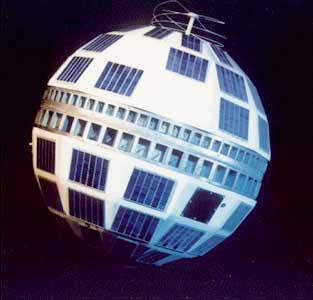
I wasn't sure why my Aunt wanted me. We'd had dinner; it was sometime after two and supper was usually at six. I'd learned during the summer that I stayed with them, that she and my Uncle Jack were very punctual folks.
She was drying her hands on her apron as I stepped up on the porch. “Come on in; there's going to be something on television we need to see.” This was a bit out of the ordinary. Usually, in the afternoon we might watch the “Channel 10 Matinee for an Afternoon” together, but that came on at two and the cat clock on the kitchen wall showed a few minutes until three.
“What's on?”
Her answer nonplussed me. “Pictures from Europe.” I raised an eyebrow (a bad habit for an eleven-year-old when dealing with adults). Reading my mind, she continued, “No, I don't mean pictures like we usually see. I mean live pictures, not on film. They're going to be showing pictures of what's going on right now, this minute. They're sending them through that satellite, Telstar.”
The two of us settled on the couch. At three sharp, we entered the world of real-time international TV. An American TV news anchorman (at this point, I frankly can't remember whether it was NBC's Chet Huntley or CBS's Walter Cronkite—or both) welcomed the viewers. I remember seeing an American Flag, the Statue of Liberty, and—I think—Mount Rushmore. This was replaced by a tweedy gentleman who said in a plummy BBC accent that he was speaking from Brussels. The picture switched to Paris and the Eiffel Tower. The broadcast closed, as I remember, with a shot of the huge white bubble that enclosed the antenna in Andover, Maine. Interestingly, the pictures from the American side were crystal-clear (at least as judged for that time), but the pictures from Europe rippled as if seen through heat waves or water. The pictures we watched were in living black and white—whether they were broadcast in color or not, I don't know; my aunt and uncle, like most at that time, owned a black and white set (it wasn't until 1964 that my father bought a RCA color console model—the local TV repairman had to study a week and a half before he could adjust the colors that had been scrambled on the trip from the store in Roanoke over the mountains into the wilds of West Virginia—he didn't charge us because of the learning opportunity). [If anyone reading this knows whether or not the broadcast was in color, I'd appreciate them leaving the answer in the “Comments.”]
*
Telstar 1 was owned by AT&T and developed by Bell Labs (part of the Bell Telephone System--”Ma Bell”). It was lofted by a NASA Delta rocket which limited its size to a 34.5 inch (87.6 cm) sphere. The satellite turned the scales at around 170 pounds (77kg). It was powered by solar cells producing a staggering 14 watts and was spin-stabilized.
Telstar first broadcast a picture on 11 July 1962, a nonpublic “Is this thing working?” broadcast. The first public broadcast, the one my aunt and I marveled over, was on 23 July 1962 at 15:00 EDT. As it was in a non-geostationary orbit, unlike the norm for communications satellites these days, Telstar 1 was only above the horizon for 20 minutes during each 150 minute orbit.
Telstar 1 established several firsts besides being the first rebroadcasting telecommunications satellite. It was also the first privately owned payload launched by NASA . It was the first satellite, to my knowledge, to have a song named for it (Joe Meek's instrumental which is on the first record I bought with my own money, “The Ventures Play Telstar and the Lonely Bull”--which I'm listening to as I write this). It's also the first satellite to have a soccer ball named for it, Adidas's design for the FIFA World Cups competitions—the black and white one that most of us in the U.S. think of when the word, “soccer ball,” is mentioned.
Telsar 1 continued in service routing TV, telephone, and fax and data traffic until a number of its transistors were fried by Van Allen Belt radiation excited by high-attitude detonations during both American and Soviet nuclear testing. It first went off the air in early December of 1962, was resuscitated a month later, and finally died on 21 February 1963. At last word, Telstar 1 is still orbiting the Earth, a victim of the Cold War.
From the Earth to the Moon, Ch 17: A TELEGRAPHIC DISPATCH
CHAPTER XVII --A TELEGRAPHIC DISPATCH
The great works undertaken by the Gun Club had now virtually come to an end; and two months still remained before the day for the discharge of the shot to the moon. To the general impatience these two months appeared as long as years! Hitherto the smallest details of the operation had been daily chronicled by the journals, which the public devoured with eager eyes.
Just at this moment a circumstance, the most unexpected, the most extraordinary and incredible, occurred to rouse afresh their panting spirits, and to throw every mind into a state of the most violent excitement.
One day, the 30th of September, at 3:47 P.M., a telegram, transmitted by cable from Valentia (Ireland) to Newfoundland and the American Mainland, arrived at the address of President Barbicane.
The president tore open the envelope, read the dispatch, and, despite his remarkable powers of self-control, his lips turned pale and his eyes grew dim, on reading the twenty words of this telegram.
Here is the text of the dispatch, which figures now in the archives of the Gun Club:
FRANCE, PARIS,
30 September, 4 A.M.
Barbicane, Tampa Town, Florida, United States.
Substitute for your spherical shell a cylindro-conical projectile.
I shall go inside. Shall arrive by steamer Atlanta.
MICHEL ARDAN.
The great works undertaken by the Gun Club had now virtually come to an end; and two months still remained before the day for the discharge of the shot to the moon. To the general impatience these two months appeared as long as years! Hitherto the smallest details of the operation had been daily chronicled by the journals, which the public devoured with eager eyes.
Just at this moment a circumstance, the most unexpected, the most extraordinary and incredible, occurred to rouse afresh their panting spirits, and to throw every mind into a state of the most violent excitement.
One day, the 30th of September, at 3:47 P.M., a telegram, transmitted by cable from Valentia (Ireland) to Newfoundland and the American Mainland, arrived at the address of President Barbicane.
The president tore open the envelope, read the dispatch, and, despite his remarkable powers of self-control, his lips turned pale and his eyes grew dim, on reading the twenty words of this telegram.
Here is the text of the dispatch, which figures now in the archives of the Gun Club:
FRANCE, PARIS,
30 September, 4 A.M.
Barbicane, Tampa Town, Florida, United States.
Substitute for your spherical shell a cylindro-conical projectile.
I shall go inside. Shall arrive by steamer Atlanta.
MICHEL ARDAN.
Selasa, 03 Januari 2012
Will China shame the US back to strong space program
From The Youngstown Vindicator: Will China shame the US back to strong space program?
Many of today’s maturing baby boomers cling to fond childhood memories of elementary-school assemblies where they’d sit knee-to-knee on freshly waxed floors and peer intently onto small-screen black and white TV sets to witness the dawn of the American space age. During those exciting Mercury, Gemini and Apollo launches in the 1960s and early ’70s, enthusiasm, adventure and national pride united them.
A sense of fierce competitiveness with the then Soviet Union also energized those children and most all Americans. After all, the Soviets, through their launch of Sputnik I in 1957, essentially shamed the United States into its massive, multi-trillion-dollar goal-oriented journey into outer space. When Ohioan Neil Armstong made his historic “small step for man” but “giant leap for mankind” onto the lunar surface in July 1969, America celebrated its come-from-behind victory with boundless elation and gratification.
Much has changed in space science and in the world order in the ensuing five decades. The Soviet Union has crumbled, its leading nation Russia has long lost its superpower lustre, China has emerged as a daunting global force and the government-sanctioned manned space program in the United States has become a mere shadow of its former robust and glorious self.
So much so, in fact, that some may wonder whether history may repeat itself in the 21st century. This time, could it be China that will shame the United States back into a serious program of space exploration and conquest?
CHINA’S AGGRESSIVE 5-YEAR PLAN
Just last week, China announced plans for an aggressive state-sponsored program to launch space labs and prepare to build space stations over the next five years.
The country says it will continue its exploration of the moon using probes, start gathering samples of the moon’s surface, land an astronaut on the lunar surface and “push forward its exploration of planets, asteroids and the sun.”
Contrast those ambitious goals with those of the U.S. space program. Funding for the National Aeronautics and Space Administration has been decimated in the current federal budget, plans for a return to the moon and other ambitious missions have been scrubbed or substantially cut back, thousands of talented NASA workers have lost their jobs and America’s working space program largely has been privatized.
Just last week, NASA announced that a private California company — SpaceX — will attempt the first-ever commercial cargo run to the International Space Station in February. The unmanned Dragon capsule will fly to the space station and dock with a load of supplies. While we wish success for the project, any failures or problems will undoubtedly reflect more profoundly on the pride of this country, not the profits of the Paypal-tied company.
Indeed China cites the effect on national pride as well worth the cost of its massive investment. Its space program already has made major breakthroughs in a relatively short time, and it is on track to replace the U.S. as the leader in space-station development.
Will we care? To be sure, much has changed in the U.S. since the launch of Mercury I, not the least of which is decreasing awe over 60 years of almost routinized manned space travel. One thing that has not changed, however, is that fierce competitiveness and drive for achievement that energized millions of American schoolchildren of the ‘60s.
Washington bureaucrats and congressional delegations would do well to remember that when debating the dollars and sense of the future course of America’s once-proud space agency.
Many of today’s maturing baby boomers cling to fond childhood memories of elementary-school assemblies where they’d sit knee-to-knee on freshly waxed floors and peer intently onto small-screen black and white TV sets to witness the dawn of the American space age. During those exciting Mercury, Gemini and Apollo launches in the 1960s and early ’70s, enthusiasm, adventure and national pride united them.
A sense of fierce competitiveness with the then Soviet Union also energized those children and most all Americans. After all, the Soviets, through their launch of Sputnik I in 1957, essentially shamed the United States into its massive, multi-trillion-dollar goal-oriented journey into outer space. When Ohioan Neil Armstong made his historic “small step for man” but “giant leap for mankind” onto the lunar surface in July 1969, America celebrated its come-from-behind victory with boundless elation and gratification.
Much has changed in space science and in the world order in the ensuing five decades. The Soviet Union has crumbled, its leading nation Russia has long lost its superpower lustre, China has emerged as a daunting global force and the government-sanctioned manned space program in the United States has become a mere shadow of its former robust and glorious self.
So much so, in fact, that some may wonder whether history may repeat itself in the 21st century. This time, could it be China that will shame the United States back into a serious program of space exploration and conquest?
CHINA’S AGGRESSIVE 5-YEAR PLAN
Just last week, China announced plans for an aggressive state-sponsored program to launch space labs and prepare to build space stations over the next five years.
The country says it will continue its exploration of the moon using probes, start gathering samples of the moon’s surface, land an astronaut on the lunar surface and “push forward its exploration of planets, asteroids and the sun.”
Contrast those ambitious goals with those of the U.S. space program. Funding for the National Aeronautics and Space Administration has been decimated in the current federal budget, plans for a return to the moon and other ambitious missions have been scrubbed or substantially cut back, thousands of talented NASA workers have lost their jobs and America’s working space program largely has been privatized.
Just last week, NASA announced that a private California company — SpaceX — will attempt the first-ever commercial cargo run to the International Space Station in February. The unmanned Dragon capsule will fly to the space station and dock with a load of supplies. While we wish success for the project, any failures or problems will undoubtedly reflect more profoundly on the pride of this country, not the profits of the Paypal-tied company.
Indeed China cites the effect on national pride as well worth the cost of its massive investment. Its space program already has made major breakthroughs in a relatively short time, and it is on track to replace the U.S. as the leader in space-station development.
Will we care? To be sure, much has changed in the U.S. since the launch of Mercury I, not the least of which is decreasing awe over 60 years of almost routinized manned space travel. One thing that has not changed, however, is that fierce competitiveness and drive for achievement that energized millions of American schoolchildren of the ‘60s.
Washington bureaucrats and congressional delegations would do well to remember that when debating the dollars and sense of the future course of America’s once-proud space agency.
Private companies need taxpayer money
From Florida Today: Private companies need taxpayer money
Private companies cannot and will not make the commitment to explore space without massive government subsidies. Their business paradigm is making a profit, and space exploration is much too risky for a private company to invest the necessary resources. Unless of course, taxpayers will shoulder the cost and liability, leaving private companies to reap all of the profits.
Take, for example SpaceX. When launching rockets from its facilities in the South Pacific, it had a dismal success rate. Now, it essentially has been given Launch Complex 40 at Cape Canaveral Air Force Station, and has had two successful launches of the vaunted Falcon 9. These launches came about after several delays, and there have been cancellations of other tests that will ensure reliability and safety for this launch system.
Now, SpaceX plans to combine two test flights of its unmanned Dragon cargo ship into a single mission in February to dock with the International Space Station.
It cost American taxpayers $100 billion to design, build and maintain the ISS, which provides much-needed research in space. Is NASA really going to risk that investment so SpaceX doesn't have to perform test flights that will cut into its profit margin?
This shows why privatization of the space program will never work. Space exploration always has been about research, science and gaining knowledge for the betterment of mankind, not for profit at the expense of taxpayers. If private companies like Space X wish to conduct space exploration to make a profit, let them do it on their own dime.
Why should taxpayers “give” them launch facilities we paid for, then pay them to launch government satellites? In a free market, SpaceX would shoulder all of the financial burden of providing a cheaper method of launching satellites into space. That is why until now, only governments have invested the capital necessary to explore space.
And we as taxpayers have benefited in the form of technological advancements we use in our daily lives.
From the Earth to the Moon, Ch 16: THE COLUMBIAD
CHAPTER XVI -- THE COLUMBIAD
Had the casting succeeded? They were reduced to mere conjecture. There was indeed every reason to expect success, since the mould has absorbed the entire mass of the molten metal; still some considerable time must elapse before they could arrive at any certainty upon the matter.
The patience of the members of the Gun Club was sorely tried during this period of time. But they could do nothing. J. T. Maston escaped roasting by a miracle. Fifteen days after the casting an immense column of smoke was still rising in the open sky and the ground burned the soles of the feet within a radius of two hundred feet round the summit of Stones Hill. It was impossible to approach nearer. All they could do was to wait with what patience they might.
"Here we are at the 10th of August," exclaimed J. T. Maston one morning, "only four months to the 1st of December! We shall never be ready in time!" Barbicane said nothing, but his silence covered serious irritation.
However, daily observations revealed a certain change going on in the state of the ground. About the 15th of August the vapors ejected had sensibly diminished in intensity and thickness. Some days afterward the earth exhaled only a slight puff of smoke, the last breath of the monster enclosed within its circle of stone. Little by little the belt of heat contracted, until on the 22nd of August, Barbicane, his colleagues, and the engineer were enabled to set foot on the iron sheet which lay level upon the summit of Stones Hill.
"At last!" exclaimed the president of the Gun Club, with an immense sigh of relief.
The work was resumed the same day. They proceeded at once to extract the interior mould, for the purpose of clearing out the boring of the piece. Pickaxes and boring irons were set to work without intermission. The clayey and sandy soils had acquired extreme hardness under the action of the heat; but, by the aid of the machines, the rubbish on being dug out was rapidly carted away on railway wagons; and such was the ardor of the work, so persuasive the arguments of Barbicane's dollars, that by the 3rd of September all traces of the mould had entirely disappeared.
Immediately the operation of boring was commenced; and by the aid of powerful machines, a few weeks later, the inner surface of the immense tube had been rendered perfectly cylindrical, and the bore of the piece had acquired a thorough polish.
At length, on the 22d of September, less than a twelvemonth after Barbicane's original proposition, the enormous weapon, accurately bored, and exactly vertically pointed, was ready for work. There was only the moon now to wait for; and they were pretty sure that she would not fail in the rendezvous.
The ecstasy of J. T. Maston knew no bounds, and he narrowly escaped a frightful fall while staring down the tube. But for the strong hand of Colonel Blomsberry, the worthy secretary, like a modern Erostratus, would have found his death in the depths of the Columbiad.
The cannon was then finished; there was no possible doubt as to its perfect completion. So, on the 6th of October, Captain Nicholl opened an account between himself and President Barbicane, in which he debited himself to the latter in the sum of two thousand dollars. One may believe that the captain's wrath was increased to its highest point, and must have made him seriously ill. However, he had still three bets of three, four, and five thousand dollars, respectively; and if he gained two out of these, his position would not be very bad. But the money question did not enter into his calculations; it was the success of his rival in casting a cannon against which iron plates sixty feet thick would have been ineffectual, that dealt him a terrible blow.
After the 23rd of September the enclosure of Stones hill was thrown open to the public; and it will be easily imagined what was the concourse of visitors to this spot! There was an incessant flow of people to and from Tampa Town and the place, which resembled a procession, or rather, in fact, a pilgrimage.
It was already clear to be seen that, on the day of the experiment itself, the aggregate of spectators would be counted by millions; for they were already arriving from all parts of the earth upon this narrow strip of promontory. Europe was emigrating to America.
Up to that time, however, it must be confessed, the curiosity of the numerous comers was but scantily gratified. Most had counted upon witnessing the spectacle of the casting, and they were treated to nothing but smoke. This was sorry food for hungry eyes; but Barbicane would admit no one to that operation. Then ensued grumbling, discontent, murmurs; they blamed the president, taxed him with dictatorial conduct. His proceedings were declared "un-American." There was very nearly a riot round Stones Hill; but Barbicane remained inflexible. When, however, the Columbiad was entirely finished, this state of closed doors could no longer be maintained; besides it would have been bad taste, and even imprudence, to affront the public feeling. Barbicane, therefore, opened the enclosure to all comers; but, true to his practical disposition, he determined to coin money out of the public curiosity.
It was something, indeed, to be enabled to contemplate this immense Columbiad; but to descend into its depths, this seemed to the Americans the ne plus ultra of earthly felicity. Consequently, there was not one curious spectator who was not willing to give himself the treat of visiting the interior of this great metallic abyss. Baskets suspended from steam-cranes permitted them to satisfy their curiosity. There was a perfect mania. Women, children, old men, all made it a point of duty to penetrate the mysteries of the colossal gun. The fare for the descent was fixed at five dollars per head; and despite this high charge, during the two months which preceded the experiment, the influx of visitors enabled the Gun Club to pocket nearly five hundred thousand dollars!
It is needless to say that the first visitors of the Columbiad were the members of the Gun Club. This privilege was justly reserved for that illustrious body. The ceremony took place on the 25th of September. A basket of honor took down the president, J. T. Maston, Major Elphinstone, General Morgan, Colonel Blomsberry, and other members of the club, to the number of ten in all. How hot it was at the bottom of that long tube of metal! They were half suffocated. But what delight! What ecstasy! A table had been laid with six covers on the massive stone which formed the bottom of the Columbiad, and lighted by a jet of electric light resembling that of day itself. Numerous exquisite dishes, which seemed to descend from heaven, were placed successively before the guests, and the richest wines of France flowed in profusion during this splendid repast, served nine hundred feet beneath the surface of the earth!
The festival was animated, not to say somewhat noisy. Toasts flew backward and forward. They drank to the earth and to her satellite, to the Gun Club, the Union, the Moon, Diana, Phoebe, Selene, the "peaceful courier of the night!" All the hurrahs, carried upward upon the sonorous waves of the immense acoustic tube, arrived with the sound of thunder at its mouth; and the multitude ranged round Stones Hill heartily united their shouts with those of the ten revelers hidden from view at the bottom of the gigantic Columbiad.
J. T. Maston was no longer master of himself. Whether he shouted or gesticulated, ate or drank most, would be a difficult matter to determine. At all events, he would not have given his place up for an empire, "not even if the cannon— loaded, primed, and fired at that very moment—were to blow him in pieces into the planetary world."
Had the casting succeeded? They were reduced to mere conjecture. There was indeed every reason to expect success, since the mould has absorbed the entire mass of the molten metal; still some considerable time must elapse before they could arrive at any certainty upon the matter.
The patience of the members of the Gun Club was sorely tried during this period of time. But they could do nothing. J. T. Maston escaped roasting by a miracle. Fifteen days after the casting an immense column of smoke was still rising in the open sky and the ground burned the soles of the feet within a radius of two hundred feet round the summit of Stones Hill. It was impossible to approach nearer. All they could do was to wait with what patience they might.
"Here we are at the 10th of August," exclaimed J. T. Maston one morning, "only four months to the 1st of December! We shall never be ready in time!" Barbicane said nothing, but his silence covered serious irritation.
However, daily observations revealed a certain change going on in the state of the ground. About the 15th of August the vapors ejected had sensibly diminished in intensity and thickness. Some days afterward the earth exhaled only a slight puff of smoke, the last breath of the monster enclosed within its circle of stone. Little by little the belt of heat contracted, until on the 22nd of August, Barbicane, his colleagues, and the engineer were enabled to set foot on the iron sheet which lay level upon the summit of Stones Hill.
"At last!" exclaimed the president of the Gun Club, with an immense sigh of relief.
The work was resumed the same day. They proceeded at once to extract the interior mould, for the purpose of clearing out the boring of the piece. Pickaxes and boring irons were set to work without intermission. The clayey and sandy soils had acquired extreme hardness under the action of the heat; but, by the aid of the machines, the rubbish on being dug out was rapidly carted away on railway wagons; and such was the ardor of the work, so persuasive the arguments of Barbicane's dollars, that by the 3rd of September all traces of the mould had entirely disappeared.
Immediately the operation of boring was commenced; and by the aid of powerful machines, a few weeks later, the inner surface of the immense tube had been rendered perfectly cylindrical, and the bore of the piece had acquired a thorough polish.
At length, on the 22d of September, less than a twelvemonth after Barbicane's original proposition, the enormous weapon, accurately bored, and exactly vertically pointed, was ready for work. There was only the moon now to wait for; and they were pretty sure that she would not fail in the rendezvous.
The ecstasy of J. T. Maston knew no bounds, and he narrowly escaped a frightful fall while staring down the tube. But for the strong hand of Colonel Blomsberry, the worthy secretary, like a modern Erostratus, would have found his death in the depths of the Columbiad.
The cannon was then finished; there was no possible doubt as to its perfect completion. So, on the 6th of October, Captain Nicholl opened an account between himself and President Barbicane, in which he debited himself to the latter in the sum of two thousand dollars. One may believe that the captain's wrath was increased to its highest point, and must have made him seriously ill. However, he had still three bets of three, four, and five thousand dollars, respectively; and if he gained two out of these, his position would not be very bad. But the money question did not enter into his calculations; it was the success of his rival in casting a cannon against which iron plates sixty feet thick would have been ineffectual, that dealt him a terrible blow.
After the 23rd of September the enclosure of Stones hill was thrown open to the public; and it will be easily imagined what was the concourse of visitors to this spot! There was an incessant flow of people to and from Tampa Town and the place, which resembled a procession, or rather, in fact, a pilgrimage.
It was already clear to be seen that, on the day of the experiment itself, the aggregate of spectators would be counted by millions; for they were already arriving from all parts of the earth upon this narrow strip of promontory. Europe was emigrating to America.
Up to that time, however, it must be confessed, the curiosity of the numerous comers was but scantily gratified. Most had counted upon witnessing the spectacle of the casting, and they were treated to nothing but smoke. This was sorry food for hungry eyes; but Barbicane would admit no one to that operation. Then ensued grumbling, discontent, murmurs; they blamed the president, taxed him with dictatorial conduct. His proceedings were declared "un-American." There was very nearly a riot round Stones Hill; but Barbicane remained inflexible. When, however, the Columbiad was entirely finished, this state of closed doors could no longer be maintained; besides it would have been bad taste, and even imprudence, to affront the public feeling. Barbicane, therefore, opened the enclosure to all comers; but, true to his practical disposition, he determined to coin money out of the public curiosity.
It was something, indeed, to be enabled to contemplate this immense Columbiad; but to descend into its depths, this seemed to the Americans the ne plus ultra of earthly felicity. Consequently, there was not one curious spectator who was not willing to give himself the treat of visiting the interior of this great metallic abyss. Baskets suspended from steam-cranes permitted them to satisfy their curiosity. There was a perfect mania. Women, children, old men, all made it a point of duty to penetrate the mysteries of the colossal gun. The fare for the descent was fixed at five dollars per head; and despite this high charge, during the two months which preceded the experiment, the influx of visitors enabled the Gun Club to pocket nearly five hundred thousand dollars!
It is needless to say that the first visitors of the Columbiad were the members of the Gun Club. This privilege was justly reserved for that illustrious body. The ceremony took place on the 25th of September. A basket of honor took down the president, J. T. Maston, Major Elphinstone, General Morgan, Colonel Blomsberry, and other members of the club, to the number of ten in all. How hot it was at the bottom of that long tube of metal! They were half suffocated. But what delight! What ecstasy! A table had been laid with six covers on the massive stone which formed the bottom of the Columbiad, and lighted by a jet of electric light resembling that of day itself. Numerous exquisite dishes, which seemed to descend from heaven, were placed successively before the guests, and the richest wines of France flowed in profusion during this splendid repast, served nine hundred feet beneath the surface of the earth!
The festival was animated, not to say somewhat noisy. Toasts flew backward and forward. They drank to the earth and to her satellite, to the Gun Club, the Union, the Moon, Diana, Phoebe, Selene, the "peaceful courier of the night!" All the hurrahs, carried upward upon the sonorous waves of the immense acoustic tube, arrived with the sound of thunder at its mouth; and the multitude ranged round Stones Hill heartily united their shouts with those of the ten revelers hidden from view at the bottom of the gigantic Columbiad.
J. T. Maston was no longer master of himself. Whether he shouted or gesticulated, ate or drank most, would be a difficult matter to determine. At all events, he would not have given his place up for an empire, "not even if the cannon— loaded, primed, and fired at that very moment—were to blow him in pieces into the planetary world."
Senin, 02 Januari 2012
2011: A Big Year For Space Exploration
From NBUR Boston NPR: 2011: A Big Year For Space Exploration
Some might be inclined to think 2011 was a pretty bad year for space, what with the U.S. space program shutting down. While the Atlantis marked the last mission in NASA's decades-long space shuttle program, the agency still managed to have other significant launches this year. Crafts visited Mercury, a massive asteroid known as Vesta, and the moon. Another left for Jupiter, and the Voyager 1 spacecraft sailed out of our solar system. Guest host Rebecca Sheir talks to Neil deGrasse Tyson, head of the Hayden Planetarium, about whether all that made 2011 a good year for space exploration.
Transcript
REBECCA SHEIR, HOST:
2011 was, of course, a big year for a lot of things, but not just here on Earth. In the spring, NASA's Messenger probe became the first spacecraft to arrive in orbit around Mercury. Over the summer, we saw groundbreaking photos of a giant asteroid nearing Earth. A craft left for Jupiter in August, another for Mars in November, and throughout the year, Voyager 1 sailed farther and farther out of our solar system. What excited Neil deGrasse Tyson most about space in 2011?
NEIL DEGRASSE TYSON: Everything.
(SOUNDBITE OF LAUGHTER)
SHEIR: He's head of New York City's Hayden Planetarium. And he says a lot of space watchers shed a tear over the biggest astro event of the year, the end of NASA's Space Shuttle program, which eclipsed some other big events in space science.
TYSON: I would say for me, the most ambitious among these missions is the Mars Science Laboratory dubbed Curiosity. And the Mars Science Laboratory is going to do experiments to see if the conditions on the Martian surface can sustain organics, which would be the building blocks for life. It's a whole other round of questions that we now get to ask about the surface of Mars.
SHEIR: Let's move on to a slightly larger planet, then, Jupiter. We've got Juno, that's the spacecraft heading up there. It won't be there for another five years, really?
TYSON: Yeah. Jupiter's far - you know, these things are far away, and we don't know how to move very fast. Interesting thing about Jupiter, Jupiter actually gives more energy out than it receives from the sun. There's a huge, monstrous magnetic field and radiation belts. So any time you go to investigate it, first, you have to have specially, what they call hardened electronics that can survive in these harsh environments. And then you want to actually make the measurements, things like the magnetic field, the radiation flux, the chemistry of the atmosphere.
And so these missions to Mercury, to Jupiter, they're all equipped with the sweep of experiments just to try to give us some understanding beyond just the spec view that telescopes give us.
SHEIR: So looking at exoplanet research, scientists announced this month they'd found Kepler-22b, a planet outside our solar system orbiting a star in the so-called Goldilocks Zone where water might be present. Now that it's been found, what would you say is next?
TYSON: Yeah. So we knew that we'd find planets around other stars, but the Holy Grail among the planets would be an Earth-like planet, and you've got it. And so now, that's where you might send radio signals to see if there's any intelligent life there. One problem there is that, first, Earth-like planet in the Goldilocks Zone is 600 light-years away. So you could send a signal today, and we'd get a reply 1,200 years later.
SHEIR: Oh, no.
TYSON: And what were we doing on Earth 1,200 years ago, you know? So right now, it's sort of a philosophical interest that there might be life there, but it's not much we know how to do about it if there is.
SHEIR: Neil, what do you hope will be accomplished in space science over this next year?
TYSON: Oh, one year is not - I got to think in longer timeframes than that. You're thinking like annual report question.
(SOUNDBITE OF LAUGHTER)
TYSON: I have to think cosmically, excuse me. So in the next five, 10 years, 20 years, I think we'll be equipped to answer definitely whether life ever thrived in our backyard. I think the Mars Science Laboratory will lead that effort. By the way, and if our backyard does not have life, the galaxy is vast. And if you looked at an image of how far we have explored and how far our radio signals have reached, that's what we call a radio bubble, it's 80 light-years across, that bubble is tiny compared with the 100,000 light-year diameter of our Milky Way galaxy. So I'd be disappointed, but I'd say let's keep looking.
SHEIR: Neil, deGrasse Tyson is director of the Hayden Planetarium at the Rose Center for Earth and Space in New York City. Thanks so much, Neil, and Happy New Year.
Some might be inclined to think 2011 was a pretty bad year for space, what with the U.S. space program shutting down. While the Atlantis marked the last mission in NASA's decades-long space shuttle program, the agency still managed to have other significant launches this year. Crafts visited Mercury, a massive asteroid known as Vesta, and the moon. Another left for Jupiter, and the Voyager 1 spacecraft sailed out of our solar system. Guest host Rebecca Sheir talks to Neil deGrasse Tyson, head of the Hayden Planetarium, about whether all that made 2011 a good year for space exploration.
Transcript
REBECCA SHEIR, HOST:
2011 was, of course, a big year for a lot of things, but not just here on Earth. In the spring, NASA's Messenger probe became the first spacecraft to arrive in orbit around Mercury. Over the summer, we saw groundbreaking photos of a giant asteroid nearing Earth. A craft left for Jupiter in August, another for Mars in November, and throughout the year, Voyager 1 sailed farther and farther out of our solar system. What excited Neil deGrasse Tyson most about space in 2011?
NEIL DEGRASSE TYSON: Everything.
(SOUNDBITE OF LAUGHTER)
SHEIR: He's head of New York City's Hayden Planetarium. And he says a lot of space watchers shed a tear over the biggest astro event of the year, the end of NASA's Space Shuttle program, which eclipsed some other big events in space science.
TYSON: I would say for me, the most ambitious among these missions is the Mars Science Laboratory dubbed Curiosity. And the Mars Science Laboratory is going to do experiments to see if the conditions on the Martian surface can sustain organics, which would be the building blocks for life. It's a whole other round of questions that we now get to ask about the surface of Mars.
SHEIR: Let's move on to a slightly larger planet, then, Jupiter. We've got Juno, that's the spacecraft heading up there. It won't be there for another five years, really?
TYSON: Yeah. Jupiter's far - you know, these things are far away, and we don't know how to move very fast. Interesting thing about Jupiter, Jupiter actually gives more energy out than it receives from the sun. There's a huge, monstrous magnetic field and radiation belts. So any time you go to investigate it, first, you have to have specially, what they call hardened electronics that can survive in these harsh environments. And then you want to actually make the measurements, things like the magnetic field, the radiation flux, the chemistry of the atmosphere.
And so these missions to Mercury, to Jupiter, they're all equipped with the sweep of experiments just to try to give us some understanding beyond just the spec view that telescopes give us.
SHEIR: So looking at exoplanet research, scientists announced this month they'd found Kepler-22b, a planet outside our solar system orbiting a star in the so-called Goldilocks Zone where water might be present. Now that it's been found, what would you say is next?
TYSON: Yeah. So we knew that we'd find planets around other stars, but the Holy Grail among the planets would be an Earth-like planet, and you've got it. And so now, that's where you might send radio signals to see if there's any intelligent life there. One problem there is that, first, Earth-like planet in the Goldilocks Zone is 600 light-years away. So you could send a signal today, and we'd get a reply 1,200 years later.
SHEIR: Oh, no.
TYSON: And what were we doing on Earth 1,200 years ago, you know? So right now, it's sort of a philosophical interest that there might be life there, but it's not much we know how to do about it if there is.
SHEIR: Neil, what do you hope will be accomplished in space science over this next year?
TYSON: Oh, one year is not - I got to think in longer timeframes than that. You're thinking like annual report question.
(SOUNDBITE OF LAUGHTER)
TYSON: I have to think cosmically, excuse me. So in the next five, 10 years, 20 years, I think we'll be equipped to answer definitely whether life ever thrived in our backyard. I think the Mars Science Laboratory will lead that effort. By the way, and if our backyard does not have life, the galaxy is vast. And if you looked at an image of how far we have explored and how far our radio signals have reached, that's what we call a radio bubble, it's 80 light-years across, that bubble is tiny compared with the 100,000 light-year diameter of our Milky Way galaxy. So I'd be disappointed, but I'd say let's keep looking.
SHEIR: Neil, deGrasse Tyson is director of the Hayden Planetarium at the Rose Center for Earth and Space in New York City. Thanks so much, Neil, and Happy New Year.
From the Earth to the Moon, Ch 15: THE FETE OF THE CASTING
CHAPTER XV --THE FETE OF THE CASTING
During the eight months which were employed in the work of excavation the preparatory works of the casting had been carried on simultaneously with extreme rapidity. A stranger arriving at Stones Hill would have been surprised at the spectacle offered to his view.
At 600 yards from the well, and circularly arranged around it as a central point, rose 1,200 reverberating ovens, each six feet in diameter, and separated from each other by an interval of three feet. The circumference occupied by these 1,200 ovens presented a length of two miles. Being all constructed on the same plan, each with its high quadrangular chimney, they produced a most singular effect.
It will be remembered that on their third meeting the committee had decided to use cast iron for the Columbiad, and in particular the white description. This metal, in fact, is the most tenacious, the most ductile, and the most malleable, and consequently suitable for all moulding operations; and when smelted with pit coal, is of superior quality for all engineering works requiring great resisting power, such as cannon, steam boilers, hydraulic presses, and the like.
Cast iron, however, if subjected to only one single fusion, is rarely sufficiently homogeneous; and it requires a second fusion completely to refine it by dispossessing it of its last earthly deposits. So long before being forwarded to Tampa Town, the iron ore, molten in the great furnaces of Coldspring, and brought into contact with coal and silicium heated to a high temperature, was carburized and transformed into cast iron. After this first operation, the metal was sent on to Stones Hill. They had, however, to deal with 136,000,000 pounds of iron, a quantity far too costly to send by railway. The cost of transport would have been double that of material. It appeared preferable to freight vessels at New York, and to load them with the iron in bars. This, however, required not less than sixty- eight vessels of 1,000 tons, a veritable fleet, which, quitting New York on the 3rd of May, on the 10th of the same month ascended the Bay of Espiritu Santo, and discharged their cargoes, without dues, in the port at Tampa Town. Thence the iron was transported by rail to Stones Hill, and about the middle of January this enormous mass of metal was delivered at its destination.
It will easily be understood that 1,200 furnaces were not too many to melt simultaneously these 60,000 tons of iron. Each of these furnaces contained nearly 140,000 pounds weight of metal. They were all built after the model of those which served for the casting of the Rodman gun; they were trapezoidal in shape, with a high elliptical arch. These furnaces, constructed of fireproof brick, were especially adapted for burning pit coal, with a flat bottom upon which the iron bars were laid. This bottom, inclined at an angle of 25 degrees, allowed the metal to flow into the receiving troughs; and the 1,200 converging trenches carried the molten metal down to the central well.
The day following that on which the works of the masonry and boring had been completed, Barbicane set to work upon the central mould. His object now was to raise within the center of the well, and with a coincident axis, a cylinder 900 feet high, and nine feet in diameter, which should exactly fill up the space reserved for the bore of the Columbiad. This cylinder was composed of a mixture of clay and sand, with the addition of a little hay and straw. The space left between the mould and the masonry was intended to be filled up by the molten metal, which would thus form the walls six feet in thickness. This cylinder, in order to maintain its equilibrium, had to be bound by iron bands, and firmly fixed at certain intervals by cross-clamps fastened into the stone lining; after the castings these would be buried in the block of metal, leaving no external projection.
This operation was completed on the 8th of July, and the run of the metal was fixed for the following day.
"This fete of the casting will be a grand ceremony," said J.
T. Maston to his friend Barbicane.
"Undoubtedly," said Barbicane; "but it will not be a public fete"
"What! will you not open the gates of the enclosure to all comers?"
"I must be very careful, Maston. The casting of the Columbiad is an extremely delicate, not to say a dangerous operation, and I should prefer its being done privately. At the discharge of the projectile, a fete if you like— till then, no!"
The president was right. The operation involved unforeseen dangers, which a great influx of spectators would have hindered him from averting. It was necessary to preserve complete freedom of movement. No one was admitted within the enclosure except a delegation of members of the Gun Club, who had made the voyage to Tampa Town. Among these was the brisk Bilsby, Tom Hunter, Colonel Blomsberry, Major Elphinstone, General Morgan, and the rest of the lot to whom the casting of the Columbiad was a matter of personal interest. J. T. Maston became their cicerone. He omitted no point of detail; he conducted them throughout the magazines, workshops, through the midst of the engines, and compelled them to visit the whole 1,200 furnaces one after the other. At the end of the twelve-hundredth visit they were pretty well knocked up.
The casting was to take place at twelve o'clock precisely. The previous evening each furnace had been charged with 114,000 pounds weight of metal in bars disposed cross-ways to each other, so as to allow the hot air to circulate freely between them. At daybreak the 1,200 chimneys vomited their torrents of flame into the air, and the ground was agitated with dull tremblings. As many pounds of metal as there were to cast, so many pounds of coal were there to burn. Thus there were 68,000 tons of coal which projected in the face of the sun a thick curtain of smoke. The heat soon became insupportable within the circle of furnaces, the rumbling of which resembled the rolling of thunder. The powerful ventilators added their continuous blasts and saturated with oxygen the glowing plates. The operation, to be successful, required to be conducted with great rapidity. On a signal given by a cannon-shot each furnace was to give vent to the molten iron and completely to empty itself. These arrangements made, foremen and workmen waited the preconcerted moment with an impatience mingled with a certain amount of emotion. Not a soul remained within the enclosure. Each superintendent took his post by the aperture of the run.
Barbicane and his colleagues, perched on a neighboring eminence, assisted at the operation. In front of them was a piece of artillery ready to give fire on the signal from the engineer. Some minutes before midday the first driblets of metal began to flow; the reservoirs filled little by little; and, by the time that the whole melting was completely accomplished, it was kept in abeyance for a few minutes in order to facilitate the separation of foreign substances.
Twelve o'clock struck! A gunshot suddenly pealed forth and shot its flame into the air. Twelve hundred melting-troughs were simultaneously opened and twelve hundred fiery serpents crept toward the central well, unrolling their incandescent curves. There, down they plunged with a terrific noise into a depth of 900 feet. It was an exciting and a magnificent spectacle. The ground trembled, while these molten waves, launching into the sky their wreaths of smoke, evaporated the moisture of the mould and hurled it upward through the vent-holes of the stone lining in the form of dense vapor-clouds. These artificial clouds unrolled their thick spirals to a height of 1,000 yards into the air. A savage, wandering somewhere beyond the limits of the horizon, might have believed that some new crater was forming in the bosom of Florida, although there was neither any eruption, nor typhoon, nor storm, nor struggle of the elements, nor any of those terrible phenomena which nature is capable of producing. No, it was man alone who had produced these reddish vapors, these gigantic flames worthy of a volcano itself, these tremendous vibrations resembling the shock of an earthquake, these reverberations rivaling those of hurricanes and storms; and it was his hand which precipitated into an abyss, dug by himself, a whole Niagara of molten metal!
During the eight months which were employed in the work of excavation the preparatory works of the casting had been carried on simultaneously with extreme rapidity. A stranger arriving at Stones Hill would have been surprised at the spectacle offered to his view.
At 600 yards from the well, and circularly arranged around it as a central point, rose 1,200 reverberating ovens, each six feet in diameter, and separated from each other by an interval of three feet. The circumference occupied by these 1,200 ovens presented a length of two miles. Being all constructed on the same plan, each with its high quadrangular chimney, they produced a most singular effect.
It will be remembered that on their third meeting the committee had decided to use cast iron for the Columbiad, and in particular the white description. This metal, in fact, is the most tenacious, the most ductile, and the most malleable, and consequently suitable for all moulding operations; and when smelted with pit coal, is of superior quality for all engineering works requiring great resisting power, such as cannon, steam boilers, hydraulic presses, and the like.
Cast iron, however, if subjected to only one single fusion, is rarely sufficiently homogeneous; and it requires a second fusion completely to refine it by dispossessing it of its last earthly deposits. So long before being forwarded to Tampa Town, the iron ore, molten in the great furnaces of Coldspring, and brought into contact with coal and silicium heated to a high temperature, was carburized and transformed into cast iron. After this first operation, the metal was sent on to Stones Hill. They had, however, to deal with 136,000,000 pounds of iron, a quantity far too costly to send by railway. The cost of transport would have been double that of material. It appeared preferable to freight vessels at New York, and to load them with the iron in bars. This, however, required not less than sixty- eight vessels of 1,000 tons, a veritable fleet, which, quitting New York on the 3rd of May, on the 10th of the same month ascended the Bay of Espiritu Santo, and discharged their cargoes, without dues, in the port at Tampa Town. Thence the iron was transported by rail to Stones Hill, and about the middle of January this enormous mass of metal was delivered at its destination.
It will easily be understood that 1,200 furnaces were not too many to melt simultaneously these 60,000 tons of iron. Each of these furnaces contained nearly 140,000 pounds weight of metal. They were all built after the model of those which served for the casting of the Rodman gun; they were trapezoidal in shape, with a high elliptical arch. These furnaces, constructed of fireproof brick, were especially adapted for burning pit coal, with a flat bottom upon which the iron bars were laid. This bottom, inclined at an angle of 25 degrees, allowed the metal to flow into the receiving troughs; and the 1,200 converging trenches carried the molten metal down to the central well.
The day following that on which the works of the masonry and boring had been completed, Barbicane set to work upon the central mould. His object now was to raise within the center of the well, and with a coincident axis, a cylinder 900 feet high, and nine feet in diameter, which should exactly fill up the space reserved for the bore of the Columbiad. This cylinder was composed of a mixture of clay and sand, with the addition of a little hay and straw. The space left between the mould and the masonry was intended to be filled up by the molten metal, which would thus form the walls six feet in thickness. This cylinder, in order to maintain its equilibrium, had to be bound by iron bands, and firmly fixed at certain intervals by cross-clamps fastened into the stone lining; after the castings these would be buried in the block of metal, leaving no external projection.
This operation was completed on the 8th of July, and the run of the metal was fixed for the following day.
"This fete of the casting will be a grand ceremony," said J.
T. Maston to his friend Barbicane.
"Undoubtedly," said Barbicane; "but it will not be a public fete"
"What! will you not open the gates of the enclosure to all comers?"
"I must be very careful, Maston. The casting of the Columbiad is an extremely delicate, not to say a dangerous operation, and I should prefer its being done privately. At the discharge of the projectile, a fete if you like— till then, no!"
The president was right. The operation involved unforeseen dangers, which a great influx of spectators would have hindered him from averting. It was necessary to preserve complete freedom of movement. No one was admitted within the enclosure except a delegation of members of the Gun Club, who had made the voyage to Tampa Town. Among these was the brisk Bilsby, Tom Hunter, Colonel Blomsberry, Major Elphinstone, General Morgan, and the rest of the lot to whom the casting of the Columbiad was a matter of personal interest. J. T. Maston became their cicerone. He omitted no point of detail; he conducted them throughout the magazines, workshops, through the midst of the engines, and compelled them to visit the whole 1,200 furnaces one after the other. At the end of the twelve-hundredth visit they were pretty well knocked up.
The casting was to take place at twelve o'clock precisely. The previous evening each furnace had been charged with 114,000 pounds weight of metal in bars disposed cross-ways to each other, so as to allow the hot air to circulate freely between them. At daybreak the 1,200 chimneys vomited their torrents of flame into the air, and the ground was agitated with dull tremblings. As many pounds of metal as there were to cast, so many pounds of coal were there to burn. Thus there were 68,000 tons of coal which projected in the face of the sun a thick curtain of smoke. The heat soon became insupportable within the circle of furnaces, the rumbling of which resembled the rolling of thunder. The powerful ventilators added their continuous blasts and saturated with oxygen the glowing plates. The operation, to be successful, required to be conducted with great rapidity. On a signal given by a cannon-shot each furnace was to give vent to the molten iron and completely to empty itself. These arrangements made, foremen and workmen waited the preconcerted moment with an impatience mingled with a certain amount of emotion. Not a soul remained within the enclosure. Each superintendent took his post by the aperture of the run.
Barbicane and his colleagues, perched on a neighboring eminence, assisted at the operation. In front of them was a piece of artillery ready to give fire on the signal from the engineer. Some minutes before midday the first driblets of metal began to flow; the reservoirs filled little by little; and, by the time that the whole melting was completely accomplished, it was kept in abeyance for a few minutes in order to facilitate the separation of foreign substances.
Twelve o'clock struck! A gunshot suddenly pealed forth and shot its flame into the air. Twelve hundred melting-troughs were simultaneously opened and twelve hundred fiery serpents crept toward the central well, unrolling their incandescent curves. There, down they plunged with a terrific noise into a depth of 900 feet. It was an exciting and a magnificent spectacle. The ground trembled, while these molten waves, launching into the sky their wreaths of smoke, evaporated the moisture of the mould and hurled it upward through the vent-holes of the stone lining in the form of dense vapor-clouds. These artificial clouds unrolled their thick spirals to a height of 1,000 yards into the air. A savage, wandering somewhere beyond the limits of the horizon, might have believed that some new crater was forming in the bosom of Florida, although there was neither any eruption, nor typhoon, nor storm, nor struggle of the elements, nor any of those terrible phenomena which nature is capable of producing. No, it was man alone who had produced these reddish vapors, these gigantic flames worthy of a volcano itself, these tremendous vibrations resembling the shock of an earthquake, these reverberations rivaling those of hurricanes and storms; and it was his hand which precipitated into an abyss, dug by himself, a whole Niagara of molten metal!
Minggu, 01 Januari 2012
China ramps up space exploration as U.S. program shrinks

From SmartPlanet: China ramps up space exploration as U.S. program shrinks
On Thursday, China unveiled a five-year plan for its space exploration program that includes putting laboratories in space, building space stations and collecting samples from the moon.
As for that last goal, they’ll start collecting samples with probes, but, as previously announced, they eventually want to put a person on the moon — though that will not happen in the next five years.
China’s bid to become a global player in the space race comes just as the U.S. program is being scaled back in scope and funding.
However, so far, China’s accomplishments in space put it where the U.S. was in the 1960s. Its major breakthroughs include becoming the third country after Russia and the U.S. to send a human into space and completing a spacewalk.
Still, the plan signals that the country, which has consistently stuck to its space program development timeline, will continue on a slow and steady course to accomplish its aims.
“I think it is a comprehensive, moderately paced program,” John M. Logsdon, former director of the Space Policy Institute at George Washington University, told the New York Times. “It’s not a crash program.”
The Times article continues:
By contrast, NASA’s direction tends to shift with every change of presidency. President George W. Bush called on NASA to return to the moon by 2020. President Obama canceled that program and now wants the agency to send astronauts to an asteroid. NASA shut down its 30-year space shuttle program after a final flight in July.
Details of China’s five-year space plan
China’s space program is run by its military, and so some of its plans have both civilian and military uses.
Global positioning system
Among the many goals released in the government white paper is an ambitious plan to further develop its global positioning system, called the Beidou Navigation Satellite System, which began this week to log data on navigation, positioning and timing in China and the surrounding region.
The country’s goal by 2020 is to have 35 satellites in orbit that collect data from around the world. Such a system would be comparable to an existing Russia system and close, though not as advanced as the U.S. system. While it would help the Chinese military, it would also be used for civilian purposes such as helping drivers navigate.
Sending more spacecraft into orbit and more people into spaceflight
The country also laid plans to achieve two larger goals: developing new launch vehicles that could send heavier spacecraft into orbit, and advancing conditions for human spaceflight.
To those ends, they plan to launch space laboratories, manned spaceships and space freighters. Additionally, they will work on space station technologies used in medium-term stay of astronauts, regenerative life support and propellant refueling.
Deep-space exploration and upgrades of satellites
China fleshed out its lunar exploration goals, with a plan to launch orbiters that would make soft lunar landings, do roving and surveying, and collect moon samples. Meanwhile, the country will also develop technology to monitor space debris and study black holes.
Lastly, China plans to further work on small satellites that can monitor the environment and forecast disasters.
From the Earth to the Moon, Ch 14: PICKAXE AND TROWEL
CHAPTER XIV: PICKAXE AND TROWEL
The same evening Barbicane and his companions returned to Tampa Town; and Murchison, the engineer, re-embarked on board the Tampico for New Orleans. His object was to enlist an army of workmen, and to collect together the greater part of the materials. The members of the Gun Club remained at Tampa Town, for the purpose of setting on foot the preliminary works by the aid of the people of the country.
Eight days after its departure, the Tampico returned into the bay of Espiritu Santo, with a whole flotilla of steamboats. Murchison had succeeded in assembling together fifteen hundred artisans. Attracted by the high pay and considerable bounties offered by the Gun Club, he had enlisted a choice legion of stokers, iron-founders, lime-burners, miners, brickmakers, and artisans of every trade, without distinction of color. As many of these people brought their families with them, their departure resembled a perfect emigration.
On the 31st of October, at ten o'clock in the morning, the troop disembarked on the quays of Tampa Town; and one may imagine the activity which pervaded that little town, whose population was thus doubled in a single day.
During the first few days they were busy discharging the cargo brought by the flotilla, the machines, and the rations, as well as a large number of huts constructed of iron plates, separately pieced and numbered. At the same period Barbicane laid the first sleepers of a railway fifteen miles in length, intended to unite Stones Hill with Tampa Town. On the first of November Barbicane quitted Tampa Town with a detachment of workmen; and on the following day the whole town of huts was erected round Stones Hill. This they enclosed with palisades; and in respect of energy and activity, it might have been mistaken for one of the great cities of the Union. Everything was placed under a complete system of discipline, and the works were commenced in most perfect order.
The nature of the soil having been carefully examined, by means of repeated borings, the work of excavation was fixed for the 4th of November.
On that day Barbicane called together his foremen and addressed them as follows: "You are well aware, my friends, of the object with which I have assembled you together in this wild part of Florida. Our business is to construct a cannon measuring nine feet in its interior diameter, six feet thick, and with a stone revetment of nineteen and a half feet in thickness. We have, therefore, a well of sixty feet in diameter to dig down to a depth of nine hundred feet. This great work must be completed within eight months, so that you have 2,543,400 cubic feet of earth to excavate in 255 days; that is to say, in round numbers, 2,000 cubic feet per day. That which would present no difficulty to a thousand navvies working in open country will be of course more troublesome in a comparatively confined space. However, the thing must be done, and I reckon for its accomplishment upon your courage as much as upon your skill."
At eight o'clock the next morning the first stroke of the pickaxe was struck upon the soil of Florida; and from that moment that prince of tools was never inactive for one moment in the hands of the excavators. The gangs relieved each other every three hours.
On the 4th of November fifty workmen commenced digging, in the very center of the enclosed space on the summit of Stones Hill, a circular hole sixty feet in diameter. The pickaxe first struck upon a kind of black earth, six inches in thickness, which was speedily disposed of. To this earth succeeded two feet of fine sand, which was carefully laid aside as being valuable for serving the casting of the inner mould. After the sand appeared some compact white clay, resembling the chalk of Great Britain, which extended down to a depth of four feet. Then the iron of the picks struck upon the hard bed of the soil; a kind of rock formed of petrified shells, very dry, very solid, and which the picks could with difficulty penetrate. At this point the excavation exhibited a depth of six and a half feet and the work of the masonry was begun.
At the bottom of the excavation they constructed a wheel of oak, a kind of circle strongly bolted together, and of immense strength. The center of this wooden disc was hollowed out to a diameter equal to the exterior diameter of the Columbiad. Upon this wheel rested the first layers of the masonry, the stones of which were bound together by hydraulic cement, with irresistible tenacity. The workmen, after laying the stones from the circumference to the center, were thus enclosed within a kind of well twenty-one feet in diameter. When this work was accomplished, the miners resumed their picks and cut away the rock from underneath the wheel itself, taking care to support it as they advanced upon blocks of great thickness. At every two feet which the hole gained in depth they successively withdrew the blocks. The wheel then sank little by little, and with it the massive ring of masonry, on the upper bed of which the masons labored incessantly, always reserving some vent holes to permit the escape of gas during the operation of the casting.
This kind of work required on the part of the workmen extreme nicety and minute attention. More than one, in digging underneath the wheel, was dangerously injured by the splinters of stone. But their ardor never relaxed, night or day. By day they worked under the rays of the scorching sun; by night, under the gleam of the electric light. The sounds of the picks against the rock, the bursting of mines, the grinding of the machines, the wreaths of smoke scattered through the air, traced around Stones Hill a circle of terror which the herds of buffaloes and the war parties of the Seminoles never ventured to pass. Nevertheless, the works advanced regularly, as the steam-cranes actively removed the rubbish. Of unexpected obstacles there was little account; and with regard to foreseen difficulties, they were speedily disposed of.
At the expiration of the first month the well had attained the depth assigned for that lapse of time, namely, 112 feet. This depth was doubled in December, and trebled in January.
During the month of February the workmen had to contend with a sheet of water which made its way right across the outer soil. It became necessary to employ very powerful pumps and compressed-air engines to drain it off, so as to close up the orifice from whence it issued; just as one stops a leak on board ship. They at last succeeded in getting the upper hand of these untoward streams; only, in consequence of the loosening of the soil, the wheel partly gave way, and a slight partial settlement ensued. This accident cost the life of several workmen.
No fresh occurrence thenceforward arrested the progress of the operation; and on the tenth of June, twenty days before the expiration of the period fixed by Barbicane, the well, lined throughout with its facing of stone, had attained the depth of 900 feet. At the bottom the masonry rested upon a massive block measuring thirty feet in thickness, while on the upper portion it was level with the surrounding soil.
President Barbicane and the members of the Gun Club warmly congratulated their engineer Murchison; the cyclopean work had been accomplished with extraordinary rapidity.
During these eight months Barbicane never quitted Stones Hill for a single instant. Keeping ever close by the work of excavation, he busied himself incessantly with the welfare and health of his workpeople, and was singularly fortunate in warding off the epidemics common to large communities of men, and so disastrous in those regions of the globe which are exposed to the influences of tropical climates.
Many workmen, it is true, paid with their lives for the rashness inherent in these dangerous labors; but these mishaps are impossible to be avoided, and they are classed among the details with which the Americans trouble themselves but little. They have in fact more regard for human nature in general than for the individual in particular.
Nevertheless, Barbicane professed opposite principles to these, and put them in force at every opportunity. So, thanks to his care, his intelligence, his useful intervention in all difficulties, his prodigious and humane sagacity, the average of accidents did not exceed that of transatlantic countries, noted for their excessive precautions— France, for instance, among others, where they reckon about one accident for every two hundred thousand francs of work.
The same evening Barbicane and his companions returned to Tampa Town; and Murchison, the engineer, re-embarked on board the Tampico for New Orleans. His object was to enlist an army of workmen, and to collect together the greater part of the materials. The members of the Gun Club remained at Tampa Town, for the purpose of setting on foot the preliminary works by the aid of the people of the country.
Eight days after its departure, the Tampico returned into the bay of Espiritu Santo, with a whole flotilla of steamboats. Murchison had succeeded in assembling together fifteen hundred artisans. Attracted by the high pay and considerable bounties offered by the Gun Club, he had enlisted a choice legion of stokers, iron-founders, lime-burners, miners, brickmakers, and artisans of every trade, without distinction of color. As many of these people brought their families with them, their departure resembled a perfect emigration.
On the 31st of October, at ten o'clock in the morning, the troop disembarked on the quays of Tampa Town; and one may imagine the activity which pervaded that little town, whose population was thus doubled in a single day.
During the first few days they were busy discharging the cargo brought by the flotilla, the machines, and the rations, as well as a large number of huts constructed of iron plates, separately pieced and numbered. At the same period Barbicane laid the first sleepers of a railway fifteen miles in length, intended to unite Stones Hill with Tampa Town. On the first of November Barbicane quitted Tampa Town with a detachment of workmen; and on the following day the whole town of huts was erected round Stones Hill. This they enclosed with palisades; and in respect of energy and activity, it might have been mistaken for one of the great cities of the Union. Everything was placed under a complete system of discipline, and the works were commenced in most perfect order.
The nature of the soil having been carefully examined, by means of repeated borings, the work of excavation was fixed for the 4th of November.
On that day Barbicane called together his foremen and addressed them as follows: "You are well aware, my friends, of the object with which I have assembled you together in this wild part of Florida. Our business is to construct a cannon measuring nine feet in its interior diameter, six feet thick, and with a stone revetment of nineteen and a half feet in thickness. We have, therefore, a well of sixty feet in diameter to dig down to a depth of nine hundred feet. This great work must be completed within eight months, so that you have 2,543,400 cubic feet of earth to excavate in 255 days; that is to say, in round numbers, 2,000 cubic feet per day. That which would present no difficulty to a thousand navvies working in open country will be of course more troublesome in a comparatively confined space. However, the thing must be done, and I reckon for its accomplishment upon your courage as much as upon your skill."
At eight o'clock the next morning the first stroke of the pickaxe was struck upon the soil of Florida; and from that moment that prince of tools was never inactive for one moment in the hands of the excavators. The gangs relieved each other every three hours.
On the 4th of November fifty workmen commenced digging, in the very center of the enclosed space on the summit of Stones Hill, a circular hole sixty feet in diameter. The pickaxe first struck upon a kind of black earth, six inches in thickness, which was speedily disposed of. To this earth succeeded two feet of fine sand, which was carefully laid aside as being valuable for serving the casting of the inner mould. After the sand appeared some compact white clay, resembling the chalk of Great Britain, which extended down to a depth of four feet. Then the iron of the picks struck upon the hard bed of the soil; a kind of rock formed of petrified shells, very dry, very solid, and which the picks could with difficulty penetrate. At this point the excavation exhibited a depth of six and a half feet and the work of the masonry was begun.
At the bottom of the excavation they constructed a wheel of oak, a kind of circle strongly bolted together, and of immense strength. The center of this wooden disc was hollowed out to a diameter equal to the exterior diameter of the Columbiad. Upon this wheel rested the first layers of the masonry, the stones of which were bound together by hydraulic cement, with irresistible tenacity. The workmen, after laying the stones from the circumference to the center, were thus enclosed within a kind of well twenty-one feet in diameter. When this work was accomplished, the miners resumed their picks and cut away the rock from underneath the wheel itself, taking care to support it as they advanced upon blocks of great thickness. At every two feet which the hole gained in depth they successively withdrew the blocks. The wheel then sank little by little, and with it the massive ring of masonry, on the upper bed of which the masons labored incessantly, always reserving some vent holes to permit the escape of gas during the operation of the casting.
This kind of work required on the part of the workmen extreme nicety and minute attention. More than one, in digging underneath the wheel, was dangerously injured by the splinters of stone. But their ardor never relaxed, night or day. By day they worked under the rays of the scorching sun; by night, under the gleam of the electric light. The sounds of the picks against the rock, the bursting of mines, the grinding of the machines, the wreaths of smoke scattered through the air, traced around Stones Hill a circle of terror which the herds of buffaloes and the war parties of the Seminoles never ventured to pass. Nevertheless, the works advanced regularly, as the steam-cranes actively removed the rubbish. Of unexpected obstacles there was little account; and with regard to foreseen difficulties, they were speedily disposed of.
At the expiration of the first month the well had attained the depth assigned for that lapse of time, namely, 112 feet. This depth was doubled in December, and trebled in January.
During the month of February the workmen had to contend with a sheet of water which made its way right across the outer soil. It became necessary to employ very powerful pumps and compressed-air engines to drain it off, so as to close up the orifice from whence it issued; just as one stops a leak on board ship. They at last succeeded in getting the upper hand of these untoward streams; only, in consequence of the loosening of the soil, the wheel partly gave way, and a slight partial settlement ensued. This accident cost the life of several workmen.
No fresh occurrence thenceforward arrested the progress of the operation; and on the tenth of June, twenty days before the expiration of the period fixed by Barbicane, the well, lined throughout with its facing of stone, had attained the depth of 900 feet. At the bottom the masonry rested upon a massive block measuring thirty feet in thickness, while on the upper portion it was level with the surrounding soil.
President Barbicane and the members of the Gun Club warmly congratulated their engineer Murchison; the cyclopean work had been accomplished with extraordinary rapidity.
During these eight months Barbicane never quitted Stones Hill for a single instant. Keeping ever close by the work of excavation, he busied himself incessantly with the welfare and health of his workpeople, and was singularly fortunate in warding off the epidemics common to large communities of men, and so disastrous in those regions of the globe which are exposed to the influences of tropical climates.
Many workmen, it is true, paid with their lives for the rashness inherent in these dangerous labors; but these mishaps are impossible to be avoided, and they are classed among the details with which the Americans trouble themselves but little. They have in fact more regard for human nature in general than for the individual in particular.
Nevertheless, Barbicane professed opposite principles to these, and put them in force at every opportunity. So, thanks to his care, his intelligence, his useful intervention in all difficulties, his prodigious and humane sagacity, the average of accidents did not exceed that of transatlantic countries, noted for their excessive precautions— France, for instance, among others, where they reckon about one accident for every two hundred thousand francs of work.
Sabtu, 31 Desember 2011
From the Earth to the Moon, Ch 13: STONES HILL
CHAPTER XIII--STONES HILL
When the decision was arrived at by the Gun Club, to the disparagement of Texas, every one in America, where reading is a universal acquirement, set to work to study the geography of Florida. Never before had there been such a sale for works like "Bertram's Travels in Florida," "Roman's Natural History of East and West Florida," "William's Territory of Florida," and "Cleland on the Cultivation of the Sugar-Cane in Florida." It became necessary to issue fresh editions of these works.
Barbicane had something better to do than to read. He desired to see things with his own eyes, and to mark the exact position of the proposed gun. So, without a moment's loss of time, he placed at the disposal of the Cambridge Observatory the funds necessary for the construction of a telescope, and entered into negotiations with the house of Breadwill and Co., of Albany, for the construction of an aluminum projectile of the required size. He then quitted Baltimore, accompanied by J. T. Maston, Major Elphinstone, and the manager of the Coldspring factory.
On the following day, the four fellow-travelers arrived at New Orleans. There they immediately embarked on board the Tampico, a despatch-boat belonging to the Federal navy, which the government had placed at their disposal; and, getting up steam, the banks of Louisiana speedily disappeared from sight.
The passage was not long. Two days after starting, the Tampico, having made four hundred and eighty miles, came in sight of the coast of Florida. On a nearer approach Barbicane found himself in view of a low, flat country of somewhat barren aspect. After coasting along a series of creeks abounding in lobsters and oysters, the Tampico entered the bay of Espiritu Santo, where she finally anchored in a small natural harbor, formed by the embouchure of the River Hillisborough, at seven P.M., on the 22d of October.
Our four passengers disembarked at once. "Gentlemen," said Barbicane, "we have no time to lose; tomorrow we must obtain horses, and proceed to reconnoiter the country."
Barbicane had scarcely set his foot on shore when three thousand of the inhabitants of Tampa Town came forth to meet him, an honor due to the president who had signalized their country by his choice.
Declining, however, every kind of ovation, Barbicane ensconced himself in a room of the Franklin Hotel.
On the morrow some of the small horses of the Spanish breed, full of vigor and of fire, stood snorting under his windows; but instead of four steeds, here were fifty, together with their riders. Barbicane descended with his three fellow- travelers; and much astonished were they all to find themselves in the midst of such a cavalcade. He remarked that every horseman carried a carbine slung across his shoulders and pistols in his holsters.
On expressing his surprise at these preparations, he was speedily enlightened by a young Floridan, who quietly said:
"Sir, there are Seminoles there."
"What do you mean by Seminoles?"
"Savages who scour the prairies. We thought it best, therefore, to escort you on your road."
"Pooh!" cried J. T. Maston, mounting his steed.
"All right," said the Floridan; "but it is true enough, nevertheless."
"Gentlemen," answered Barbicane, "I thank you for your kind attention; but it is time to be off."
It was five A.M. when Barbicane and his party, quitting Tampa Town, made their way along the coast in the direction of Alifia Creek. This little river falls into Hillisborough Bay twelve miles above Tampa Town. Barbicane and his escort coasted along its right bank to the eastward. Soon the waves of the bay disappeared behind a bend of rising ground, and the Floridan "champagne" alone offered itself to view.
Florida, discovered on Palm Sunday, in 1512, by Juan Ponce de Leon, was originally named Pascha Florida. It little deserved that designation, with its dry and parched coasts. But after some few miles of tract the nature of the soil gradually changes and the country shows itself worthy of the name. Cultivated plains soon appear, where are united all the productions of the northern and tropical floras, terminating in prairies abounding with pineapples and yams, tobacco, rice, cotton-plants, and sugar-canes, which extend beyond reach of sight, flinging their riches broadcast with careless prodigality.
Barbicane appeared highly pleased on observing the progressive elevation of the land; and in answer to a question of J. T. Maston, replied:
"My worthy friend, we cannot do better than sink our Columbiad in these high grounds."
"To get nearer the moon, perhaps?" said the secretary of the Gun Club.
"Not exactly," replied Barbicane, smiling; "do you not see that among these elevated plateaus we shall have a much easier work of it? No struggles with the water-springs, which will save us long expensive tubings; and we shall be working in daylight instead of down a deep and narrow well. Our business, then, is to open our trenches upon ground some hundreds of yards above the level of the sea."
"You are right, sir," struck in Murchison, the engineer; "and, if I mistake not, we shall ere long find a suitable spot for our purpose."
"I wish we were at the first stroke of the pickaxe," said the president.
"And I wish we were at the last," cried J. T. Maston.
About ten A.M. the little band had crossed a dozen miles. To fertile plains succeeded a region of forests. There perfumes of the most varied kinds mingled together in tropical profusion. These almost impenetrable forests were composed of pomegranates, orange-trees, citrons, figs, olives, apricots, bananas, huge vines, whose blossoms and fruits rivaled each other in color and perfume. Beneath the odorous shade of these magnificent trees fluttered and warbled a little world of brilliantly plumaged birds.
J. T. Maston and the major could not repress their admiration on finding themselves in the presence of the glorious beauties of this wealth of nature. President Barbicane, however, less sensitive to these wonders, was in haste to press forward; the very luxuriance of the country was displeasing to him. They hastened onward, therefore, and were compelled to ford several rivers, not without danger, for they were infested with huge alligators from fifteen to eighteen feet long. Maston courageously menaced them with his steel hook, but he only succeeded in frightening some pelicans and teal, while tall flamingos stared stupidly at the party.
At length these denizens of the swamps disappeared in their turn; smaller trees became thinly scattered among less dense thickets— a few isolated groups detached in the midst of endless plains over which ranged herds of startled deer.
"At last," cried Barbicane, rising in his stirrups, "here we are at the region of pines!"
"Yes! and of savages too," replied the major.
In fact, some Seminoles had just came in sight upon the horizon; they rode violently backward and forward on their fleet horses, brandishing their spears or discharging their guns with a dull report. These hostile demonstrations, however, had no effect upon Barbicane and his companions.
They were then occupying the center of a rocky plain, which the sun scorched with its parching rays. This was formed by a considerable elevation of the soil, which seemed to offer to the members of the Gun Club all the conditions requisite for the construction of their Columbiad.
"Halt!" said Barbicane, reining up. "Has this place any local appellation?"
"It is called Stones Hill," replied one of the Floridans.
Barbicane, without saying a word, dismounted, seized his instruments, and began to note his position with extreme exactness. The little band, drawn up in the rear, watched his proceedings in profound silence.
At this moment the sun passed the meridian. Barbicane, after a few moments, rapidly wrote down the result of his observations, and said:
"This spot is situated eighteen hundred feet above the level of the sea, in 27@ 7' N. lat. and 5@ 7' W. long. of the meridian of Washington. It appears to me by its rocky and barren character to offer all the conditions requisite for our experiment. On that plain will be raised our magazines, workshops, furnaces, and workmen's huts; and here, from this very spot," said he, stamping his foot on the summit of Stones Hill, "hence shall our projectile take its flight into the regions of the Solar World."
When the decision was arrived at by the Gun Club, to the disparagement of Texas, every one in America, where reading is a universal acquirement, set to work to study the geography of Florida. Never before had there been such a sale for works like "Bertram's Travels in Florida," "Roman's Natural History of East and West Florida," "William's Territory of Florida," and "Cleland on the Cultivation of the Sugar-Cane in Florida." It became necessary to issue fresh editions of these works.
Barbicane had something better to do than to read. He desired to see things with his own eyes, and to mark the exact position of the proposed gun. So, without a moment's loss of time, he placed at the disposal of the Cambridge Observatory the funds necessary for the construction of a telescope, and entered into negotiations with the house of Breadwill and Co., of Albany, for the construction of an aluminum projectile of the required size. He then quitted Baltimore, accompanied by J. T. Maston, Major Elphinstone, and the manager of the Coldspring factory.
On the following day, the four fellow-travelers arrived at New Orleans. There they immediately embarked on board the Tampico, a despatch-boat belonging to the Federal navy, which the government had placed at their disposal; and, getting up steam, the banks of Louisiana speedily disappeared from sight.
The passage was not long. Two days after starting, the Tampico, having made four hundred and eighty miles, came in sight of the coast of Florida. On a nearer approach Barbicane found himself in view of a low, flat country of somewhat barren aspect. After coasting along a series of creeks abounding in lobsters and oysters, the Tampico entered the bay of Espiritu Santo, where she finally anchored in a small natural harbor, formed by the embouchure of the River Hillisborough, at seven P.M., on the 22d of October.
Our four passengers disembarked at once. "Gentlemen," said Barbicane, "we have no time to lose; tomorrow we must obtain horses, and proceed to reconnoiter the country."
Barbicane had scarcely set his foot on shore when three thousand of the inhabitants of Tampa Town came forth to meet him, an honor due to the president who had signalized their country by his choice.
Declining, however, every kind of ovation, Barbicane ensconced himself in a room of the Franklin Hotel.
On the morrow some of the small horses of the Spanish breed, full of vigor and of fire, stood snorting under his windows; but instead of four steeds, here were fifty, together with their riders. Barbicane descended with his three fellow- travelers; and much astonished were they all to find themselves in the midst of such a cavalcade. He remarked that every horseman carried a carbine slung across his shoulders and pistols in his holsters.
On expressing his surprise at these preparations, he was speedily enlightened by a young Floridan, who quietly said:
"Sir, there are Seminoles there."
"What do you mean by Seminoles?"
"Savages who scour the prairies. We thought it best, therefore, to escort you on your road."
"Pooh!" cried J. T. Maston, mounting his steed.
"All right," said the Floridan; "but it is true enough, nevertheless."
"Gentlemen," answered Barbicane, "I thank you for your kind attention; but it is time to be off."
It was five A.M. when Barbicane and his party, quitting Tampa Town, made their way along the coast in the direction of Alifia Creek. This little river falls into Hillisborough Bay twelve miles above Tampa Town. Barbicane and his escort coasted along its right bank to the eastward. Soon the waves of the bay disappeared behind a bend of rising ground, and the Floridan "champagne" alone offered itself to view.
Florida, discovered on Palm Sunday, in 1512, by Juan Ponce de Leon, was originally named Pascha Florida. It little deserved that designation, with its dry and parched coasts. But after some few miles of tract the nature of the soil gradually changes and the country shows itself worthy of the name. Cultivated plains soon appear, where are united all the productions of the northern and tropical floras, terminating in prairies abounding with pineapples and yams, tobacco, rice, cotton-plants, and sugar-canes, which extend beyond reach of sight, flinging their riches broadcast with careless prodigality.
Barbicane appeared highly pleased on observing the progressive elevation of the land; and in answer to a question of J. T. Maston, replied:
"My worthy friend, we cannot do better than sink our Columbiad in these high grounds."
"To get nearer the moon, perhaps?" said the secretary of the Gun Club.
"Not exactly," replied Barbicane, smiling; "do you not see that among these elevated plateaus we shall have a much easier work of it? No struggles with the water-springs, which will save us long expensive tubings; and we shall be working in daylight instead of down a deep and narrow well. Our business, then, is to open our trenches upon ground some hundreds of yards above the level of the sea."
"You are right, sir," struck in Murchison, the engineer; "and, if I mistake not, we shall ere long find a suitable spot for our purpose."
"I wish we were at the first stroke of the pickaxe," said the president.
"And I wish we were at the last," cried J. T. Maston.
About ten A.M. the little band had crossed a dozen miles. To fertile plains succeeded a region of forests. There perfumes of the most varied kinds mingled together in tropical profusion. These almost impenetrable forests were composed of pomegranates, orange-trees, citrons, figs, olives, apricots, bananas, huge vines, whose blossoms and fruits rivaled each other in color and perfume. Beneath the odorous shade of these magnificent trees fluttered and warbled a little world of brilliantly plumaged birds.
J. T. Maston and the major could not repress their admiration on finding themselves in the presence of the glorious beauties of this wealth of nature. President Barbicane, however, less sensitive to these wonders, was in haste to press forward; the very luxuriance of the country was displeasing to him. They hastened onward, therefore, and were compelled to ford several rivers, not without danger, for they were infested with huge alligators from fifteen to eighteen feet long. Maston courageously menaced them with his steel hook, but he only succeeded in frightening some pelicans and teal, while tall flamingos stared stupidly at the party.
At length these denizens of the swamps disappeared in their turn; smaller trees became thinly scattered among less dense thickets— a few isolated groups detached in the midst of endless plains over which ranged herds of startled deer.
"At last," cried Barbicane, rising in his stirrups, "here we are at the region of pines!"
"Yes! and of savages too," replied the major.
In fact, some Seminoles had just came in sight upon the horizon; they rode violently backward and forward on their fleet horses, brandishing their spears or discharging their guns with a dull report. These hostile demonstrations, however, had no effect upon Barbicane and his companions.
They were then occupying the center of a rocky plain, which the sun scorched with its parching rays. This was formed by a considerable elevation of the soil, which seemed to offer to the members of the Gun Club all the conditions requisite for the construction of their Columbiad.
"Halt!" said Barbicane, reining up. "Has this place any local appellation?"
"It is called Stones Hill," replied one of the Floridans.
Barbicane, without saying a word, dismounted, seized his instruments, and began to note his position with extreme exactness. The little band, drawn up in the rear, watched his proceedings in profound silence.
At this moment the sun passed the meridian. Barbicane, after a few moments, rapidly wrote down the result of his observations, and said:
"This spot is situated eighteen hundred feet above the level of the sea, in 27@ 7' N. lat. and 5@ 7' W. long. of the meridian of Washington. It appears to me by its rocky and barren character to offer all the conditions requisite for our experiment. On that plain will be raised our magazines, workshops, furnaces, and workmen's huts; and here, from this very spot," said he, stamping his foot on the summit of Stones Hill, "hence shall our projectile take its flight into the regions of the Solar World."
Jumat, 30 Desember 2011
From the Earth to the Moon, Ch 12: URBI ET ORBI
CHAPTER XII: URBI ET ORBI
The astronomical, mechanical, and topographical difficulties resolved, finally came the question of finance. The sum required was far too great for any individual, or even any single State, to provide the requisite millions.
President Barbicane undertook, despite of the matter being a purely American affair, to render it one of universal interest, and to request the financial co-operation of all peoples. It was, he maintained, the right and duty of the whole earth to interfere in the affairs of its satellite. The subscription opened at Baltimore extended properly to the whole world— Urbi et orbi.
This subscription was successful beyond all expectation; notwithstanding that it was a question not of lending but of giving the money. It was a purely disinterested operation in the strictest sense of the term, and offered not the slightest chance of profit.
The effect, however, of Barbicane's communication was not confined to the frontiers of the United States; it crossed the Atlantic and Pacific, invading simultaneously Asia and Europe, Africa and Oceanica. The observatories of the Union placed themselves in immediate communication with those of foreign countries. Some, such as those of Paris, Petersburg, Berlin, Stockholm, Hamburg, Malta, Lisbon, Benares, Madras, and others, transmitted their good wishes; the rest maintained a prudent silence, quietly awaiting the result. As for the observatory at Greenwich, seconded as it was by the twenty- two astronomical establishments of Great Britain, it spoke plainly enough. It boldly denied the possibility of success, and pronounced in favor of the theories of Captain Nicholl. But this was nothing more than mere English jealousy.
On the 8th of October President Barbicane published a manifesto full of enthusiasm, in which he made an appeal to "all persons of good will upon the face of the earth." This document, translated into all languages, met with immense success.
Subscription lists were opened in all the principal cities of the Union, with a central office at the Baltimore Bank, 9 Baltimore Street.
In addition, subscriptions were received at the following banks in the different states of the two continents:
At Vienna, with S. M. de Rothschild.
At Petersburg, Stieglitz and Co.
At Paris, The Credit Mobilier.
At Stockholm, Tottie and Arfuredson.
At London, N. M. Rothschild and Son.
At Turin, Ardouin and Co.
At Berlin, Mendelssohn.
At Geneva, Lombard, Odier and Co.
At Constantinople, The Ottoman Bank.
At Brussels, J. Lambert.
At Madrid, Daniel Weisweller.
At Amsterdam, Netherlands Credit Co.
At Rome, Torlonia and Co.
At Lisbon, Lecesne.
At Copenhagen, Private Bank.
At Rio de Janeiro, Private Bank.
At Montevideo, Private Bank.
At Valparaiso and Lima, Thomas la Chambre and Co.
At Mexico, Martin Daran and Co.
Three days after the manifesto of President Barbicane $4,000,000 were paid into the different towns of the Union. With such a balance the Gun Club might begin operations at once. But some days later advices were received to the effect that foreign subscriptions were being eagerly taken up. Certain countries distinguished themselves by their liberality; others untied their purse-strings with less facility—a matter of temperament. Figures are, however, more eloquent than words, and here is the official statement of the sums which were paid in to the credit of the Gun Club at the close of the subscription.
Russia paid in as her contingent the enormous sum of 368,733 roubles. No one need be surprised at this, who bears in mind the scientific taste of the Russians, and the impetus which they have given to astronomical studies—thanks to their numerous observatories.
France began by deriding the pretensions of the Americans. The moon served as a pretext for a thousand stale puns and a score of ballads, in which bad taste contested the palm with ignorance. But as formerly the French paid before singing, so now they paid after having had their laugh, and they subscribed for a sum of 1,253,930 francs. At that price they had a right to enjoy themselves a little.
Austria showed herself generous in the midst of her financial crisis. Her public contributions amounted to the sum of 216,000 florins— a perfect godsend.
Fifty-two thousand rix-dollars were the remittance of Sweden and Norway; the amount is large for the country, but it would undoubtedly have been considerably increased had the subscription been opened in Christiana simultaneously with that at Stockholm. For some reason or other the Norwegians do not like to send their money to Sweden.
Prussia, by a remittance of 250,000 thalers, testified her high approval of the enterprise.
Turkey behaved generously; but she had a personal interest in the matter. The moon, in fact, regulates the cycle of her years and her fast of Ramadan. She could not do less than give 1,372,640 piastres; and she gave them with an eagerness which denoted, however, some pressure on the part of the government.
Belgium distinguished herself among the second-rate states by a grant of 513,000 francs— about two centimes per head of her population.
Holland and her colonies interested themselves to the extent of 110,000 florins, only demanding an allowance of five per cent. discount for paying ready money.
Denmark, a little contracted in territory, gave nevertheless 9,000 ducats, proving her love for scientific experiments.
The Germanic Confederation pledged itself to 34,285 florins. It was impossible to ask for more; besides, they would not have given it.
Though very much crippled, Italy found 200,000 lire in the pockets of her people. If she had had Venetia she would have done better; but she had not.
The States of the Church thought that they could not send less than 7,040 Roman crowns; and Portugal carried her devotion to science as far as 30,000 cruzados. It was the widow's mite— eighty-six piastres; but self-constituted empires are always rather short of money.
Two hundred and fifty-seven francs, this was the modest contribution of Switzerland to the American work. One must freely admit that she did not see the practical side of the matter. It did not seem to her that the mere despatch of a shot to the moon could possibly establish any relation of affairs with her; and it did not seem prudent to her to embark her capital in so hazardous an enterprise. After all, perhaps she was right.
As to Spain, she could not scrape together more than 110 reals. She gave as an excuse that she had her railways to finish. The truth is, that science is not favorably regarded in that country, it is still in a backward state; and moreover, certain Spaniards, not by any means the least educated, did not form a correct estimate of the bulk of the projectile compared with that of the moon. They feared that it would disturb the established order of things. In that case it were better to keep aloof; which they did to the tune of some reals.
There remained but England; and we know the contemptuous antipathy with which she received Barbicane's proposition. The English have but one soul for the whole twenty-six millions of inhabitants which Great Britain contains. They hinted that the enterprise of the Gun Club was contrary to the "principle of non-intervention." And they did not subscribe a single farthing.
At this intimation the Gun Club merely shrugged its shoulders and returned to its great work. When South America, that is to say, Peru, Chili, Brazil, the provinces of La Plata and Columbia, had poured forth their quota into their hands, the sum of $300,000, it found itself in possession of a considerable capital, of which the following is a statement:
United States subscriptions, . . $4,000,000
Foreign subscriptions . . . $1,446,675
—————-
Total, . . . . $5,446,675
Such was the sum which the public poured into the treasury of the Gun Club.
Let no one be surprised at the vastness of the amount. The work of casting, boring, masonry, the transport of workmen, their establishment in an almost uninhabited country, the construction of furnaces and workshops, the plant, the powder, the projectile, and incipient expenses, would, according to the estimates, absorb nearly the whole. Certain cannon-shots in the Federal war cost one thousand dollars apiece. This one of President Barbicane, unique in the annals of gunnery, might well cost five thousand times more.
On the 20th of October a contract was entered into with the manufactory at Coldspring, near New York, which during the war had furnished the largest Parrott, cast-iron guns. It was stipulated between the contracting parties that the manufactory of Coldspring should engage to transport to Tampa Town, in southern Florida, the necessary materials for casting the Columbiad. The work was bound to be completed at latest by the 15th of October following, and the cannon delivered in good condition under penalty of a forfeit of one hundred dollars a day to the moment when the moon should again present herself under the same conditions— that is to say, in eighteen years and eleven days.
The engagement of the workmen, their pay, and all the necessary details of the work, devolved upon the Coldspring Company.
This contract, executed in duplicate, was signed by Barbicane, president of the Gun Club, of the one part, and T. Murchison director of the Coldspring manufactory, of the other, who thus executed the deed on behalf of their respective principals.
The astronomical, mechanical, and topographical difficulties resolved, finally came the question of finance. The sum required was far too great for any individual, or even any single State, to provide the requisite millions.
President Barbicane undertook, despite of the matter being a purely American affair, to render it one of universal interest, and to request the financial co-operation of all peoples. It was, he maintained, the right and duty of the whole earth to interfere in the affairs of its satellite. The subscription opened at Baltimore extended properly to the whole world— Urbi et orbi.
This subscription was successful beyond all expectation; notwithstanding that it was a question not of lending but of giving the money. It was a purely disinterested operation in the strictest sense of the term, and offered not the slightest chance of profit.
The effect, however, of Barbicane's communication was not confined to the frontiers of the United States; it crossed the Atlantic and Pacific, invading simultaneously Asia and Europe, Africa and Oceanica. The observatories of the Union placed themselves in immediate communication with those of foreign countries. Some, such as those of Paris, Petersburg, Berlin, Stockholm, Hamburg, Malta, Lisbon, Benares, Madras, and others, transmitted their good wishes; the rest maintained a prudent silence, quietly awaiting the result. As for the observatory at Greenwich, seconded as it was by the twenty- two astronomical establishments of Great Britain, it spoke plainly enough. It boldly denied the possibility of success, and pronounced in favor of the theories of Captain Nicholl. But this was nothing more than mere English jealousy.
On the 8th of October President Barbicane published a manifesto full of enthusiasm, in which he made an appeal to "all persons of good will upon the face of the earth." This document, translated into all languages, met with immense success.
Subscription lists were opened in all the principal cities of the Union, with a central office at the Baltimore Bank, 9 Baltimore Street.
In addition, subscriptions were received at the following banks in the different states of the two continents:
At Vienna, with S. M. de Rothschild.
At Petersburg, Stieglitz and Co.
At Paris, The Credit Mobilier.
At Stockholm, Tottie and Arfuredson.
At London, N. M. Rothschild and Son.
At Turin, Ardouin and Co.
At Berlin, Mendelssohn.
At Geneva, Lombard, Odier and Co.
At Constantinople, The Ottoman Bank.
At Brussels, J. Lambert.
At Madrid, Daniel Weisweller.
At Amsterdam, Netherlands Credit Co.
At Rome, Torlonia and Co.
At Lisbon, Lecesne.
At Copenhagen, Private Bank.
At Rio de Janeiro, Private Bank.
At Montevideo, Private Bank.
At Valparaiso and Lima, Thomas la Chambre and Co.
At Mexico, Martin Daran and Co.
Three days after the manifesto of President Barbicane $4,000,000 were paid into the different towns of the Union. With such a balance the Gun Club might begin operations at once. But some days later advices were received to the effect that foreign subscriptions were being eagerly taken up. Certain countries distinguished themselves by their liberality; others untied their purse-strings with less facility—a matter of temperament. Figures are, however, more eloquent than words, and here is the official statement of the sums which were paid in to the credit of the Gun Club at the close of the subscription.
Russia paid in as her contingent the enormous sum of 368,733 roubles. No one need be surprised at this, who bears in mind the scientific taste of the Russians, and the impetus which they have given to astronomical studies—thanks to their numerous observatories.
France began by deriding the pretensions of the Americans. The moon served as a pretext for a thousand stale puns and a score of ballads, in which bad taste contested the palm with ignorance. But as formerly the French paid before singing, so now they paid after having had their laugh, and they subscribed for a sum of 1,253,930 francs. At that price they had a right to enjoy themselves a little.
Austria showed herself generous in the midst of her financial crisis. Her public contributions amounted to the sum of 216,000 florins— a perfect godsend.
Fifty-two thousand rix-dollars were the remittance of Sweden and Norway; the amount is large for the country, but it would undoubtedly have been considerably increased had the subscription been opened in Christiana simultaneously with that at Stockholm. For some reason or other the Norwegians do not like to send their money to Sweden.
Prussia, by a remittance of 250,000 thalers, testified her high approval of the enterprise.
Turkey behaved generously; but she had a personal interest in the matter. The moon, in fact, regulates the cycle of her years and her fast of Ramadan. She could not do less than give 1,372,640 piastres; and she gave them with an eagerness which denoted, however, some pressure on the part of the government.
Belgium distinguished herself among the second-rate states by a grant of 513,000 francs— about two centimes per head of her population.
Holland and her colonies interested themselves to the extent of 110,000 florins, only demanding an allowance of five per cent. discount for paying ready money.
Denmark, a little contracted in territory, gave nevertheless 9,000 ducats, proving her love for scientific experiments.
The Germanic Confederation pledged itself to 34,285 florins. It was impossible to ask for more; besides, they would not have given it.
Though very much crippled, Italy found 200,000 lire in the pockets of her people. If she had had Venetia she would have done better; but she had not.
The States of the Church thought that they could not send less than 7,040 Roman crowns; and Portugal carried her devotion to science as far as 30,000 cruzados. It was the widow's mite— eighty-six piastres; but self-constituted empires are always rather short of money.
Two hundred and fifty-seven francs, this was the modest contribution of Switzerland to the American work. One must freely admit that she did not see the practical side of the matter. It did not seem to her that the mere despatch of a shot to the moon could possibly establish any relation of affairs with her; and it did not seem prudent to her to embark her capital in so hazardous an enterprise. After all, perhaps she was right.
As to Spain, she could not scrape together more than 110 reals. She gave as an excuse that she had her railways to finish. The truth is, that science is not favorably regarded in that country, it is still in a backward state; and moreover, certain Spaniards, not by any means the least educated, did not form a correct estimate of the bulk of the projectile compared with that of the moon. They feared that it would disturb the established order of things. In that case it were better to keep aloof; which they did to the tune of some reals.
There remained but England; and we know the contemptuous antipathy with which she received Barbicane's proposition. The English have but one soul for the whole twenty-six millions of inhabitants which Great Britain contains. They hinted that the enterprise of the Gun Club was contrary to the "principle of non-intervention." And they did not subscribe a single farthing.
At this intimation the Gun Club merely shrugged its shoulders and returned to its great work. When South America, that is to say, Peru, Chili, Brazil, the provinces of La Plata and Columbia, had poured forth their quota into their hands, the sum of $300,000, it found itself in possession of a considerable capital, of which the following is a statement:
United States subscriptions, . . $4,000,000
Foreign subscriptions . . . $1,446,675
—————-
Total, . . . . $5,446,675
Such was the sum which the public poured into the treasury of the Gun Club.
Let no one be surprised at the vastness of the amount. The work of casting, boring, masonry, the transport of workmen, their establishment in an almost uninhabited country, the construction of furnaces and workshops, the plant, the powder, the projectile, and incipient expenses, would, according to the estimates, absorb nearly the whole. Certain cannon-shots in the Federal war cost one thousand dollars apiece. This one of President Barbicane, unique in the annals of gunnery, might well cost five thousand times more.
On the 20th of October a contract was entered into with the manufactory at Coldspring, near New York, which during the war had furnished the largest Parrott, cast-iron guns. It was stipulated between the contracting parties that the manufactory of Coldspring should engage to transport to Tampa Town, in southern Florida, the necessary materials for casting the Columbiad. The work was bound to be completed at latest by the 15th of October following, and the cannon delivered in good condition under penalty of a forfeit of one hundred dollars a day to the moment when the moon should again present herself under the same conditions— that is to say, in eighteen years and eleven days.
The engagement of the workmen, their pay, and all the necessary details of the work, devolved upon the Coldspring Company.
This contract, executed in duplicate, was signed by Barbicane, president of the Gun Club, of the one part, and T. Murchison director of the Coldspring manufactory, of the other, who thus executed the deed on behalf of their respective principals.
Kamis, 29 Desember 2011
From the Earth to the Moon, Ch 11: FLORIDA AND TEXAS
FLORIDA AND TEXAS
One question remained yet to be decided; it was necessary to choose a favorable spot for the experiment. According to the advice of the Observatory of Cambridge, the gun must be fired perpendicularly to the plane of the horizon, that is to say, toward the zenith. Now the moon does not traverse the zenith, except in places situated between 0@ and 28@ of latitude. It became, then, necessary to determine exactly that spot on the globe where the immense Columbiad should be cast.
On the 20th of October, at a general meeting of the Gun Club, Barbicane produced a magnificent map of the United States. "Gentlemen," said he, in opening the discussion, "I presume that we are all agreed that this experiment cannot and ought not to be tried anywhere but within the limits of the soil of the Union. Now, by good fortune, certain frontiers of the United States extend downward as far as the 28th parallel of the north latitude. If you will cast your eye over this map, you will see that we have at our disposal the whole of the southern portion of Texas and Florida."
It was finally agreed, then, that the Columbiad must be cast on the soil of either Texas or Florida. The result, however, of this decision was to create a rivalry entirely without precedent between the different towns of these two States.
The 28th parallel, on reaching the American coast, traverses the peninsula of Florida, dividing it into two nearly equal portions. Then, plunging into the Gulf of Mexico, it subtends the arc formed by the coast of Alabama, Mississippi, and Louisiana; then skirting Texas, off which it cuts an angle, it continues its course over Mexico, crosses the Sonora, Old California, and loses itself in the Pacific Ocean. It was, therefore, only those portions of Texas and Florida which were situated below this parallel which came within the prescribed conditions of latitude.
Florida, in its southern part, reckons no cities of importance; it is simply studded with forts raised against the roving Indians. One solitary town, Tampa Town, was able to put in a claim in favor of its situation.
In Texas, on the contrary, the towns are much more numerous and important. Corpus Christi, in the county of Nueces, and all the cities situated on the Rio Bravo, Laredo, Comalites, San Ignacio on the Web, Rio Grande City on the Starr, Edinburgh in the Hidalgo, Santa Rita, Elpanda, Brownsville in the Cameron, formed an imposing league against the pretensions of Florida. So, scarcely was the decision known, when the Texan and Floridan deputies arrived at Baltimore in an incredibly short space of time. From that very moment President Barbicane and the influential members of the Gun Club were besieged day and night by formidable claims. If seven cities of Greece contended for the honor of having given birth to a Homer, here were two entire States threatening to come to blows about the question of a cannon.
The rival parties promenaded the streets with arms in their hands; and at every occasion of their meeting a collision was to be apprehended which might have been attended with disastrous results. Happily the prudence and address of President Barbicane averted the danger. These personal demonstrations found a division in the newspapers of the different States. The New York Herald and the Tribune supported Texas, while the Times and the American Review espoused the cause of the Floridan deputies. The members of the Gun Club could not decide to which to give the preference.
Texas produced its array of twenty-six counties; Florida replied that twelve counties were better than twenty-six in a country only one-sixth part of the size.
Texas plumed itself upon its 330,000 natives; Florida, with a far smaller territory, boasted of being much more densely populated with 56,000.
The Texans, through the columns of the Herald claimed that some regard should be had to a State which grew the best cotton in all America, produced the best green oak for the service of the navy, and contained the finest oil, besides iron mines, in which the yield was fifty per cent. of pure metal.
To this the American Review replied that the soil of Florida, although not equally rich, afforded the best conditions for the moulding and casting of the Columbiad, consisting as it did of sand and argillaceous earth.
"That may be all very well," replied the Texans; "but you must first get to this country. Now the communications with Florida are difficult, while the coast of Texas offers the bay of Galveston, which possesses a circumference of fourteen leagues, and is capable of containing the navies of the entire world!"
"A pretty notion truly," replied the papers in the interest of Florida, "that of Galveston bay below the 29th parallel! Have we not got the bay of Espiritu Santo, opening precisely upon the 28th degree, and by which ships can reach Tampa Town by direct route?"
"A fine bay; half choked with sand!"
"Choked yourselves!" returned the others.
Thus the war went on for several days, when Florida endeavored to draw her adversary away on to fresh ground; and one morning the Times hinted that, the enterprise being essentially American, it ought not to be attempted upon other than purely American territory.
To these words Texas retorted, "American! are we not as much so as you? Were not Texas and Florida both incorporated into the Union in 1845?"
"Undoubtedly," replied the Times; "but we have belonged to the
Americans ever since 1820."
"Yes!" returned the Tribune; "after having been Spaniards or
English for two hundred years, you were sold to the United
States for five million dollars!"
"Well! and why need we blush for that? Was not Louisiana bought from Napoleon in 1803 at the price of sixteen million dollars?"
"Scandalous!" roared the Texas deputies. "A wretched little strip of country like Florida to dare to compare itself to Texas, who, in place of selling herself, asserted her own independence, drove out the Mexicans in March 2, 1846, and declared herself a federal republic after the victory gained by Samuel Houston, on the banks of the San Jacinto, over the troops of Santa Anna!— a country, in fine, which voluntarily annexed itself to the United States of America!"
"Yes; because it was afraid of the Mexicans!" replied Florida.
"Afraid!" From this moment the state of things became intolerable. A sanguinary encounter seemed daily imminent between the two parties in the streets of Baltimore. It became necessary to keep an eye upon the deputies.
President Barbicane knew not which way to look. Notes, documents, letters full of menaces showered down upon his house. Which side ought he to take? As regarded the appropriation of the soil, the facility of communication, the rapidity of transport, the claims of both States were evenly balanced. As for political prepossessions, they had nothing to do with the question.
This dead block had existed for some little time, when Barbicane resolved to get rid of it all at once. He called a meeting of his colleagues, and laid before them a proposition which, it will be seen, was profoundly sagacious.
"On carefully considering," he said, "what is going on now between Florida and Texas, it is clear that the same difficulties will recur with all the towns of the favored State. The rivalry will descend from State to city, and so on downward. Now Texas possesses eleven towns within the prescribed conditions, which will further dispute the honor and create us new enemies, while Florida has only one. I go in, therefore, for Florida and Tampa Town."
This decision, on being made known, utterly crushed the Texan deputies. Seized with an indescribable fury, they addressed threatening letters to the different members of the Gun Club by name. The magistrates had but one course to take, and they took it. They chartered a special train, forced the Texans into it whether they would or no; and they quitted the city with a speed of thirty miles an hour.
Quickly, however, as they were despatched, they found time to hurl one last and bitter sarcasm at their adversaries.
Alluding to the extent of Florida, a mere peninsula confined between two seas, they pretended that it could never sustain the shock of the discharge, and that it would "bust up" at the very first shot.
"Very well, let it bust up!" replied the Floridans, with a brevity of the days of ancient Sparta.
One question remained yet to be decided; it was necessary to choose a favorable spot for the experiment. According to the advice of the Observatory of Cambridge, the gun must be fired perpendicularly to the plane of the horizon, that is to say, toward the zenith. Now the moon does not traverse the zenith, except in places situated between 0@ and 28@ of latitude. It became, then, necessary to determine exactly that spot on the globe where the immense Columbiad should be cast.
On the 20th of October, at a general meeting of the Gun Club, Barbicane produced a magnificent map of the United States. "Gentlemen," said he, in opening the discussion, "I presume that we are all agreed that this experiment cannot and ought not to be tried anywhere but within the limits of the soil of the Union. Now, by good fortune, certain frontiers of the United States extend downward as far as the 28th parallel of the north latitude. If you will cast your eye over this map, you will see that we have at our disposal the whole of the southern portion of Texas and Florida."
It was finally agreed, then, that the Columbiad must be cast on the soil of either Texas or Florida. The result, however, of this decision was to create a rivalry entirely without precedent between the different towns of these two States.
The 28th parallel, on reaching the American coast, traverses the peninsula of Florida, dividing it into two nearly equal portions. Then, plunging into the Gulf of Mexico, it subtends the arc formed by the coast of Alabama, Mississippi, and Louisiana; then skirting Texas, off which it cuts an angle, it continues its course over Mexico, crosses the Sonora, Old California, and loses itself in the Pacific Ocean. It was, therefore, only those portions of Texas and Florida which were situated below this parallel which came within the prescribed conditions of latitude.
Florida, in its southern part, reckons no cities of importance; it is simply studded with forts raised against the roving Indians. One solitary town, Tampa Town, was able to put in a claim in favor of its situation.
In Texas, on the contrary, the towns are much more numerous and important. Corpus Christi, in the county of Nueces, and all the cities situated on the Rio Bravo, Laredo, Comalites, San Ignacio on the Web, Rio Grande City on the Starr, Edinburgh in the Hidalgo, Santa Rita, Elpanda, Brownsville in the Cameron, formed an imposing league against the pretensions of Florida. So, scarcely was the decision known, when the Texan and Floridan deputies arrived at Baltimore in an incredibly short space of time. From that very moment President Barbicane and the influential members of the Gun Club were besieged day and night by formidable claims. If seven cities of Greece contended for the honor of having given birth to a Homer, here were two entire States threatening to come to blows about the question of a cannon.
The rival parties promenaded the streets with arms in their hands; and at every occasion of their meeting a collision was to be apprehended which might have been attended with disastrous results. Happily the prudence and address of President Barbicane averted the danger. These personal demonstrations found a division in the newspapers of the different States. The New York Herald and the Tribune supported Texas, while the Times and the American Review espoused the cause of the Floridan deputies. The members of the Gun Club could not decide to which to give the preference.
Texas produced its array of twenty-six counties; Florida replied that twelve counties were better than twenty-six in a country only one-sixth part of the size.
Texas plumed itself upon its 330,000 natives; Florida, with a far smaller territory, boasted of being much more densely populated with 56,000.
The Texans, through the columns of the Herald claimed that some regard should be had to a State which grew the best cotton in all America, produced the best green oak for the service of the navy, and contained the finest oil, besides iron mines, in which the yield was fifty per cent. of pure metal.
To this the American Review replied that the soil of Florida, although not equally rich, afforded the best conditions for the moulding and casting of the Columbiad, consisting as it did of sand and argillaceous earth.
"That may be all very well," replied the Texans; "but you must first get to this country. Now the communications with Florida are difficult, while the coast of Texas offers the bay of Galveston, which possesses a circumference of fourteen leagues, and is capable of containing the navies of the entire world!"
"A pretty notion truly," replied the papers in the interest of Florida, "that of Galveston bay below the 29th parallel! Have we not got the bay of Espiritu Santo, opening precisely upon the 28th degree, and by which ships can reach Tampa Town by direct route?"
"A fine bay; half choked with sand!"
"Choked yourselves!" returned the others.
Thus the war went on for several days, when Florida endeavored to draw her adversary away on to fresh ground; and one morning the Times hinted that, the enterprise being essentially American, it ought not to be attempted upon other than purely American territory.
To these words Texas retorted, "American! are we not as much so as you? Were not Texas and Florida both incorporated into the Union in 1845?"
"Undoubtedly," replied the Times; "but we have belonged to the
Americans ever since 1820."
"Yes!" returned the Tribune; "after having been Spaniards or
English for two hundred years, you were sold to the United
States for five million dollars!"
"Well! and why need we blush for that? Was not Louisiana bought from Napoleon in 1803 at the price of sixteen million dollars?"
"Scandalous!" roared the Texas deputies. "A wretched little strip of country like Florida to dare to compare itself to Texas, who, in place of selling herself, asserted her own independence, drove out the Mexicans in March 2, 1846, and declared herself a federal republic after the victory gained by Samuel Houston, on the banks of the San Jacinto, over the troops of Santa Anna!— a country, in fine, which voluntarily annexed itself to the United States of America!"
"Yes; because it was afraid of the Mexicans!" replied Florida.
"Afraid!" From this moment the state of things became intolerable. A sanguinary encounter seemed daily imminent between the two parties in the streets of Baltimore. It became necessary to keep an eye upon the deputies.
President Barbicane knew not which way to look. Notes, documents, letters full of menaces showered down upon his house. Which side ought he to take? As regarded the appropriation of the soil, the facility of communication, the rapidity of transport, the claims of both States were evenly balanced. As for political prepossessions, they had nothing to do with the question.
This dead block had existed for some little time, when Barbicane resolved to get rid of it all at once. He called a meeting of his colleagues, and laid before them a proposition which, it will be seen, was profoundly sagacious.
"On carefully considering," he said, "what is going on now between Florida and Texas, it is clear that the same difficulties will recur with all the towns of the favored State. The rivalry will descend from State to city, and so on downward. Now Texas possesses eleven towns within the prescribed conditions, which will further dispute the honor and create us new enemies, while Florida has only one. I go in, therefore, for Florida and Tampa Town."
This decision, on being made known, utterly crushed the Texan deputies. Seized with an indescribable fury, they addressed threatening letters to the different members of the Gun Club by name. The magistrates had but one course to take, and they took it. They chartered a special train, forced the Texans into it whether they would or no; and they quitted the city with a speed of thirty miles an hour.
Quickly, however, as they were despatched, they found time to hurl one last and bitter sarcasm at their adversaries.
Alluding to the extent of Florida, a mere peninsula confined between two seas, they pretended that it could never sustain the shock of the discharge, and that it would "bust up" at the very first shot.
"Very well, let it bust up!" replied the Floridans, with a brevity of the days of ancient Sparta.
Rabu, 28 Desember 2011
Socorro, NM: Science education gets big boost from Aerojet
From DChieftain.com (Socorro, NM): Science education gets big boost from Aerojet
Aerojet presented a check Monday to the Socorro Consolidated Schools District for $17,140, to be used for science and astronomy teaching workshops for local educators, classroom presentations, fieldtrips to local observatories and star parties. The award was the result of a grant application submitted to the GenCorp Foundation, a division of Aerojet’s parent company that supports science, technology, engineering and mathematics education in communities where the company’s employees live and work.
Aerojet presented a check Monday to the Socorro Consolidated Schools District for $17,140, to be used for science and astronomy teaching workshops for local educators, classroom presentations, fieldtrips to local observatories and star parties. The award was the result of a grant application submitted to the GenCorp Foundation, a division of Aerojet’s parent company that supports science, technology, engineering and mathematics education in communities where the company’s employees live and work.
The application, submitted by Socorro Consolidated Schools, was written by Magdalena Ridge Observatory’s Coordinator of Education and Public Outreach, Dr. Daniel Klinglesmith, Cottonwood Valley Charter School Principal Karin Williams and Socorro Schools Interim Superintendent Vannetta Perry. Together, they proposed a collaboration between the schools, MRO and National Radio Astronomy Observatory’s Very Large Array, to create unique opportunities for local students to get hands-on experience in how scientists and astronomers explore the universe, and why.
“It’s a great opportunity for the schools and the kids, and for Aerojet,” said Aerojet Business Analyst Kathy Spring, who was instrumental in moving the application through the necessary channels. “It should be very exciting.”
The funding will pay for a series of two-day teacher workshops to be held at New Mexico Tech’s Etscorn Observatory, and for students from New Mexico Tech to present a series of classroom demonstrations with those teachers. The presentations will include creating models of extra-planetary bodies and introductions to opportunities for students to participate in and contribute to astronomical research. The funding will also pay for field trips to the MRO and VLA, complete with transportation and tours guided by professional astronomers, and to the Etscorn Observatory. The star parties at Etscorn will be open to teachers and students, and also to their friends and family members.
Spring said Aerojet has been part of the Socorro community for 28 years. The GenCorp Foundation was started in 2000 as a way for the company to support the communities where it conducts business, and the causes that are important to its employees.
Since 2000, the foundation has donated more than $70,000 to the community. The funding for the Aerojet Astronomy and Space Science Program brings that total to close to $90,000.
Some of the causes Aerojet has participated in and supported locally include the annual Relay for Life events, Girl Scouts, DAV, NM Boys and Girls Ranches, NM Tech’s Performing Arts Series, Puerto Seguro homeless shelter and Socorro Storehouse food pantry. Aerojet also gives scholarships to seniors graduating from Socorro High School.
Spring herself takes advantage of a dollar-for-dollar matching grant program where, for every hour she volunteers at her granddaughter’s school, Aerojet donates an equivalent sum of money.
“Aerojet’s goal is to encourage our students to pursue careers in engineering and science — to help protect our soldiers, keep our nation safe, and provide America the ability to explore space,” Spring said, during the presentation of the check.
She said Aerojet has dozens of programs for investing in the future of the community, and her goal is to find out about and take advantage of every single one.
Aerojet presented a check Monday to the Socorro Consolidated Schools District for $17,140, to be used for science and astronomy teaching workshops for local educators, classroom presentations, fieldtrips to local observatories and star parties. The award was the result of a grant application submitted to the GenCorp Foundation, a division of Aerojet’s parent company that supports science, technology, engineering and mathematics education in communities where the company’s employees live and work.
Aerojet presented a check Monday to the Socorro Consolidated Schools District for $17,140, to be used for science and astronomy teaching workshops for local educators, classroom presentations, fieldtrips to local observatories and star parties. The award was the result of a grant application submitted to the GenCorp Foundation, a division of Aerojet’s parent company that supports science, technology, engineering and mathematics education in communities where the company’s employees live and work.
The application, submitted by Socorro Consolidated Schools, was written by Magdalena Ridge Observatory’s Coordinator of Education and Public Outreach, Dr. Daniel Klinglesmith, Cottonwood Valley Charter School Principal Karin Williams and Socorro Schools Interim Superintendent Vannetta Perry. Together, they proposed a collaboration between the schools, MRO and National Radio Astronomy Observatory’s Very Large Array, to create unique opportunities for local students to get hands-on experience in how scientists and astronomers explore the universe, and why.
“It’s a great opportunity for the schools and the kids, and for Aerojet,” said Aerojet Business Analyst Kathy Spring, who was instrumental in moving the application through the necessary channels. “It should be very exciting.”
The funding will pay for a series of two-day teacher workshops to be held at New Mexico Tech’s Etscorn Observatory, and for students from New Mexico Tech to present a series of classroom demonstrations with those teachers. The presentations will include creating models of extra-planetary bodies and introductions to opportunities for students to participate in and contribute to astronomical research. The funding will also pay for field trips to the MRO and VLA, complete with transportation and tours guided by professional astronomers, and to the Etscorn Observatory. The star parties at Etscorn will be open to teachers and students, and also to their friends and family members.
Spring said Aerojet has been part of the Socorro community for 28 years. The GenCorp Foundation was started in 2000 as a way for the company to support the communities where it conducts business, and the causes that are important to its employees.
Since 2000, the foundation has donated more than $70,000 to the community. The funding for the Aerojet Astronomy and Space Science Program brings that total to close to $90,000.
Some of the causes Aerojet has participated in and supported locally include the annual Relay for Life events, Girl Scouts, DAV, NM Boys and Girls Ranches, NM Tech’s Performing Arts Series, Puerto Seguro homeless shelter and Socorro Storehouse food pantry. Aerojet also gives scholarships to seniors graduating from Socorro High School.
Spring herself takes advantage of a dollar-for-dollar matching grant program where, for every hour she volunteers at her granddaughter’s school, Aerojet donates an equivalent sum of money.
“Aerojet’s goal is to encourage our students to pursue careers in engineering and science — to help protect our soldiers, keep our nation safe, and provide America the ability to explore space,” Spring said, during the presentation of the check.
She said Aerojet has dozens of programs for investing in the future of the community, and her goal is to find out about and take advantage of every single one.
NASA telescopes help find rare galaxy at dawn of time
From Astronomy Magazine: NASA telescopes help find rare galaxy at dawn of time
Astronomers using NASA’s Spitzer and Hubble space telescopes have discovered that one of the most distant galaxies known is churning out stars at a shockingly high rate. The blob-shaped galaxy, called GN-108036, is the brightest galaxy found to date at such great distances.
The galaxy, which was discovered and confirmed using ground-based telescopes, is 12.9 billion light-years away. Data from Spitzer and Hubble were used to measure the galaxy’s high star production rate, equivalent to about 100 Suns per year. For reference, our Milky Way Galaxy is about five times larger and 100 times more massive than GN-108036, but makes roughly 30 times fewer stars per year.
“The discovery is surprising because previous surveys had not found galaxies this bright so early in the history of the universe,” said Mark Dickinson from the National Optical Astronomy Observatory in Tucson, Arizona. “Perhaps those surveys were just too small to find galaxies like GN-108036. It may be a special, rare object that we just happened to catch during an extreme burst of star formation.”
The international team of astronomers, led by Masami Ouchi from the University of Tokyo, Japan, first identified the remote galaxy after scanning a large patch of sky with the Subaru Telescope atop Mauna Kea in Hawaii. Its great distance was then carefully confirmed with the W.M. Keck Observatory, also on Mauna Kea.
“We checked our results on three different occasions over two years, and each time confirmed the previous measurement,” said Yoshiaki Ono from the University of Tokyo.
GN-108036 lies near the beginning of time itself, a mere 750 million years after our universe was created 13.7 billion years ago in the “Big Bang.” Its light has taken 12.9 billion years to reach us, so we are seeing it as it existed in the distant past.
Astronomers refer to the object’s distance by a number called its “redshift,” which relates to how much of its light has stretched to longer, redder wavelengths due to the expansion of the universe. Objects with larger redshifts are farther away and are seen further back in time. GN-108036 has a redshift of 7.2. Only a handful of galaxies have confirmed redshifts greater than 7, and only two of these have been reported to be more distant than GN-108036.
Infrared observations from Spitzer and Hubble were crucial for measuring the galaxy’s star-formation activity. Astronomers were surprised to see such a large burst of star formation because the galaxy is so small and from such an early cosmic era. Back when galaxies were first forming in the first few hundreds of millions of years after the Big Bang, they were much smaller than they are today, having yet to bulk up in mass.
During this epoch, as the universe expanded and cooled after its explosive start, hydrogen atoms permeating the cosmos formed a thick fog that was opaque to ultraviolet light. This period, before the first stars and galaxies had formed and illuminated the universe, is referred to as the Dark Ages. The era came to an end when light from the earliest galaxies burned through, or “ionized,” the opaque gas, causing it to become transparent. Galaxies similar to GN-108036 may have played an important role in this event.
“The high rate of star formation found for GN-108036 implies that it was rapidly building up its mass some 750 million years after the Big Bang when the universe was only about five percent of its present age,” said Bahram Mobasher from the University of California, Riverside. “This was, therefore, a likely ancestor of massive and evolved galaxies seen today.”
From the Earth to the Moon, Ch 10: ONE ENEMY v. TWENTY-FIVE MILLIONS OF FRIENDS
ONE ENEMY v. TWENTY-FIVE MILLIONS OF FRIENDS
The American public took a lively interest in the smallest details of the enterprise of the Gun Club. It followed day by day the discussion of the committee. The most simple preparations for the great experiment, the questions of figures which it involved, the mechanical difficulties to be resolved— in one word, the entire plan of work— roused the popular excitement to the highest pitch.
The purely scientific attraction was suddenly intensified by the following incident:
We have seen what legions of admirers and friends Barbicane's project had rallied round its author. There was, however, one single individual alone in all the States of the Union who protested against the attempt of the Gun Club. He attacked it furiously on every opportunity, and human nature is such that Barbicane felt more keenly the opposition of that one man than he did the applause of all the others. He was well aware of the motive of this antipathy, the origin of this solitary enmity, the cause of its personality and old standing, and in what rivalry of self-love it had its rise.
This persevering enemy the president of the Gun Club had never seen. Fortunate that it was so, for a meeting between the two men would certainly have been attended with serious consequences. This rival was a man of science, like Barbicane himself, of a fiery, daring, and violent disposition; a pure Yankee. His name was Captain Nicholl; he lived at Philadelphia.
Most people are aware of the curious struggle which arose during the Federal war between the guns and armor of iron-plated ships. The result was the entire reconstruction of the navy of both the continents; as the one grew heavier, the other became thicker in proportion. The Merrimac, the Monitor, the Tennessee, the Weehawken discharged enormous projectiles themselves, after having been armor-clad against the projectiles of others. In fact they did to others that which they would not they should do to them— that grand principle of immortality upon which rests the whole art of war.
Now if Barbicane was a great founder of shot, Nicholl was a great forger of plates; the one cast night and day at Baltimore, the other forged day and night at Philadelphia. As soon as ever Barbicane invented a new shot, Nicholl invented a new plate; each followed a current of ideas essentially opposed to the other. Happily for these citizens, so useful to their country, a distance of from fifty to sixty miles separated them from one another, and they had never yet met. Which of these two inventors had the advantage over the other it was difficult to decide from the results obtained. By last accounts, however, it would seem that the armor-plate would in the end have to give way to the shot; nevertheless, there were competent judges who had their doubts on the point.
At the last experiment the cylindro-conical projectiles of Barbicane stuck like so many pins in the Nicholl plates. On that day the Philadelphia iron-forger then believed himself victorious, and could not evince contempt enough for his rival; but when the other afterward substituted for conical shot simple 600-pound shells, at very moderate velocity, the captain was obliged to give in. In fact, these projectiles knocked his best metal plate to shivers.
Matters were at this stage, and victory seemed to rest with the shot, when the war came to an end on the very day when Nicholl had completed a new armor-plate of wrought steel. It was a masterpiece of its kind, and bid defiance to all the projectiles of the world. The captain had it conveyed to the Polygon at Washington, challenging the president of the Gun Club to break it. Barbicane, peace having been declared, declined to try the experiment.
Nicholl, now furious, offered to expose his plate to the shock of any shot, solid, hollow, round, or conical. Refused by the president, who did not choose to compromise his last success.
Nicholl, disgusted by this obstinacy, tried to tempt Barbicane by offering him every chance. He proposed to fix the plate within two hundred yards of the gun. Barbicane still obstinate in refusal. A hundred yards? Not even seventy-five!
"At fifty then!" roared the captain through the newspapers.
"At twenty-five yards! and I'll stand behind!"
Barbicane returned for answer that, even if Captain Nicholl would be so good as to stand in front, he would not fire any more.
Nicholl could not contain himself at this reply; threw out hints of cowardice; that a man who refused to fire a cannon-shot was pretty near being afraid of it; that artillerists who fight at six miles distance are substituting mathematical formulae for individual courage.
To these insinuations Barbicane returned no answer; perhaps he never heard of them, so absorbed was he in the calculations for his great enterprise.
When his famous communication was made to the Gun Club, the captain's wrath passed all bounds; with his intense jealousy was mingled a feeling of absolute impotence. How was he to invent anything to beat this 900-feet Columbiad? What armor-plate could ever resist a projectile of 30,000 pounds weight? Overwhelmed at first under this violent shock, he by and by recovered himself, and resolved to crush the proposal by weight of his arguments.
He then violently attacked the labors of the Gun Club, published a number of letters in the newspapers, endeavored to prove Barbicane ignorant of the first principles of gunnery. He maintained that it was absolutely impossible to impress upon any body whatever a velocity of 12,000 yards per second; that even with such a velocity a projectile of such a weight could not transcend the limits of the earth's atmosphere. Further still, even regarding the velocity to be acquired, and granting it to be sufficient, the shell could not resist the pressure of the gas developed by the ignition of 1,600,000 pounds of powder; and supposing it to resist that pressure, it would be less able to support that temperature; it would melt on quitting the Columbiad, and fall back in a red-hot shower upon the heads of the imprudent spectators.
Barbicane continued his work without regarding these attacks.
Nicholl then took up the question in its other aspects. Without touching upon its uselessness in all points of view, he regarded the experiment as fraught with extreme danger, both to the citizens, who might sanction by their presence so reprehensible a spectacle, and also to the towns in the neighborhood of this deplorable cannon. He also observed that if the projectile did not succeed in reaching its destination (a result absolutely impossible), it must inevitably fall back upon the earth, and that the shock of such a mass, multiplied by the square of its velocity, would seriously endanger every point of the globe. Under the circumstances, therefore, and without interfering with the rights of free citizens, it was a case for the intervention of Government, which ought not to endanger the safety of all for the pleasure of one individual.
In spite of all his arguments, however, Captain Nicholl remained alone in his opinion. Nobody listened to him, and he did not succeed in alienating a single admirer from the president of the Gun Club. The latter did not even take the pains to refute the arguments of his rival.
Nicholl, driven into his last entrenchments, and not able to fight personally in the cause, resolved to fight with money. He published, therefore, in the Richmond Inquirer a series of wagers, conceived in these terms, and on an increasing scale:
No. 1 ($1,000).— That the necessary funds for the experiment of the Gun Club will not be forthcoming.
No. 2 ($2,000).— That the operation of casting a cannon of 900 feet is impracticable, and cannot possibly succeed.
No. 3 ($3,000).— That is it impossible to load the Columbiad, and that the pyroxyle will take fire spontaneously under the pressure of the projectile.
No. 4 ($4,000).— That the Columbiad will burst at the first fire.
No. 5 ($5,000).— That the shot will not travel farther than six miles, and that it will fall back again a few seconds after its discharge.
It was an important sum, therefore, which the captain risked in his invincible obstinacy. He had no less than $15,000 at stake.
Notwithstanding the importance of the challenge, on the 19th of
May he received a sealed packet containing the following
superbly laconic reply:
"BALTIMORE, October 19.
"Done.
"BARBICANE."
The American public took a lively interest in the smallest details of the enterprise of the Gun Club. It followed day by day the discussion of the committee. The most simple preparations for the great experiment, the questions of figures which it involved, the mechanical difficulties to be resolved— in one word, the entire plan of work— roused the popular excitement to the highest pitch.
The purely scientific attraction was suddenly intensified by the following incident:
We have seen what legions of admirers and friends Barbicane's project had rallied round its author. There was, however, one single individual alone in all the States of the Union who protested against the attempt of the Gun Club. He attacked it furiously on every opportunity, and human nature is such that Barbicane felt more keenly the opposition of that one man than he did the applause of all the others. He was well aware of the motive of this antipathy, the origin of this solitary enmity, the cause of its personality and old standing, and in what rivalry of self-love it had its rise.
This persevering enemy the president of the Gun Club had never seen. Fortunate that it was so, for a meeting between the two men would certainly have been attended with serious consequences. This rival was a man of science, like Barbicane himself, of a fiery, daring, and violent disposition; a pure Yankee. His name was Captain Nicholl; he lived at Philadelphia.
Most people are aware of the curious struggle which arose during the Federal war between the guns and armor of iron-plated ships. The result was the entire reconstruction of the navy of both the continents; as the one grew heavier, the other became thicker in proportion. The Merrimac, the Monitor, the Tennessee, the Weehawken discharged enormous projectiles themselves, after having been armor-clad against the projectiles of others. In fact they did to others that which they would not they should do to them— that grand principle of immortality upon which rests the whole art of war.
Now if Barbicane was a great founder of shot, Nicholl was a great forger of plates; the one cast night and day at Baltimore, the other forged day and night at Philadelphia. As soon as ever Barbicane invented a new shot, Nicholl invented a new plate; each followed a current of ideas essentially opposed to the other. Happily for these citizens, so useful to their country, a distance of from fifty to sixty miles separated them from one another, and they had never yet met. Which of these two inventors had the advantage over the other it was difficult to decide from the results obtained. By last accounts, however, it would seem that the armor-plate would in the end have to give way to the shot; nevertheless, there were competent judges who had their doubts on the point.
At the last experiment the cylindro-conical projectiles of Barbicane stuck like so many pins in the Nicholl plates. On that day the Philadelphia iron-forger then believed himself victorious, and could not evince contempt enough for his rival; but when the other afterward substituted for conical shot simple 600-pound shells, at very moderate velocity, the captain was obliged to give in. In fact, these projectiles knocked his best metal plate to shivers.
Matters were at this stage, and victory seemed to rest with the shot, when the war came to an end on the very day when Nicholl had completed a new armor-plate of wrought steel. It was a masterpiece of its kind, and bid defiance to all the projectiles of the world. The captain had it conveyed to the Polygon at Washington, challenging the president of the Gun Club to break it. Barbicane, peace having been declared, declined to try the experiment.
Nicholl, now furious, offered to expose his plate to the shock of any shot, solid, hollow, round, or conical. Refused by the president, who did not choose to compromise his last success.
Nicholl, disgusted by this obstinacy, tried to tempt Barbicane by offering him every chance. He proposed to fix the plate within two hundred yards of the gun. Barbicane still obstinate in refusal. A hundred yards? Not even seventy-five!
"At fifty then!" roared the captain through the newspapers.
"At twenty-five yards! and I'll stand behind!"
Barbicane returned for answer that, even if Captain Nicholl would be so good as to stand in front, he would not fire any more.
Nicholl could not contain himself at this reply; threw out hints of cowardice; that a man who refused to fire a cannon-shot was pretty near being afraid of it; that artillerists who fight at six miles distance are substituting mathematical formulae for individual courage.
To these insinuations Barbicane returned no answer; perhaps he never heard of them, so absorbed was he in the calculations for his great enterprise.
When his famous communication was made to the Gun Club, the captain's wrath passed all bounds; with his intense jealousy was mingled a feeling of absolute impotence. How was he to invent anything to beat this 900-feet Columbiad? What armor-plate could ever resist a projectile of 30,000 pounds weight? Overwhelmed at first under this violent shock, he by and by recovered himself, and resolved to crush the proposal by weight of his arguments.
He then violently attacked the labors of the Gun Club, published a number of letters in the newspapers, endeavored to prove Barbicane ignorant of the first principles of gunnery. He maintained that it was absolutely impossible to impress upon any body whatever a velocity of 12,000 yards per second; that even with such a velocity a projectile of such a weight could not transcend the limits of the earth's atmosphere. Further still, even regarding the velocity to be acquired, and granting it to be sufficient, the shell could not resist the pressure of the gas developed by the ignition of 1,600,000 pounds of powder; and supposing it to resist that pressure, it would be less able to support that temperature; it would melt on quitting the Columbiad, and fall back in a red-hot shower upon the heads of the imprudent spectators.
Barbicane continued his work without regarding these attacks.
Nicholl then took up the question in its other aspects. Without touching upon its uselessness in all points of view, he regarded the experiment as fraught with extreme danger, both to the citizens, who might sanction by their presence so reprehensible a spectacle, and also to the towns in the neighborhood of this deplorable cannon. He also observed that if the projectile did not succeed in reaching its destination (a result absolutely impossible), it must inevitably fall back upon the earth, and that the shock of such a mass, multiplied by the square of its velocity, would seriously endanger every point of the globe. Under the circumstances, therefore, and without interfering with the rights of free citizens, it was a case for the intervention of Government, which ought not to endanger the safety of all for the pleasure of one individual.
In spite of all his arguments, however, Captain Nicholl remained alone in his opinion. Nobody listened to him, and he did not succeed in alienating a single admirer from the president of the Gun Club. The latter did not even take the pains to refute the arguments of his rival.
Nicholl, driven into his last entrenchments, and not able to fight personally in the cause, resolved to fight with money. He published, therefore, in the Richmond Inquirer a series of wagers, conceived in these terms, and on an increasing scale:
No. 1 ($1,000).— That the necessary funds for the experiment of the Gun Club will not be forthcoming.
No. 2 ($2,000).— That the operation of casting a cannon of 900 feet is impracticable, and cannot possibly succeed.
No. 3 ($3,000).— That is it impossible to load the Columbiad, and that the pyroxyle will take fire spontaneously under the pressure of the projectile.
No. 4 ($4,000).— That the Columbiad will burst at the first fire.
No. 5 ($5,000).— That the shot will not travel farther than six miles, and that it will fall back again a few seconds after its discharge.
It was an important sum, therefore, which the captain risked in his invincible obstinacy. He had no less than $15,000 at stake.
Notwithstanding the importance of the challenge, on the 19th of
May he received a sealed packet containing the following
superbly laconic reply:
"BALTIMORE, October 19.
"Done.
"BARBICANE."
Langganan:
Postingan (Atom)
