CHAPTER XVIII -- THE PASSENGER OF THE ATLANTA
If this astounding news, instead of flying through the electric wires, had simply arrived by post in the ordinary sealed envelope, Barbicane would not have hesitated a moment. He would have held his tongue about it, both as a measure of prudence, and in order not to have to reconsider his plans. This telegram might be a cover for some jest, especially as it came from a Frenchman. What human being would ever have conceived the idea of such a journey? and, if such a person really existed, he must be an idiot, whom one would shut up in a lunatic ward, rather than within the walls of the projectile.
The contents of the dispatch, however, speedily became known; for the telegraphic officials possessed but little discretion, and Michel Ardan's proposition ran at once throughout the several States of the Union. Barbicane, had, therefore, no further motives for keeping silence. Consequently, he called together such of his colleagues as were at the moment in Tampa Town, and without any expression of his own opinions simply read to them the laconic text itself. It was received with every possible variety of expressions of doubt, incredulity, and derision from every one, with the exception of J. T. Maston, who exclaimed, "It is a grand idea, however!"
When Barbicane originally proposed to send a shot to the moon every one looked upon the enterprise as simple and practicable enough— a mere question of gunnery; but when a person, professing to be a reasonable being, offered to take passage within the projectile, the whole thing became a farce, or, in plainer language a humbug.
One question, however, remained. Did such a being exist? This telegram flashed across the depths of the Atlantic, the designation of the vessel on board which he was to take his passage, the date assigned for his speedy arrival, all combined to impart a certain character of reality to the proposal. They must get some clearer notion of the matter. Scattered groups of inquirers at length condensed themselves into a compact crowd, which made straight for the residence of President Barbicane. That worthy individual was keeping quiet with the intention of watching events as they arose. But he had forgotten to take into account the public impatience; and it was with no pleasant countenance that he watched the population of Tampa Town gathering under his windows. The murmurs and vociferations below presently obliged him to appear. He came forward, therefore, and on silence being procured, a citizen put point-blank to him the following question: "Is the person mentioned in the telegram, under the name of Michel Ardan, on his way here? Yes or no."
"Gentlemen," replied Barbicane, "I know no more than you do."
"We must know," roared the impatient voices.
"Time will show," calmly replied the president.
"Time has no business to keep a whole country in suspense," replied the orator. "Have you altered the plans of the projectile according to the request of the telegram?"
"Not yet, gentlemen; but you are right! we must have better information to go by. The telegraph must complete its information."
"To the telegraph!" roared the crowd.
Barbicane descended; and heading the immense assemblage, led the way to the telegraph office. A few minutes later a telegram was dispatched to the secretary of the underwriters at Liverpool, requesting answers to the following queries:
"About the ship Atlanta— when did she leave Europe? Had she on board a Frenchman named Michel Ardan?"
Two hours afterward Barbicane received information too exact to leave room for the smallest remaining doubt.
"The steamer Atlanta from Liverpool put to sea on the 2nd of October, bound for Tampa Town, having on board a Frenchman borne on the list of passengers by the name of Michel Ardan."
That very evening he wrote to the house of Breadwill and Co., requesting them to suspend the casting of the projectile until the receipt of further orders. On the 10th of October, at nine A.M., the semaphores of the Bahama Canal signaled a thick smoke on the horizon. Two hours later a large steamer exchanged signals with them. the name of the Atlanta flew at once over Tampa Town. At four o'clock the English vessel entered the Bay of Espiritu Santo. At five it crossed the passage of Hillisborough Bay at full steam. At six she cast anchor at Port Tampa. The anchor had scarcely caught the sandy bottom when five hundred boats surrounded the Atlanta, and the steamer was taken by assault. Barbicane was the first to set foot on deck, and in a voice of which he vainly tried to conceal the emotion, called "Michel Ardan."
"Here!" replied an individual perched on the poop.
Barbicane, with arms crossed, looked fixedly at the passenger of the Atlanta.
He was a man of about forty-two years of age, of large build, but slightly round-shouldered. His massive head momentarily shook a shock of reddish hair, which resembled a lion's mane. His face was short with a broad forehead, and furnished with a moustache as bristly as a cat's, and little patches of yellowish whiskers upon full cheeks. Round, wildish eyes, slightly near-sighted, completed a physiognomy essentially feline. His nose was firmly shaped, his mouth particularly sweet in expression, high forehead, intelligent and furrowed with wrinkles like a newly-plowed field. The body was powerfully developed and firmly fixed upon long legs. Muscular arms, and a general air of decision gave him the appearance of a hardy, jolly, companion. He was dressed in a suit of ample dimensions, loose neckerchief, open shirtcollar, disclosing a robust neck; his cuffs were invariably unbuttoned, through which appeared a pair of red hands.
On the bridge of the steamer, in the midst of the crowd, he bustled to and fro, never still for a moment, "dragging his anchors," as the sailors say, gesticulating, making free with everybody, biting his nails with nervous avidity. He was one of those originals which nature sometimes invents in the freak of a moment, and of which she then breaks the mould.
Among other peculiarities, this curiosity gave himself out for a sublime ignoramus, "like Shakespeare," and professed supreme contempt for all scientific men. Those "fellows," as he called them, "are only fit to mark the points, while we play the game." He was, in fact, a thorough Bohemian, adventurous, but not an adventurer; a hare-brained fellow, a kind of Icarus, only possessing relays of wings. For the rest, he was ever in scrapes, ending invariably by falling on his feet, like those little figures which they sell for children's toys. In a few words, his motto was "I have my opinions," and the love of the impossible constituted his ruling passion.
Such was the passenger of the Atlanta, always excitable, as if boiling under the action of some internal fire by the character of his physical organization. If ever two individuals offered a striking contrast to each other, these were certainly Michel Ardan and the Yankee Barbicane; both, moreover, being equally enterprising and daring, each in his own way.
The scrutiny which the president of the Gun Club had instituted regarding this new rival was quickly interrupted by the shouts and hurrahs of the crowd. The cries became at last so uproarious, and the popular enthusiasm assumed so personal a form, that Michel Ardan, after having shaken hands some thousands of times, at the imminent risk of leaving his fingers behind him, was fain at last to make a bolt for his cabin.
Barbicane followed him without uttering a word.
"You are Barbicane, I suppose?" said Michel Ardan, in a tone of voice in which he would have addressed a friend of twenty years' standing.
"Yes," replied the president of the Gun Club.
"All right! how d'ye do, Barbicane? how are you getting on— pretty well? that's right."
"So," said Barbicane without further preliminary, "you are quite determined to go."
"Quite decided."
"Nothing will stop you?"
"Nothing. Have you modified your projectile according to my telegram."
"I waited for your arrival. But," asked Barbicane again, "have you carefully reflected?"
"Reflected? have I any time to spare? I find an opportunity of making a tour in the moon, and I mean to profit by it. There is the whole gist of the matter."
Barbicane looked hard at this man who spoke so lightly of his project with such complete absence of anxiety. "But, at least," said he, "you have some plans, some means of carrying your project into execution?"
"Excellent, my dear Barbicane; only permit me to offer one remark: My wish is to tell my story once for all, to everybody, and then have done with it; then there will be no need for recapitulation. So, if you have no objection, assemble your friends, colleagues, the whole town, all Florida, all America if you like, and to-morrow I shall be ready to explain my plans and answer any objections whatever that may be advanced. You may rest assured I shall wait without stirring. Will that suit you?"
"All right," replied Barbicane.
So saying, the president left the cabin and informed the crowd of the proposal of Michel Ardan. His words were received with clappings of hands and shouts of joy. They had removed all difficulties. To-morrow every one would contemplate at his ease this European hero. However, some of the spectators, more infatuated than the rest, would not leave the deck of the Atlanta. They passed the night on board. Among others J. T. Maston got his hook fixed in the combing of the poop, and it pretty nearly required the capstan to get it out again.
"He is a hero! a hero!" he cried, a theme of which he was never tired of ringing the changes; "and we are only like weak, silly women, compared with this European!"
As to the president, after having suggested to the visitors it was time to retire, he re-entered the passenger's cabin, and remained there till the bell of the steamer made it midnight.
But then the two rivals in popularity shook hands heartily and parted on terms of intimate friendship.
Kamis, 05 Januari 2012
Rabu, 04 Januari 2012
Watching the Space Race: The World Got Smaller
by Walt Staples
Note from Karina: This one should have posted on the 30th. Hope you've been enjoying the walk down Memory Lane with Walt. We'll resume the normal schedule of "Watching the Space Race" next week, with Walt's posts resuming Jan 7 and going on Saturdays until he runs out of events. (He'll never run out of interesting things to say.)
 There are few things as exasperating as receiving orders to break off an operation just as you're ready to take the other guy in the flank. Unfortunately, when Aunt Geneva called your name from the backdoor, an immediate truce ensued. This July afternoon in 1962 was no different. I dropped the muzzle of my weapon of choice, a .45 Thompson submachine gun—one of the finest examples of Mattel's firearms production—and told Tommy Huddleston I'd see him later.
Note from Karina: This one should have posted on the 30th. Hope you've been enjoying the walk down Memory Lane with Walt. We'll resume the normal schedule of "Watching the Space Race" next week, with Walt's posts resuming Jan 7 and going on Saturdays until he runs out of events. (He'll never run out of interesting things to say.)
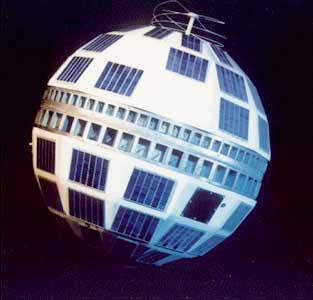
I wasn't sure why my Aunt wanted me. We'd had dinner; it was sometime after two and supper was usually at six. I'd learned during the summer that I stayed with them, that she and my Uncle Jack were very punctual folks.
She was drying her hands on her apron as I stepped up on the porch. “Come on in; there's going to be something on television we need to see.” This was a bit out of the ordinary. Usually, in the afternoon we might watch the “Channel 10 Matinee for an Afternoon” together, but that came on at two and the cat clock on the kitchen wall showed a few minutes until three.
“What's on?”
Her answer nonplussed me. “Pictures from Europe.” I raised an eyebrow (a bad habit for an eleven-year-old when dealing with adults). Reading my mind, she continued, “No, I don't mean pictures like we usually see. I mean live pictures, not on film. They're going to be showing pictures of what's going on right now, this minute. They're sending them through that satellite, Telstar.”
The two of us settled on the couch. At three sharp, we entered the world of real-time international TV. An American TV news anchorman (at this point, I frankly can't remember whether it was NBC's Chet Huntley or CBS's Walter Cronkite—or both) welcomed the viewers. I remember seeing an American Flag, the Statue of Liberty, and—I think—Mount Rushmore. This was replaced by a tweedy gentleman who said in a plummy BBC accent that he was speaking from Brussels. The picture switched to Paris and the Eiffel Tower. The broadcast closed, as I remember, with a shot of the huge white bubble that enclosed the antenna in Andover, Maine. Interestingly, the pictures from the American side were crystal-clear (at least as judged for that time), but the pictures from Europe rippled as if seen through heat waves or water. The pictures we watched were in living black and white—whether they were broadcast in color or not, I don't know; my aunt and uncle, like most at that time, owned a black and white set (it wasn't until 1964 that my father bought a RCA color console model—the local TV repairman had to study a week and a half before he could adjust the colors that had been scrambled on the trip from the store in Roanoke over the mountains into the wilds of West Virginia—he didn't charge us because of the learning opportunity). [If anyone reading this knows whether or not the broadcast was in color, I'd appreciate them leaving the answer in the “Comments.”]
*
Telstar 1 was owned by AT&T and developed by Bell Labs (part of the Bell Telephone System--”Ma Bell”). It was lofted by a NASA Delta rocket which limited its size to a 34.5 inch (87.6 cm) sphere. The satellite turned the scales at around 170 pounds (77kg). It was powered by solar cells producing a staggering 14 watts and was spin-stabilized.
Telstar first broadcast a picture on 11 July 1962, a nonpublic “Is this thing working?” broadcast. The first public broadcast, the one my aunt and I marveled over, was on 23 July 1962 at 15:00 EDT. As it was in a non-geostationary orbit, unlike the norm for communications satellites these days, Telstar 1 was only above the horizon for 20 minutes during each 150 minute orbit.
Telstar 1 established several firsts besides being the first rebroadcasting telecommunications satellite. It was also the first privately owned payload launched by NASA . It was the first satellite, to my knowledge, to have a song named for it (Joe Meek's instrumental which is on the first record I bought with my own money, “The Ventures Play Telstar and the Lonely Bull”--which I'm listening to as I write this). It's also the first satellite to have a soccer ball named for it, Adidas's design for the FIFA World Cups competitions—the black and white one that most of us in the U.S. think of when the word, “soccer ball,” is mentioned.
Telsar 1 continued in service routing TV, telephone, and fax and data traffic until a number of its transistors were fried by Van Allen Belt radiation excited by high-attitude detonations during both American and Soviet nuclear testing. It first went off the air in early December of 1962, was resuscitated a month later, and finally died on 21 February 1963. At last word, Telstar 1 is still orbiting the Earth, a victim of the Cold War.
From the Earth to the Moon, Ch 17: A TELEGRAPHIC DISPATCH
CHAPTER XVII --A TELEGRAPHIC DISPATCH
The great works undertaken by the Gun Club had now virtually come to an end; and two months still remained before the day for the discharge of the shot to the moon. To the general impatience these two months appeared as long as years! Hitherto the smallest details of the operation had been daily chronicled by the journals, which the public devoured with eager eyes.
Just at this moment a circumstance, the most unexpected, the most extraordinary and incredible, occurred to rouse afresh their panting spirits, and to throw every mind into a state of the most violent excitement.
One day, the 30th of September, at 3:47 P.M., a telegram, transmitted by cable from Valentia (Ireland) to Newfoundland and the American Mainland, arrived at the address of President Barbicane.
The president tore open the envelope, read the dispatch, and, despite his remarkable powers of self-control, his lips turned pale and his eyes grew dim, on reading the twenty words of this telegram.
Here is the text of the dispatch, which figures now in the archives of the Gun Club:
FRANCE, PARIS,
30 September, 4 A.M.
Barbicane, Tampa Town, Florida, United States.
Substitute for your spherical shell a cylindro-conical projectile.
I shall go inside. Shall arrive by steamer Atlanta.
MICHEL ARDAN.
The great works undertaken by the Gun Club had now virtually come to an end; and two months still remained before the day for the discharge of the shot to the moon. To the general impatience these two months appeared as long as years! Hitherto the smallest details of the operation had been daily chronicled by the journals, which the public devoured with eager eyes.
Just at this moment a circumstance, the most unexpected, the most extraordinary and incredible, occurred to rouse afresh their panting spirits, and to throw every mind into a state of the most violent excitement.
One day, the 30th of September, at 3:47 P.M., a telegram, transmitted by cable from Valentia (Ireland) to Newfoundland and the American Mainland, arrived at the address of President Barbicane.
The president tore open the envelope, read the dispatch, and, despite his remarkable powers of self-control, his lips turned pale and his eyes grew dim, on reading the twenty words of this telegram.
Here is the text of the dispatch, which figures now in the archives of the Gun Club:
FRANCE, PARIS,
30 September, 4 A.M.
Barbicane, Tampa Town, Florida, United States.
Substitute for your spherical shell a cylindro-conical projectile.
I shall go inside. Shall arrive by steamer Atlanta.
MICHEL ARDAN.
Selasa, 03 Januari 2012
Will China shame the US back to strong space program
From The Youngstown Vindicator: Will China shame the US back to strong space program?
Many of today’s maturing baby boomers cling to fond childhood memories of elementary-school assemblies where they’d sit knee-to-knee on freshly waxed floors and peer intently onto small-screen black and white TV sets to witness the dawn of the American space age. During those exciting Mercury, Gemini and Apollo launches in the 1960s and early ’70s, enthusiasm, adventure and national pride united them.
A sense of fierce competitiveness with the then Soviet Union also energized those children and most all Americans. After all, the Soviets, through their launch of Sputnik I in 1957, essentially shamed the United States into its massive, multi-trillion-dollar goal-oriented journey into outer space. When Ohioan Neil Armstong made his historic “small step for man” but “giant leap for mankind” onto the lunar surface in July 1969, America celebrated its come-from-behind victory with boundless elation and gratification.
Much has changed in space science and in the world order in the ensuing five decades. The Soviet Union has crumbled, its leading nation Russia has long lost its superpower lustre, China has emerged as a daunting global force and the government-sanctioned manned space program in the United States has become a mere shadow of its former robust and glorious self.
So much so, in fact, that some may wonder whether history may repeat itself in the 21st century. This time, could it be China that will shame the United States back into a serious program of space exploration and conquest?
CHINA’S AGGRESSIVE 5-YEAR PLAN
Just last week, China announced plans for an aggressive state-sponsored program to launch space labs and prepare to build space stations over the next five years.
The country says it will continue its exploration of the moon using probes, start gathering samples of the moon’s surface, land an astronaut on the lunar surface and “push forward its exploration of planets, asteroids and the sun.”
Contrast those ambitious goals with those of the U.S. space program. Funding for the National Aeronautics and Space Administration has been decimated in the current federal budget, plans for a return to the moon and other ambitious missions have been scrubbed or substantially cut back, thousands of talented NASA workers have lost their jobs and America’s working space program largely has been privatized.
Just last week, NASA announced that a private California company — SpaceX — will attempt the first-ever commercial cargo run to the International Space Station in February. The unmanned Dragon capsule will fly to the space station and dock with a load of supplies. While we wish success for the project, any failures or problems will undoubtedly reflect more profoundly on the pride of this country, not the profits of the Paypal-tied company.
Indeed China cites the effect on national pride as well worth the cost of its massive investment. Its space program already has made major breakthroughs in a relatively short time, and it is on track to replace the U.S. as the leader in space-station development.
Will we care? To be sure, much has changed in the U.S. since the launch of Mercury I, not the least of which is decreasing awe over 60 years of almost routinized manned space travel. One thing that has not changed, however, is that fierce competitiveness and drive for achievement that energized millions of American schoolchildren of the ‘60s.
Washington bureaucrats and congressional delegations would do well to remember that when debating the dollars and sense of the future course of America’s once-proud space agency.
Many of today’s maturing baby boomers cling to fond childhood memories of elementary-school assemblies where they’d sit knee-to-knee on freshly waxed floors and peer intently onto small-screen black and white TV sets to witness the dawn of the American space age. During those exciting Mercury, Gemini and Apollo launches in the 1960s and early ’70s, enthusiasm, adventure and national pride united them.
A sense of fierce competitiveness with the then Soviet Union also energized those children and most all Americans. After all, the Soviets, through their launch of Sputnik I in 1957, essentially shamed the United States into its massive, multi-trillion-dollar goal-oriented journey into outer space. When Ohioan Neil Armstong made his historic “small step for man” but “giant leap for mankind” onto the lunar surface in July 1969, America celebrated its come-from-behind victory with boundless elation and gratification.
Much has changed in space science and in the world order in the ensuing five decades. The Soviet Union has crumbled, its leading nation Russia has long lost its superpower lustre, China has emerged as a daunting global force and the government-sanctioned manned space program in the United States has become a mere shadow of its former robust and glorious self.
So much so, in fact, that some may wonder whether history may repeat itself in the 21st century. This time, could it be China that will shame the United States back into a serious program of space exploration and conquest?
CHINA’S AGGRESSIVE 5-YEAR PLAN
Just last week, China announced plans for an aggressive state-sponsored program to launch space labs and prepare to build space stations over the next five years.
The country says it will continue its exploration of the moon using probes, start gathering samples of the moon’s surface, land an astronaut on the lunar surface and “push forward its exploration of planets, asteroids and the sun.”
Contrast those ambitious goals with those of the U.S. space program. Funding for the National Aeronautics and Space Administration has been decimated in the current federal budget, plans for a return to the moon and other ambitious missions have been scrubbed or substantially cut back, thousands of talented NASA workers have lost their jobs and America’s working space program largely has been privatized.
Just last week, NASA announced that a private California company — SpaceX — will attempt the first-ever commercial cargo run to the International Space Station in February. The unmanned Dragon capsule will fly to the space station and dock with a load of supplies. While we wish success for the project, any failures or problems will undoubtedly reflect more profoundly on the pride of this country, not the profits of the Paypal-tied company.
Indeed China cites the effect on national pride as well worth the cost of its massive investment. Its space program already has made major breakthroughs in a relatively short time, and it is on track to replace the U.S. as the leader in space-station development.
Will we care? To be sure, much has changed in the U.S. since the launch of Mercury I, not the least of which is decreasing awe over 60 years of almost routinized manned space travel. One thing that has not changed, however, is that fierce competitiveness and drive for achievement that energized millions of American schoolchildren of the ‘60s.
Washington bureaucrats and congressional delegations would do well to remember that when debating the dollars and sense of the future course of America’s once-proud space agency.
Private companies need taxpayer money
From Florida Today: Private companies need taxpayer money
Private companies cannot and will not make the commitment to explore space without massive government subsidies. Their business paradigm is making a profit, and space exploration is much too risky for a private company to invest the necessary resources. Unless of course, taxpayers will shoulder the cost and liability, leaving private companies to reap all of the profits.
Take, for example SpaceX. When launching rockets from its facilities in the South Pacific, it had a dismal success rate. Now, it essentially has been given Launch Complex 40 at Cape Canaveral Air Force Station, and has had two successful launches of the vaunted Falcon 9. These launches came about after several delays, and there have been cancellations of other tests that will ensure reliability and safety for this launch system.
Now, SpaceX plans to combine two test flights of its unmanned Dragon cargo ship into a single mission in February to dock with the International Space Station.
It cost American taxpayers $100 billion to design, build and maintain the ISS, which provides much-needed research in space. Is NASA really going to risk that investment so SpaceX doesn't have to perform test flights that will cut into its profit margin?
This shows why privatization of the space program will never work. Space exploration always has been about research, science and gaining knowledge for the betterment of mankind, not for profit at the expense of taxpayers. If private companies like Space X wish to conduct space exploration to make a profit, let them do it on their own dime.
Why should taxpayers “give” them launch facilities we paid for, then pay them to launch government satellites? In a free market, SpaceX would shoulder all of the financial burden of providing a cheaper method of launching satellites into space. That is why until now, only governments have invested the capital necessary to explore space.
And we as taxpayers have benefited in the form of technological advancements we use in our daily lives.
From the Earth to the Moon, Ch 16: THE COLUMBIAD
CHAPTER XVI -- THE COLUMBIAD
Had the casting succeeded? They were reduced to mere conjecture. There was indeed every reason to expect success, since the mould has absorbed the entire mass of the molten metal; still some considerable time must elapse before they could arrive at any certainty upon the matter.
The patience of the members of the Gun Club was sorely tried during this period of time. But they could do nothing. J. T. Maston escaped roasting by a miracle. Fifteen days after the casting an immense column of smoke was still rising in the open sky and the ground burned the soles of the feet within a radius of two hundred feet round the summit of Stones Hill. It was impossible to approach nearer. All they could do was to wait with what patience they might.
"Here we are at the 10th of August," exclaimed J. T. Maston one morning, "only four months to the 1st of December! We shall never be ready in time!" Barbicane said nothing, but his silence covered serious irritation.
However, daily observations revealed a certain change going on in the state of the ground. About the 15th of August the vapors ejected had sensibly diminished in intensity and thickness. Some days afterward the earth exhaled only a slight puff of smoke, the last breath of the monster enclosed within its circle of stone. Little by little the belt of heat contracted, until on the 22nd of August, Barbicane, his colleagues, and the engineer were enabled to set foot on the iron sheet which lay level upon the summit of Stones Hill.
"At last!" exclaimed the president of the Gun Club, with an immense sigh of relief.
The work was resumed the same day. They proceeded at once to extract the interior mould, for the purpose of clearing out the boring of the piece. Pickaxes and boring irons were set to work without intermission. The clayey and sandy soils had acquired extreme hardness under the action of the heat; but, by the aid of the machines, the rubbish on being dug out was rapidly carted away on railway wagons; and such was the ardor of the work, so persuasive the arguments of Barbicane's dollars, that by the 3rd of September all traces of the mould had entirely disappeared.
Immediately the operation of boring was commenced; and by the aid of powerful machines, a few weeks later, the inner surface of the immense tube had been rendered perfectly cylindrical, and the bore of the piece had acquired a thorough polish.
At length, on the 22d of September, less than a twelvemonth after Barbicane's original proposition, the enormous weapon, accurately bored, and exactly vertically pointed, was ready for work. There was only the moon now to wait for; and they were pretty sure that she would not fail in the rendezvous.
The ecstasy of J. T. Maston knew no bounds, and he narrowly escaped a frightful fall while staring down the tube. But for the strong hand of Colonel Blomsberry, the worthy secretary, like a modern Erostratus, would have found his death in the depths of the Columbiad.
The cannon was then finished; there was no possible doubt as to its perfect completion. So, on the 6th of October, Captain Nicholl opened an account between himself and President Barbicane, in which he debited himself to the latter in the sum of two thousand dollars. One may believe that the captain's wrath was increased to its highest point, and must have made him seriously ill. However, he had still three bets of three, four, and five thousand dollars, respectively; and if he gained two out of these, his position would not be very bad. But the money question did not enter into his calculations; it was the success of his rival in casting a cannon against which iron plates sixty feet thick would have been ineffectual, that dealt him a terrible blow.
After the 23rd of September the enclosure of Stones hill was thrown open to the public; and it will be easily imagined what was the concourse of visitors to this spot! There was an incessant flow of people to and from Tampa Town and the place, which resembled a procession, or rather, in fact, a pilgrimage.
It was already clear to be seen that, on the day of the experiment itself, the aggregate of spectators would be counted by millions; for they were already arriving from all parts of the earth upon this narrow strip of promontory. Europe was emigrating to America.
Up to that time, however, it must be confessed, the curiosity of the numerous comers was but scantily gratified. Most had counted upon witnessing the spectacle of the casting, and they were treated to nothing but smoke. This was sorry food for hungry eyes; but Barbicane would admit no one to that operation. Then ensued grumbling, discontent, murmurs; they blamed the president, taxed him with dictatorial conduct. His proceedings were declared "un-American." There was very nearly a riot round Stones Hill; but Barbicane remained inflexible. When, however, the Columbiad was entirely finished, this state of closed doors could no longer be maintained; besides it would have been bad taste, and even imprudence, to affront the public feeling. Barbicane, therefore, opened the enclosure to all comers; but, true to his practical disposition, he determined to coin money out of the public curiosity.
It was something, indeed, to be enabled to contemplate this immense Columbiad; but to descend into its depths, this seemed to the Americans the ne plus ultra of earthly felicity. Consequently, there was not one curious spectator who was not willing to give himself the treat of visiting the interior of this great metallic abyss. Baskets suspended from steam-cranes permitted them to satisfy their curiosity. There was a perfect mania. Women, children, old men, all made it a point of duty to penetrate the mysteries of the colossal gun. The fare for the descent was fixed at five dollars per head; and despite this high charge, during the two months which preceded the experiment, the influx of visitors enabled the Gun Club to pocket nearly five hundred thousand dollars!
It is needless to say that the first visitors of the Columbiad were the members of the Gun Club. This privilege was justly reserved for that illustrious body. The ceremony took place on the 25th of September. A basket of honor took down the president, J. T. Maston, Major Elphinstone, General Morgan, Colonel Blomsberry, and other members of the club, to the number of ten in all. How hot it was at the bottom of that long tube of metal! They were half suffocated. But what delight! What ecstasy! A table had been laid with six covers on the massive stone which formed the bottom of the Columbiad, and lighted by a jet of electric light resembling that of day itself. Numerous exquisite dishes, which seemed to descend from heaven, were placed successively before the guests, and the richest wines of France flowed in profusion during this splendid repast, served nine hundred feet beneath the surface of the earth!
The festival was animated, not to say somewhat noisy. Toasts flew backward and forward. They drank to the earth and to her satellite, to the Gun Club, the Union, the Moon, Diana, Phoebe, Selene, the "peaceful courier of the night!" All the hurrahs, carried upward upon the sonorous waves of the immense acoustic tube, arrived with the sound of thunder at its mouth; and the multitude ranged round Stones Hill heartily united their shouts with those of the ten revelers hidden from view at the bottom of the gigantic Columbiad.
J. T. Maston was no longer master of himself. Whether he shouted or gesticulated, ate or drank most, would be a difficult matter to determine. At all events, he would not have given his place up for an empire, "not even if the cannon— loaded, primed, and fired at that very moment—were to blow him in pieces into the planetary world."
Had the casting succeeded? They were reduced to mere conjecture. There was indeed every reason to expect success, since the mould has absorbed the entire mass of the molten metal; still some considerable time must elapse before they could arrive at any certainty upon the matter.
The patience of the members of the Gun Club was sorely tried during this period of time. But they could do nothing. J. T. Maston escaped roasting by a miracle. Fifteen days after the casting an immense column of smoke was still rising in the open sky and the ground burned the soles of the feet within a radius of two hundred feet round the summit of Stones Hill. It was impossible to approach nearer. All they could do was to wait with what patience they might.
"Here we are at the 10th of August," exclaimed J. T. Maston one morning, "only four months to the 1st of December! We shall never be ready in time!" Barbicane said nothing, but his silence covered serious irritation.
However, daily observations revealed a certain change going on in the state of the ground. About the 15th of August the vapors ejected had sensibly diminished in intensity and thickness. Some days afterward the earth exhaled only a slight puff of smoke, the last breath of the monster enclosed within its circle of stone. Little by little the belt of heat contracted, until on the 22nd of August, Barbicane, his colleagues, and the engineer were enabled to set foot on the iron sheet which lay level upon the summit of Stones Hill.
"At last!" exclaimed the president of the Gun Club, with an immense sigh of relief.
The work was resumed the same day. They proceeded at once to extract the interior mould, for the purpose of clearing out the boring of the piece. Pickaxes and boring irons were set to work without intermission. The clayey and sandy soils had acquired extreme hardness under the action of the heat; but, by the aid of the machines, the rubbish on being dug out was rapidly carted away on railway wagons; and such was the ardor of the work, so persuasive the arguments of Barbicane's dollars, that by the 3rd of September all traces of the mould had entirely disappeared.
Immediately the operation of boring was commenced; and by the aid of powerful machines, a few weeks later, the inner surface of the immense tube had been rendered perfectly cylindrical, and the bore of the piece had acquired a thorough polish.
At length, on the 22d of September, less than a twelvemonth after Barbicane's original proposition, the enormous weapon, accurately bored, and exactly vertically pointed, was ready for work. There was only the moon now to wait for; and they were pretty sure that she would not fail in the rendezvous.
The ecstasy of J. T. Maston knew no bounds, and he narrowly escaped a frightful fall while staring down the tube. But for the strong hand of Colonel Blomsberry, the worthy secretary, like a modern Erostratus, would have found his death in the depths of the Columbiad.
The cannon was then finished; there was no possible doubt as to its perfect completion. So, on the 6th of October, Captain Nicholl opened an account between himself and President Barbicane, in which he debited himself to the latter in the sum of two thousand dollars. One may believe that the captain's wrath was increased to its highest point, and must have made him seriously ill. However, he had still three bets of three, four, and five thousand dollars, respectively; and if he gained two out of these, his position would not be very bad. But the money question did not enter into his calculations; it was the success of his rival in casting a cannon against which iron plates sixty feet thick would have been ineffectual, that dealt him a terrible blow.
After the 23rd of September the enclosure of Stones hill was thrown open to the public; and it will be easily imagined what was the concourse of visitors to this spot! There was an incessant flow of people to and from Tampa Town and the place, which resembled a procession, or rather, in fact, a pilgrimage.
It was already clear to be seen that, on the day of the experiment itself, the aggregate of spectators would be counted by millions; for they were already arriving from all parts of the earth upon this narrow strip of promontory. Europe was emigrating to America.
Up to that time, however, it must be confessed, the curiosity of the numerous comers was but scantily gratified. Most had counted upon witnessing the spectacle of the casting, and they were treated to nothing but smoke. This was sorry food for hungry eyes; but Barbicane would admit no one to that operation. Then ensued grumbling, discontent, murmurs; they blamed the president, taxed him with dictatorial conduct. His proceedings were declared "un-American." There was very nearly a riot round Stones Hill; but Barbicane remained inflexible. When, however, the Columbiad was entirely finished, this state of closed doors could no longer be maintained; besides it would have been bad taste, and even imprudence, to affront the public feeling. Barbicane, therefore, opened the enclosure to all comers; but, true to his practical disposition, he determined to coin money out of the public curiosity.
It was something, indeed, to be enabled to contemplate this immense Columbiad; but to descend into its depths, this seemed to the Americans the ne plus ultra of earthly felicity. Consequently, there was not one curious spectator who was not willing to give himself the treat of visiting the interior of this great metallic abyss. Baskets suspended from steam-cranes permitted them to satisfy their curiosity. There was a perfect mania. Women, children, old men, all made it a point of duty to penetrate the mysteries of the colossal gun. The fare for the descent was fixed at five dollars per head; and despite this high charge, during the two months which preceded the experiment, the influx of visitors enabled the Gun Club to pocket nearly five hundred thousand dollars!
It is needless to say that the first visitors of the Columbiad were the members of the Gun Club. This privilege was justly reserved for that illustrious body. The ceremony took place on the 25th of September. A basket of honor took down the president, J. T. Maston, Major Elphinstone, General Morgan, Colonel Blomsberry, and other members of the club, to the number of ten in all. How hot it was at the bottom of that long tube of metal! They were half suffocated. But what delight! What ecstasy! A table had been laid with six covers on the massive stone which formed the bottom of the Columbiad, and lighted by a jet of electric light resembling that of day itself. Numerous exquisite dishes, which seemed to descend from heaven, were placed successively before the guests, and the richest wines of France flowed in profusion during this splendid repast, served nine hundred feet beneath the surface of the earth!
The festival was animated, not to say somewhat noisy. Toasts flew backward and forward. They drank to the earth and to her satellite, to the Gun Club, the Union, the Moon, Diana, Phoebe, Selene, the "peaceful courier of the night!" All the hurrahs, carried upward upon the sonorous waves of the immense acoustic tube, arrived with the sound of thunder at its mouth; and the multitude ranged round Stones Hill heartily united their shouts with those of the ten revelers hidden from view at the bottom of the gigantic Columbiad.
J. T. Maston was no longer master of himself. Whether he shouted or gesticulated, ate or drank most, would be a difficult matter to determine. At all events, he would not have given his place up for an empire, "not even if the cannon— loaded, primed, and fired at that very moment—were to blow him in pieces into the planetary world."
Senin, 02 Januari 2012
2011: A Big Year For Space Exploration
From NBUR Boston NPR: 2011: A Big Year For Space Exploration
Some might be inclined to think 2011 was a pretty bad year for space, what with the U.S. space program shutting down. While the Atlantis marked the last mission in NASA's decades-long space shuttle program, the agency still managed to have other significant launches this year. Crafts visited Mercury, a massive asteroid known as Vesta, and the moon. Another left for Jupiter, and the Voyager 1 spacecraft sailed out of our solar system. Guest host Rebecca Sheir talks to Neil deGrasse Tyson, head of the Hayden Planetarium, about whether all that made 2011 a good year for space exploration.
Transcript
REBECCA SHEIR, HOST:
2011 was, of course, a big year for a lot of things, but not just here on Earth. In the spring, NASA's Messenger probe became the first spacecraft to arrive in orbit around Mercury. Over the summer, we saw groundbreaking photos of a giant asteroid nearing Earth. A craft left for Jupiter in August, another for Mars in November, and throughout the year, Voyager 1 sailed farther and farther out of our solar system. What excited Neil deGrasse Tyson most about space in 2011?
NEIL DEGRASSE TYSON: Everything.
(SOUNDBITE OF LAUGHTER)
SHEIR: He's head of New York City's Hayden Planetarium. And he says a lot of space watchers shed a tear over the biggest astro event of the year, the end of NASA's Space Shuttle program, which eclipsed some other big events in space science.
TYSON: I would say for me, the most ambitious among these missions is the Mars Science Laboratory dubbed Curiosity. And the Mars Science Laboratory is going to do experiments to see if the conditions on the Martian surface can sustain organics, which would be the building blocks for life. It's a whole other round of questions that we now get to ask about the surface of Mars.
SHEIR: Let's move on to a slightly larger planet, then, Jupiter. We've got Juno, that's the spacecraft heading up there. It won't be there for another five years, really?
TYSON: Yeah. Jupiter's far - you know, these things are far away, and we don't know how to move very fast. Interesting thing about Jupiter, Jupiter actually gives more energy out than it receives from the sun. There's a huge, monstrous magnetic field and radiation belts. So any time you go to investigate it, first, you have to have specially, what they call hardened electronics that can survive in these harsh environments. And then you want to actually make the measurements, things like the magnetic field, the radiation flux, the chemistry of the atmosphere.
And so these missions to Mercury, to Jupiter, they're all equipped with the sweep of experiments just to try to give us some understanding beyond just the spec view that telescopes give us.
SHEIR: So looking at exoplanet research, scientists announced this month they'd found Kepler-22b, a planet outside our solar system orbiting a star in the so-called Goldilocks Zone where water might be present. Now that it's been found, what would you say is next?
TYSON: Yeah. So we knew that we'd find planets around other stars, but the Holy Grail among the planets would be an Earth-like planet, and you've got it. And so now, that's where you might send radio signals to see if there's any intelligent life there. One problem there is that, first, Earth-like planet in the Goldilocks Zone is 600 light-years away. So you could send a signal today, and we'd get a reply 1,200 years later.
SHEIR: Oh, no.
TYSON: And what were we doing on Earth 1,200 years ago, you know? So right now, it's sort of a philosophical interest that there might be life there, but it's not much we know how to do about it if there is.
SHEIR: Neil, what do you hope will be accomplished in space science over this next year?
TYSON: Oh, one year is not - I got to think in longer timeframes than that. You're thinking like annual report question.
(SOUNDBITE OF LAUGHTER)
TYSON: I have to think cosmically, excuse me. So in the next five, 10 years, 20 years, I think we'll be equipped to answer definitely whether life ever thrived in our backyard. I think the Mars Science Laboratory will lead that effort. By the way, and if our backyard does not have life, the galaxy is vast. And if you looked at an image of how far we have explored and how far our radio signals have reached, that's what we call a radio bubble, it's 80 light-years across, that bubble is tiny compared with the 100,000 light-year diameter of our Milky Way galaxy. So I'd be disappointed, but I'd say let's keep looking.
SHEIR: Neil, deGrasse Tyson is director of the Hayden Planetarium at the Rose Center for Earth and Space in New York City. Thanks so much, Neil, and Happy New Year.
Some might be inclined to think 2011 was a pretty bad year for space, what with the U.S. space program shutting down. While the Atlantis marked the last mission in NASA's decades-long space shuttle program, the agency still managed to have other significant launches this year. Crafts visited Mercury, a massive asteroid known as Vesta, and the moon. Another left for Jupiter, and the Voyager 1 spacecraft sailed out of our solar system. Guest host Rebecca Sheir talks to Neil deGrasse Tyson, head of the Hayden Planetarium, about whether all that made 2011 a good year for space exploration.
Transcript
REBECCA SHEIR, HOST:
2011 was, of course, a big year for a lot of things, but not just here on Earth. In the spring, NASA's Messenger probe became the first spacecraft to arrive in orbit around Mercury. Over the summer, we saw groundbreaking photos of a giant asteroid nearing Earth. A craft left for Jupiter in August, another for Mars in November, and throughout the year, Voyager 1 sailed farther and farther out of our solar system. What excited Neil deGrasse Tyson most about space in 2011?
NEIL DEGRASSE TYSON: Everything.
(SOUNDBITE OF LAUGHTER)
SHEIR: He's head of New York City's Hayden Planetarium. And he says a lot of space watchers shed a tear over the biggest astro event of the year, the end of NASA's Space Shuttle program, which eclipsed some other big events in space science.
TYSON: I would say for me, the most ambitious among these missions is the Mars Science Laboratory dubbed Curiosity. And the Mars Science Laboratory is going to do experiments to see if the conditions on the Martian surface can sustain organics, which would be the building blocks for life. It's a whole other round of questions that we now get to ask about the surface of Mars.
SHEIR: Let's move on to a slightly larger planet, then, Jupiter. We've got Juno, that's the spacecraft heading up there. It won't be there for another five years, really?
TYSON: Yeah. Jupiter's far - you know, these things are far away, and we don't know how to move very fast. Interesting thing about Jupiter, Jupiter actually gives more energy out than it receives from the sun. There's a huge, monstrous magnetic field and radiation belts. So any time you go to investigate it, first, you have to have specially, what they call hardened electronics that can survive in these harsh environments. And then you want to actually make the measurements, things like the magnetic field, the radiation flux, the chemistry of the atmosphere.
And so these missions to Mercury, to Jupiter, they're all equipped with the sweep of experiments just to try to give us some understanding beyond just the spec view that telescopes give us.
SHEIR: So looking at exoplanet research, scientists announced this month they'd found Kepler-22b, a planet outside our solar system orbiting a star in the so-called Goldilocks Zone where water might be present. Now that it's been found, what would you say is next?
TYSON: Yeah. So we knew that we'd find planets around other stars, but the Holy Grail among the planets would be an Earth-like planet, and you've got it. And so now, that's where you might send radio signals to see if there's any intelligent life there. One problem there is that, first, Earth-like planet in the Goldilocks Zone is 600 light-years away. So you could send a signal today, and we'd get a reply 1,200 years later.
SHEIR: Oh, no.
TYSON: And what were we doing on Earth 1,200 years ago, you know? So right now, it's sort of a philosophical interest that there might be life there, but it's not much we know how to do about it if there is.
SHEIR: Neil, what do you hope will be accomplished in space science over this next year?
TYSON: Oh, one year is not - I got to think in longer timeframes than that. You're thinking like annual report question.
(SOUNDBITE OF LAUGHTER)
TYSON: I have to think cosmically, excuse me. So in the next five, 10 years, 20 years, I think we'll be equipped to answer definitely whether life ever thrived in our backyard. I think the Mars Science Laboratory will lead that effort. By the way, and if our backyard does not have life, the galaxy is vast. And if you looked at an image of how far we have explored and how far our radio signals have reached, that's what we call a radio bubble, it's 80 light-years across, that bubble is tiny compared with the 100,000 light-year diameter of our Milky Way galaxy. So I'd be disappointed, but I'd say let's keep looking.
SHEIR: Neil, deGrasse Tyson is director of the Hayden Planetarium at the Rose Center for Earth and Space in New York City. Thanks so much, Neil, and Happy New Year.
From the Earth to the Moon, Ch 15: THE FETE OF THE CASTING
CHAPTER XV --THE FETE OF THE CASTING
During the eight months which were employed in the work of excavation the preparatory works of the casting had been carried on simultaneously with extreme rapidity. A stranger arriving at Stones Hill would have been surprised at the spectacle offered to his view.
At 600 yards from the well, and circularly arranged around it as a central point, rose 1,200 reverberating ovens, each six feet in diameter, and separated from each other by an interval of three feet. The circumference occupied by these 1,200 ovens presented a length of two miles. Being all constructed on the same plan, each with its high quadrangular chimney, they produced a most singular effect.
It will be remembered that on their third meeting the committee had decided to use cast iron for the Columbiad, and in particular the white description. This metal, in fact, is the most tenacious, the most ductile, and the most malleable, and consequently suitable for all moulding operations; and when smelted with pit coal, is of superior quality for all engineering works requiring great resisting power, such as cannon, steam boilers, hydraulic presses, and the like.
Cast iron, however, if subjected to only one single fusion, is rarely sufficiently homogeneous; and it requires a second fusion completely to refine it by dispossessing it of its last earthly deposits. So long before being forwarded to Tampa Town, the iron ore, molten in the great furnaces of Coldspring, and brought into contact with coal and silicium heated to a high temperature, was carburized and transformed into cast iron. After this first operation, the metal was sent on to Stones Hill. They had, however, to deal with 136,000,000 pounds of iron, a quantity far too costly to send by railway. The cost of transport would have been double that of material. It appeared preferable to freight vessels at New York, and to load them with the iron in bars. This, however, required not less than sixty- eight vessels of 1,000 tons, a veritable fleet, which, quitting New York on the 3rd of May, on the 10th of the same month ascended the Bay of Espiritu Santo, and discharged their cargoes, without dues, in the port at Tampa Town. Thence the iron was transported by rail to Stones Hill, and about the middle of January this enormous mass of metal was delivered at its destination.
It will easily be understood that 1,200 furnaces were not too many to melt simultaneously these 60,000 tons of iron. Each of these furnaces contained nearly 140,000 pounds weight of metal. They were all built after the model of those which served for the casting of the Rodman gun; they were trapezoidal in shape, with a high elliptical arch. These furnaces, constructed of fireproof brick, were especially adapted for burning pit coal, with a flat bottom upon which the iron bars were laid. This bottom, inclined at an angle of 25 degrees, allowed the metal to flow into the receiving troughs; and the 1,200 converging trenches carried the molten metal down to the central well.
The day following that on which the works of the masonry and boring had been completed, Barbicane set to work upon the central mould. His object now was to raise within the center of the well, and with a coincident axis, a cylinder 900 feet high, and nine feet in diameter, which should exactly fill up the space reserved for the bore of the Columbiad. This cylinder was composed of a mixture of clay and sand, with the addition of a little hay and straw. The space left between the mould and the masonry was intended to be filled up by the molten metal, which would thus form the walls six feet in thickness. This cylinder, in order to maintain its equilibrium, had to be bound by iron bands, and firmly fixed at certain intervals by cross-clamps fastened into the stone lining; after the castings these would be buried in the block of metal, leaving no external projection.
This operation was completed on the 8th of July, and the run of the metal was fixed for the following day.
"This fete of the casting will be a grand ceremony," said J.
T. Maston to his friend Barbicane.
"Undoubtedly," said Barbicane; "but it will not be a public fete"
"What! will you not open the gates of the enclosure to all comers?"
"I must be very careful, Maston. The casting of the Columbiad is an extremely delicate, not to say a dangerous operation, and I should prefer its being done privately. At the discharge of the projectile, a fete if you like— till then, no!"
The president was right. The operation involved unforeseen dangers, which a great influx of spectators would have hindered him from averting. It was necessary to preserve complete freedom of movement. No one was admitted within the enclosure except a delegation of members of the Gun Club, who had made the voyage to Tampa Town. Among these was the brisk Bilsby, Tom Hunter, Colonel Blomsberry, Major Elphinstone, General Morgan, and the rest of the lot to whom the casting of the Columbiad was a matter of personal interest. J. T. Maston became their cicerone. He omitted no point of detail; he conducted them throughout the magazines, workshops, through the midst of the engines, and compelled them to visit the whole 1,200 furnaces one after the other. At the end of the twelve-hundredth visit they were pretty well knocked up.
The casting was to take place at twelve o'clock precisely. The previous evening each furnace had been charged with 114,000 pounds weight of metal in bars disposed cross-ways to each other, so as to allow the hot air to circulate freely between them. At daybreak the 1,200 chimneys vomited their torrents of flame into the air, and the ground was agitated with dull tremblings. As many pounds of metal as there were to cast, so many pounds of coal were there to burn. Thus there were 68,000 tons of coal which projected in the face of the sun a thick curtain of smoke. The heat soon became insupportable within the circle of furnaces, the rumbling of which resembled the rolling of thunder. The powerful ventilators added their continuous blasts and saturated with oxygen the glowing plates. The operation, to be successful, required to be conducted with great rapidity. On a signal given by a cannon-shot each furnace was to give vent to the molten iron and completely to empty itself. These arrangements made, foremen and workmen waited the preconcerted moment with an impatience mingled with a certain amount of emotion. Not a soul remained within the enclosure. Each superintendent took his post by the aperture of the run.
Barbicane and his colleagues, perched on a neighboring eminence, assisted at the operation. In front of them was a piece of artillery ready to give fire on the signal from the engineer. Some minutes before midday the first driblets of metal began to flow; the reservoirs filled little by little; and, by the time that the whole melting was completely accomplished, it was kept in abeyance for a few minutes in order to facilitate the separation of foreign substances.
Twelve o'clock struck! A gunshot suddenly pealed forth and shot its flame into the air. Twelve hundred melting-troughs were simultaneously opened and twelve hundred fiery serpents crept toward the central well, unrolling their incandescent curves. There, down they plunged with a terrific noise into a depth of 900 feet. It was an exciting and a magnificent spectacle. The ground trembled, while these molten waves, launching into the sky their wreaths of smoke, evaporated the moisture of the mould and hurled it upward through the vent-holes of the stone lining in the form of dense vapor-clouds. These artificial clouds unrolled their thick spirals to a height of 1,000 yards into the air. A savage, wandering somewhere beyond the limits of the horizon, might have believed that some new crater was forming in the bosom of Florida, although there was neither any eruption, nor typhoon, nor storm, nor struggle of the elements, nor any of those terrible phenomena which nature is capable of producing. No, it was man alone who had produced these reddish vapors, these gigantic flames worthy of a volcano itself, these tremendous vibrations resembling the shock of an earthquake, these reverberations rivaling those of hurricanes and storms; and it was his hand which precipitated into an abyss, dug by himself, a whole Niagara of molten metal!
During the eight months which were employed in the work of excavation the preparatory works of the casting had been carried on simultaneously with extreme rapidity. A stranger arriving at Stones Hill would have been surprised at the spectacle offered to his view.
At 600 yards from the well, and circularly arranged around it as a central point, rose 1,200 reverberating ovens, each six feet in diameter, and separated from each other by an interval of three feet. The circumference occupied by these 1,200 ovens presented a length of two miles. Being all constructed on the same plan, each with its high quadrangular chimney, they produced a most singular effect.
It will be remembered that on their third meeting the committee had decided to use cast iron for the Columbiad, and in particular the white description. This metal, in fact, is the most tenacious, the most ductile, and the most malleable, and consequently suitable for all moulding operations; and when smelted with pit coal, is of superior quality for all engineering works requiring great resisting power, such as cannon, steam boilers, hydraulic presses, and the like.
Cast iron, however, if subjected to only one single fusion, is rarely sufficiently homogeneous; and it requires a second fusion completely to refine it by dispossessing it of its last earthly deposits. So long before being forwarded to Tampa Town, the iron ore, molten in the great furnaces of Coldspring, and brought into contact with coal and silicium heated to a high temperature, was carburized and transformed into cast iron. After this first operation, the metal was sent on to Stones Hill. They had, however, to deal with 136,000,000 pounds of iron, a quantity far too costly to send by railway. The cost of transport would have been double that of material. It appeared preferable to freight vessels at New York, and to load them with the iron in bars. This, however, required not less than sixty- eight vessels of 1,000 tons, a veritable fleet, which, quitting New York on the 3rd of May, on the 10th of the same month ascended the Bay of Espiritu Santo, and discharged their cargoes, without dues, in the port at Tampa Town. Thence the iron was transported by rail to Stones Hill, and about the middle of January this enormous mass of metal was delivered at its destination.
It will easily be understood that 1,200 furnaces were not too many to melt simultaneously these 60,000 tons of iron. Each of these furnaces contained nearly 140,000 pounds weight of metal. They were all built after the model of those which served for the casting of the Rodman gun; they were trapezoidal in shape, with a high elliptical arch. These furnaces, constructed of fireproof brick, were especially adapted for burning pit coal, with a flat bottom upon which the iron bars were laid. This bottom, inclined at an angle of 25 degrees, allowed the metal to flow into the receiving troughs; and the 1,200 converging trenches carried the molten metal down to the central well.
The day following that on which the works of the masonry and boring had been completed, Barbicane set to work upon the central mould. His object now was to raise within the center of the well, and with a coincident axis, a cylinder 900 feet high, and nine feet in diameter, which should exactly fill up the space reserved for the bore of the Columbiad. This cylinder was composed of a mixture of clay and sand, with the addition of a little hay and straw. The space left between the mould and the masonry was intended to be filled up by the molten metal, which would thus form the walls six feet in thickness. This cylinder, in order to maintain its equilibrium, had to be bound by iron bands, and firmly fixed at certain intervals by cross-clamps fastened into the stone lining; after the castings these would be buried in the block of metal, leaving no external projection.
This operation was completed on the 8th of July, and the run of the metal was fixed for the following day.
"This fete of the casting will be a grand ceremony," said J.
T. Maston to his friend Barbicane.
"Undoubtedly," said Barbicane; "but it will not be a public fete"
"What! will you not open the gates of the enclosure to all comers?"
"I must be very careful, Maston. The casting of the Columbiad is an extremely delicate, not to say a dangerous operation, and I should prefer its being done privately. At the discharge of the projectile, a fete if you like— till then, no!"
The president was right. The operation involved unforeseen dangers, which a great influx of spectators would have hindered him from averting. It was necessary to preserve complete freedom of movement. No one was admitted within the enclosure except a delegation of members of the Gun Club, who had made the voyage to Tampa Town. Among these was the brisk Bilsby, Tom Hunter, Colonel Blomsberry, Major Elphinstone, General Morgan, and the rest of the lot to whom the casting of the Columbiad was a matter of personal interest. J. T. Maston became their cicerone. He omitted no point of detail; he conducted them throughout the magazines, workshops, through the midst of the engines, and compelled them to visit the whole 1,200 furnaces one after the other. At the end of the twelve-hundredth visit they were pretty well knocked up.
The casting was to take place at twelve o'clock precisely. The previous evening each furnace had been charged with 114,000 pounds weight of metal in bars disposed cross-ways to each other, so as to allow the hot air to circulate freely between them. At daybreak the 1,200 chimneys vomited their torrents of flame into the air, and the ground was agitated with dull tremblings. As many pounds of metal as there were to cast, so many pounds of coal were there to burn. Thus there were 68,000 tons of coal which projected in the face of the sun a thick curtain of smoke. The heat soon became insupportable within the circle of furnaces, the rumbling of which resembled the rolling of thunder. The powerful ventilators added their continuous blasts and saturated with oxygen the glowing plates. The operation, to be successful, required to be conducted with great rapidity. On a signal given by a cannon-shot each furnace was to give vent to the molten iron and completely to empty itself. These arrangements made, foremen and workmen waited the preconcerted moment with an impatience mingled with a certain amount of emotion. Not a soul remained within the enclosure. Each superintendent took his post by the aperture of the run.
Barbicane and his colleagues, perched on a neighboring eminence, assisted at the operation. In front of them was a piece of artillery ready to give fire on the signal from the engineer. Some minutes before midday the first driblets of metal began to flow; the reservoirs filled little by little; and, by the time that the whole melting was completely accomplished, it was kept in abeyance for a few minutes in order to facilitate the separation of foreign substances.
Twelve o'clock struck! A gunshot suddenly pealed forth and shot its flame into the air. Twelve hundred melting-troughs were simultaneously opened and twelve hundred fiery serpents crept toward the central well, unrolling their incandescent curves. There, down they plunged with a terrific noise into a depth of 900 feet. It was an exciting and a magnificent spectacle. The ground trembled, while these molten waves, launching into the sky their wreaths of smoke, evaporated the moisture of the mould and hurled it upward through the vent-holes of the stone lining in the form of dense vapor-clouds. These artificial clouds unrolled their thick spirals to a height of 1,000 yards into the air. A savage, wandering somewhere beyond the limits of the horizon, might have believed that some new crater was forming in the bosom of Florida, although there was neither any eruption, nor typhoon, nor storm, nor struggle of the elements, nor any of those terrible phenomena which nature is capable of producing. No, it was man alone who had produced these reddish vapors, these gigantic flames worthy of a volcano itself, these tremendous vibrations resembling the shock of an earthquake, these reverberations rivaling those of hurricanes and storms; and it was his hand which precipitated into an abyss, dug by himself, a whole Niagara of molten metal!
Minggu, 01 Januari 2012
China ramps up space exploration as U.S. program shrinks

From SmartPlanet: China ramps up space exploration as U.S. program shrinks
On Thursday, China unveiled a five-year plan for its space exploration program that includes putting laboratories in space, building space stations and collecting samples from the moon.
As for that last goal, they’ll start collecting samples with probes, but, as previously announced, they eventually want to put a person on the moon — though that will not happen in the next five years.
China’s bid to become a global player in the space race comes just as the U.S. program is being scaled back in scope and funding.
However, so far, China’s accomplishments in space put it where the U.S. was in the 1960s. Its major breakthroughs include becoming the third country after Russia and the U.S. to send a human into space and completing a spacewalk.
Still, the plan signals that the country, which has consistently stuck to its space program development timeline, will continue on a slow and steady course to accomplish its aims.
“I think it is a comprehensive, moderately paced program,” John M. Logsdon, former director of the Space Policy Institute at George Washington University, told the New York Times. “It’s not a crash program.”
The Times article continues:
By contrast, NASA’s direction tends to shift with every change of presidency. President George W. Bush called on NASA to return to the moon by 2020. President Obama canceled that program and now wants the agency to send astronauts to an asteroid. NASA shut down its 30-year space shuttle program after a final flight in July.
Details of China’s five-year space plan
China’s space program is run by its military, and so some of its plans have both civilian and military uses.
Global positioning system
Among the many goals released in the government white paper is an ambitious plan to further develop its global positioning system, called the Beidou Navigation Satellite System, which began this week to log data on navigation, positioning and timing in China and the surrounding region.
The country’s goal by 2020 is to have 35 satellites in orbit that collect data from around the world. Such a system would be comparable to an existing Russia system and close, though not as advanced as the U.S. system. While it would help the Chinese military, it would also be used for civilian purposes such as helping drivers navigate.
Sending more spacecraft into orbit and more people into spaceflight
The country also laid plans to achieve two larger goals: developing new launch vehicles that could send heavier spacecraft into orbit, and advancing conditions for human spaceflight.
To those ends, they plan to launch space laboratories, manned spaceships and space freighters. Additionally, they will work on space station technologies used in medium-term stay of astronauts, regenerative life support and propellant refueling.
Deep-space exploration and upgrades of satellites
China fleshed out its lunar exploration goals, with a plan to launch orbiters that would make soft lunar landings, do roving and surveying, and collect moon samples. Meanwhile, the country will also develop technology to monitor space debris and study black holes.
Lastly, China plans to further work on small satellites that can monitor the environment and forecast disasters.
From the Earth to the Moon, Ch 14: PICKAXE AND TROWEL
CHAPTER XIV: PICKAXE AND TROWEL
The same evening Barbicane and his companions returned to Tampa Town; and Murchison, the engineer, re-embarked on board the Tampico for New Orleans. His object was to enlist an army of workmen, and to collect together the greater part of the materials. The members of the Gun Club remained at Tampa Town, for the purpose of setting on foot the preliminary works by the aid of the people of the country.
Eight days after its departure, the Tampico returned into the bay of Espiritu Santo, with a whole flotilla of steamboats. Murchison had succeeded in assembling together fifteen hundred artisans. Attracted by the high pay and considerable bounties offered by the Gun Club, he had enlisted a choice legion of stokers, iron-founders, lime-burners, miners, brickmakers, and artisans of every trade, without distinction of color. As many of these people brought their families with them, their departure resembled a perfect emigration.
On the 31st of October, at ten o'clock in the morning, the troop disembarked on the quays of Tampa Town; and one may imagine the activity which pervaded that little town, whose population was thus doubled in a single day.
During the first few days they were busy discharging the cargo brought by the flotilla, the machines, and the rations, as well as a large number of huts constructed of iron plates, separately pieced and numbered. At the same period Barbicane laid the first sleepers of a railway fifteen miles in length, intended to unite Stones Hill with Tampa Town. On the first of November Barbicane quitted Tampa Town with a detachment of workmen; and on the following day the whole town of huts was erected round Stones Hill. This they enclosed with palisades; and in respect of energy and activity, it might have been mistaken for one of the great cities of the Union. Everything was placed under a complete system of discipline, and the works were commenced in most perfect order.
The nature of the soil having been carefully examined, by means of repeated borings, the work of excavation was fixed for the 4th of November.
On that day Barbicane called together his foremen and addressed them as follows: "You are well aware, my friends, of the object with which I have assembled you together in this wild part of Florida. Our business is to construct a cannon measuring nine feet in its interior diameter, six feet thick, and with a stone revetment of nineteen and a half feet in thickness. We have, therefore, a well of sixty feet in diameter to dig down to a depth of nine hundred feet. This great work must be completed within eight months, so that you have 2,543,400 cubic feet of earth to excavate in 255 days; that is to say, in round numbers, 2,000 cubic feet per day. That which would present no difficulty to a thousand navvies working in open country will be of course more troublesome in a comparatively confined space. However, the thing must be done, and I reckon for its accomplishment upon your courage as much as upon your skill."
At eight o'clock the next morning the first stroke of the pickaxe was struck upon the soil of Florida; and from that moment that prince of tools was never inactive for one moment in the hands of the excavators. The gangs relieved each other every three hours.
On the 4th of November fifty workmen commenced digging, in the very center of the enclosed space on the summit of Stones Hill, a circular hole sixty feet in diameter. The pickaxe first struck upon a kind of black earth, six inches in thickness, which was speedily disposed of. To this earth succeeded two feet of fine sand, which was carefully laid aside as being valuable for serving the casting of the inner mould. After the sand appeared some compact white clay, resembling the chalk of Great Britain, which extended down to a depth of four feet. Then the iron of the picks struck upon the hard bed of the soil; a kind of rock formed of petrified shells, very dry, very solid, and which the picks could with difficulty penetrate. At this point the excavation exhibited a depth of six and a half feet and the work of the masonry was begun.
At the bottom of the excavation they constructed a wheel of oak, a kind of circle strongly bolted together, and of immense strength. The center of this wooden disc was hollowed out to a diameter equal to the exterior diameter of the Columbiad. Upon this wheel rested the first layers of the masonry, the stones of which were bound together by hydraulic cement, with irresistible tenacity. The workmen, after laying the stones from the circumference to the center, were thus enclosed within a kind of well twenty-one feet in diameter. When this work was accomplished, the miners resumed their picks and cut away the rock from underneath the wheel itself, taking care to support it as they advanced upon blocks of great thickness. At every two feet which the hole gained in depth they successively withdrew the blocks. The wheel then sank little by little, and with it the massive ring of masonry, on the upper bed of which the masons labored incessantly, always reserving some vent holes to permit the escape of gas during the operation of the casting.
This kind of work required on the part of the workmen extreme nicety and minute attention. More than one, in digging underneath the wheel, was dangerously injured by the splinters of stone. But their ardor never relaxed, night or day. By day they worked under the rays of the scorching sun; by night, under the gleam of the electric light. The sounds of the picks against the rock, the bursting of mines, the grinding of the machines, the wreaths of smoke scattered through the air, traced around Stones Hill a circle of terror which the herds of buffaloes and the war parties of the Seminoles never ventured to pass. Nevertheless, the works advanced regularly, as the steam-cranes actively removed the rubbish. Of unexpected obstacles there was little account; and with regard to foreseen difficulties, they were speedily disposed of.
At the expiration of the first month the well had attained the depth assigned for that lapse of time, namely, 112 feet. This depth was doubled in December, and trebled in January.
During the month of February the workmen had to contend with a sheet of water which made its way right across the outer soil. It became necessary to employ very powerful pumps and compressed-air engines to drain it off, so as to close up the orifice from whence it issued; just as one stops a leak on board ship. They at last succeeded in getting the upper hand of these untoward streams; only, in consequence of the loosening of the soil, the wheel partly gave way, and a slight partial settlement ensued. This accident cost the life of several workmen.
No fresh occurrence thenceforward arrested the progress of the operation; and on the tenth of June, twenty days before the expiration of the period fixed by Barbicane, the well, lined throughout with its facing of stone, had attained the depth of 900 feet. At the bottom the masonry rested upon a massive block measuring thirty feet in thickness, while on the upper portion it was level with the surrounding soil.
President Barbicane and the members of the Gun Club warmly congratulated their engineer Murchison; the cyclopean work had been accomplished with extraordinary rapidity.
During these eight months Barbicane never quitted Stones Hill for a single instant. Keeping ever close by the work of excavation, he busied himself incessantly with the welfare and health of his workpeople, and was singularly fortunate in warding off the epidemics common to large communities of men, and so disastrous in those regions of the globe which are exposed to the influences of tropical climates.
Many workmen, it is true, paid with their lives for the rashness inherent in these dangerous labors; but these mishaps are impossible to be avoided, and they are classed among the details with which the Americans trouble themselves but little. They have in fact more regard for human nature in general than for the individual in particular.
Nevertheless, Barbicane professed opposite principles to these, and put them in force at every opportunity. So, thanks to his care, his intelligence, his useful intervention in all difficulties, his prodigious and humane sagacity, the average of accidents did not exceed that of transatlantic countries, noted for their excessive precautions— France, for instance, among others, where they reckon about one accident for every two hundred thousand francs of work.
The same evening Barbicane and his companions returned to Tampa Town; and Murchison, the engineer, re-embarked on board the Tampico for New Orleans. His object was to enlist an army of workmen, and to collect together the greater part of the materials. The members of the Gun Club remained at Tampa Town, for the purpose of setting on foot the preliminary works by the aid of the people of the country.
Eight days after its departure, the Tampico returned into the bay of Espiritu Santo, with a whole flotilla of steamboats. Murchison had succeeded in assembling together fifteen hundred artisans. Attracted by the high pay and considerable bounties offered by the Gun Club, he had enlisted a choice legion of stokers, iron-founders, lime-burners, miners, brickmakers, and artisans of every trade, without distinction of color. As many of these people brought their families with them, their departure resembled a perfect emigration.
On the 31st of October, at ten o'clock in the morning, the troop disembarked on the quays of Tampa Town; and one may imagine the activity which pervaded that little town, whose population was thus doubled in a single day.
During the first few days they were busy discharging the cargo brought by the flotilla, the machines, and the rations, as well as a large number of huts constructed of iron plates, separately pieced and numbered. At the same period Barbicane laid the first sleepers of a railway fifteen miles in length, intended to unite Stones Hill with Tampa Town. On the first of November Barbicane quitted Tampa Town with a detachment of workmen; and on the following day the whole town of huts was erected round Stones Hill. This they enclosed with palisades; and in respect of energy and activity, it might have been mistaken for one of the great cities of the Union. Everything was placed under a complete system of discipline, and the works were commenced in most perfect order.
The nature of the soil having been carefully examined, by means of repeated borings, the work of excavation was fixed for the 4th of November.
On that day Barbicane called together his foremen and addressed them as follows: "You are well aware, my friends, of the object with which I have assembled you together in this wild part of Florida. Our business is to construct a cannon measuring nine feet in its interior diameter, six feet thick, and with a stone revetment of nineteen and a half feet in thickness. We have, therefore, a well of sixty feet in diameter to dig down to a depth of nine hundred feet. This great work must be completed within eight months, so that you have 2,543,400 cubic feet of earth to excavate in 255 days; that is to say, in round numbers, 2,000 cubic feet per day. That which would present no difficulty to a thousand navvies working in open country will be of course more troublesome in a comparatively confined space. However, the thing must be done, and I reckon for its accomplishment upon your courage as much as upon your skill."
At eight o'clock the next morning the first stroke of the pickaxe was struck upon the soil of Florida; and from that moment that prince of tools was never inactive for one moment in the hands of the excavators. The gangs relieved each other every three hours.
On the 4th of November fifty workmen commenced digging, in the very center of the enclosed space on the summit of Stones Hill, a circular hole sixty feet in diameter. The pickaxe first struck upon a kind of black earth, six inches in thickness, which was speedily disposed of. To this earth succeeded two feet of fine sand, which was carefully laid aside as being valuable for serving the casting of the inner mould. After the sand appeared some compact white clay, resembling the chalk of Great Britain, which extended down to a depth of four feet. Then the iron of the picks struck upon the hard bed of the soil; a kind of rock formed of petrified shells, very dry, very solid, and which the picks could with difficulty penetrate. At this point the excavation exhibited a depth of six and a half feet and the work of the masonry was begun.
At the bottom of the excavation they constructed a wheel of oak, a kind of circle strongly bolted together, and of immense strength. The center of this wooden disc was hollowed out to a diameter equal to the exterior diameter of the Columbiad. Upon this wheel rested the first layers of the masonry, the stones of which were bound together by hydraulic cement, with irresistible tenacity. The workmen, after laying the stones from the circumference to the center, were thus enclosed within a kind of well twenty-one feet in diameter. When this work was accomplished, the miners resumed their picks and cut away the rock from underneath the wheel itself, taking care to support it as they advanced upon blocks of great thickness. At every two feet which the hole gained in depth they successively withdrew the blocks. The wheel then sank little by little, and with it the massive ring of masonry, on the upper bed of which the masons labored incessantly, always reserving some vent holes to permit the escape of gas during the operation of the casting.
This kind of work required on the part of the workmen extreme nicety and minute attention. More than one, in digging underneath the wheel, was dangerously injured by the splinters of stone. But their ardor never relaxed, night or day. By day they worked under the rays of the scorching sun; by night, under the gleam of the electric light. The sounds of the picks against the rock, the bursting of mines, the grinding of the machines, the wreaths of smoke scattered through the air, traced around Stones Hill a circle of terror which the herds of buffaloes and the war parties of the Seminoles never ventured to pass. Nevertheless, the works advanced regularly, as the steam-cranes actively removed the rubbish. Of unexpected obstacles there was little account; and with regard to foreseen difficulties, they were speedily disposed of.
At the expiration of the first month the well had attained the depth assigned for that lapse of time, namely, 112 feet. This depth was doubled in December, and trebled in January.
During the month of February the workmen had to contend with a sheet of water which made its way right across the outer soil. It became necessary to employ very powerful pumps and compressed-air engines to drain it off, so as to close up the orifice from whence it issued; just as one stops a leak on board ship. They at last succeeded in getting the upper hand of these untoward streams; only, in consequence of the loosening of the soil, the wheel partly gave way, and a slight partial settlement ensued. This accident cost the life of several workmen.
No fresh occurrence thenceforward arrested the progress of the operation; and on the tenth of June, twenty days before the expiration of the period fixed by Barbicane, the well, lined throughout with its facing of stone, had attained the depth of 900 feet. At the bottom the masonry rested upon a massive block measuring thirty feet in thickness, while on the upper portion it was level with the surrounding soil.
President Barbicane and the members of the Gun Club warmly congratulated their engineer Murchison; the cyclopean work had been accomplished with extraordinary rapidity.
During these eight months Barbicane never quitted Stones Hill for a single instant. Keeping ever close by the work of excavation, he busied himself incessantly with the welfare and health of his workpeople, and was singularly fortunate in warding off the epidemics common to large communities of men, and so disastrous in those regions of the globe which are exposed to the influences of tropical climates.
Many workmen, it is true, paid with their lives for the rashness inherent in these dangerous labors; but these mishaps are impossible to be avoided, and they are classed among the details with which the Americans trouble themselves but little. They have in fact more regard for human nature in general than for the individual in particular.
Nevertheless, Barbicane professed opposite principles to these, and put them in force at every opportunity. So, thanks to his care, his intelligence, his useful intervention in all difficulties, his prodigious and humane sagacity, the average of accidents did not exceed that of transatlantic countries, noted for their excessive precautions— France, for instance, among others, where they reckon about one accident for every two hundred thousand francs of work.
Langganan:
Komentar (Atom)
