CHAPTER XVIII -- THE PASSENGER OF THE ATLANTA
If this astounding news, instead of flying through the electric wires, had simply arrived by post in the ordinary sealed envelope, Barbicane would not have hesitated a moment. He would have held his tongue about it, both as a measure of prudence, and in order not to have to reconsider his plans. This telegram might be a cover for some jest, especially as it came from a Frenchman. What human being would ever have conceived the idea of such a journey? and, if such a person really existed, he must be an idiot, whom one would shut up in a lunatic ward, rather than within the walls of the projectile.
The contents of the dispatch, however, speedily became known; for the telegraphic officials possessed but little discretion, and Michel Ardan's proposition ran at once throughout the several States of the Union. Barbicane, had, therefore, no further motives for keeping silence. Consequently, he called together such of his colleagues as were at the moment in Tampa Town, and without any expression of his own opinions simply read to them the laconic text itself. It was received with every possible variety of expressions of doubt, incredulity, and derision from every one, with the exception of J. T. Maston, who exclaimed, "It is a grand idea, however!"
When Barbicane originally proposed to send a shot to the moon every one looked upon the enterprise as simple and practicable enough— a mere question of gunnery; but when a person, professing to be a reasonable being, offered to take passage within the projectile, the whole thing became a farce, or, in plainer language a humbug.
One question, however, remained. Did such a being exist? This telegram flashed across the depths of the Atlantic, the designation of the vessel on board which he was to take his passage, the date assigned for his speedy arrival, all combined to impart a certain character of reality to the proposal. They must get some clearer notion of the matter. Scattered groups of inquirers at length condensed themselves into a compact crowd, which made straight for the residence of President Barbicane. That worthy individual was keeping quiet with the intention of watching events as they arose. But he had forgotten to take into account the public impatience; and it was with no pleasant countenance that he watched the population of Tampa Town gathering under his windows. The murmurs and vociferations below presently obliged him to appear. He came forward, therefore, and on silence being procured, a citizen put point-blank to him the following question: "Is the person mentioned in the telegram, under the name of Michel Ardan, on his way here? Yes or no."
"Gentlemen," replied Barbicane, "I know no more than you do."
"We must know," roared the impatient voices.
"Time will show," calmly replied the president.
"Time has no business to keep a whole country in suspense," replied the orator. "Have you altered the plans of the projectile according to the request of the telegram?"
"Not yet, gentlemen; but you are right! we must have better information to go by. The telegraph must complete its information."
"To the telegraph!" roared the crowd.
Barbicane descended; and heading the immense assemblage, led the way to the telegraph office. A few minutes later a telegram was dispatched to the secretary of the underwriters at Liverpool, requesting answers to the following queries:
"About the ship Atlanta— when did she leave Europe? Had she on board a Frenchman named Michel Ardan?"
Two hours afterward Barbicane received information too exact to leave room for the smallest remaining doubt.
"The steamer Atlanta from Liverpool put to sea on the 2nd of October, bound for Tampa Town, having on board a Frenchman borne on the list of passengers by the name of Michel Ardan."
That very evening he wrote to the house of Breadwill and Co., requesting them to suspend the casting of the projectile until the receipt of further orders. On the 10th of October, at nine A.M., the semaphores of the Bahama Canal signaled a thick smoke on the horizon. Two hours later a large steamer exchanged signals with them. the name of the Atlanta flew at once over Tampa Town. At four o'clock the English vessel entered the Bay of Espiritu Santo. At five it crossed the passage of Hillisborough Bay at full steam. At six she cast anchor at Port Tampa. The anchor had scarcely caught the sandy bottom when five hundred boats surrounded the Atlanta, and the steamer was taken by assault. Barbicane was the first to set foot on deck, and in a voice of which he vainly tried to conceal the emotion, called "Michel Ardan."
"Here!" replied an individual perched on the poop.
Barbicane, with arms crossed, looked fixedly at the passenger of the Atlanta.
He was a man of about forty-two years of age, of large build, but slightly round-shouldered. His massive head momentarily shook a shock of reddish hair, which resembled a lion's mane. His face was short with a broad forehead, and furnished with a moustache as bristly as a cat's, and little patches of yellowish whiskers upon full cheeks. Round, wildish eyes, slightly near-sighted, completed a physiognomy essentially feline. His nose was firmly shaped, his mouth particularly sweet in expression, high forehead, intelligent and furrowed with wrinkles like a newly-plowed field. The body was powerfully developed and firmly fixed upon long legs. Muscular arms, and a general air of decision gave him the appearance of a hardy, jolly, companion. He was dressed in a suit of ample dimensions, loose neckerchief, open shirtcollar, disclosing a robust neck; his cuffs were invariably unbuttoned, through which appeared a pair of red hands.
On the bridge of the steamer, in the midst of the crowd, he bustled to and fro, never still for a moment, "dragging his anchors," as the sailors say, gesticulating, making free with everybody, biting his nails with nervous avidity. He was one of those originals which nature sometimes invents in the freak of a moment, and of which she then breaks the mould.
Among other peculiarities, this curiosity gave himself out for a sublime ignoramus, "like Shakespeare," and professed supreme contempt for all scientific men. Those "fellows," as he called them, "are only fit to mark the points, while we play the game." He was, in fact, a thorough Bohemian, adventurous, but not an adventurer; a hare-brained fellow, a kind of Icarus, only possessing relays of wings. For the rest, he was ever in scrapes, ending invariably by falling on his feet, like those little figures which they sell for children's toys. In a few words, his motto was "I have my opinions," and the love of the impossible constituted his ruling passion.
Such was the passenger of the Atlanta, always excitable, as if boiling under the action of some internal fire by the character of his physical organization. If ever two individuals offered a striking contrast to each other, these were certainly Michel Ardan and the Yankee Barbicane; both, moreover, being equally enterprising and daring, each in his own way.
The scrutiny which the president of the Gun Club had instituted regarding this new rival was quickly interrupted by the shouts and hurrahs of the crowd. The cries became at last so uproarious, and the popular enthusiasm assumed so personal a form, that Michel Ardan, after having shaken hands some thousands of times, at the imminent risk of leaving his fingers behind him, was fain at last to make a bolt for his cabin.
Barbicane followed him without uttering a word.
"You are Barbicane, I suppose?" said Michel Ardan, in a tone of voice in which he would have addressed a friend of twenty years' standing.
"Yes," replied the president of the Gun Club.
"All right! how d'ye do, Barbicane? how are you getting on— pretty well? that's right."
"So," said Barbicane without further preliminary, "you are quite determined to go."
"Quite decided."
"Nothing will stop you?"
"Nothing. Have you modified your projectile according to my telegram."
"I waited for your arrival. But," asked Barbicane again, "have you carefully reflected?"
"Reflected? have I any time to spare? I find an opportunity of making a tour in the moon, and I mean to profit by it. There is the whole gist of the matter."
Barbicane looked hard at this man who spoke so lightly of his project with such complete absence of anxiety. "But, at least," said he, "you have some plans, some means of carrying your project into execution?"
"Excellent, my dear Barbicane; only permit me to offer one remark: My wish is to tell my story once for all, to everybody, and then have done with it; then there will be no need for recapitulation. So, if you have no objection, assemble your friends, colleagues, the whole town, all Florida, all America if you like, and to-morrow I shall be ready to explain my plans and answer any objections whatever that may be advanced. You may rest assured I shall wait without stirring. Will that suit you?"
"All right," replied Barbicane.
So saying, the president left the cabin and informed the crowd of the proposal of Michel Ardan. His words were received with clappings of hands and shouts of joy. They had removed all difficulties. To-morrow every one would contemplate at his ease this European hero. However, some of the spectators, more infatuated than the rest, would not leave the deck of the Atlanta. They passed the night on board. Among others J. T. Maston got his hook fixed in the combing of the poop, and it pretty nearly required the capstan to get it out again.
"He is a hero! a hero!" he cried, a theme of which he was never tired of ringing the changes; "and we are only like weak, silly women, compared with this European!"
As to the president, after having suggested to the visitors it was time to retire, he re-entered the passenger's cabin, and remained there till the bell of the steamer made it midnight.
But then the two rivals in popularity shook hands heartily and parted on terms of intimate friendship.
Kamis, 05 Januari 2012
Rabu, 04 Januari 2012
Watching the Space Race: The World Got Smaller
by Walt Staples
Note from Karina: This one should have posted on the 30th. Hope you've been enjoying the walk down Memory Lane with Walt. We'll resume the normal schedule of "Watching the Space Race" next week, with Walt's posts resuming Jan 7 and going on Saturdays until he runs out of events. (He'll never run out of interesting things to say.)
 There are few things as exasperating as receiving orders to break off an operation just as you're ready to take the other guy in the flank. Unfortunately, when Aunt Geneva called your name from the backdoor, an immediate truce ensued. This July afternoon in 1962 was no different. I dropped the muzzle of my weapon of choice, a .45 Thompson submachine gun—one of the finest examples of Mattel's firearms production—and told Tommy Huddleston I'd see him later.
Note from Karina: This one should have posted on the 30th. Hope you've been enjoying the walk down Memory Lane with Walt. We'll resume the normal schedule of "Watching the Space Race" next week, with Walt's posts resuming Jan 7 and going on Saturdays until he runs out of events. (He'll never run out of interesting things to say.)
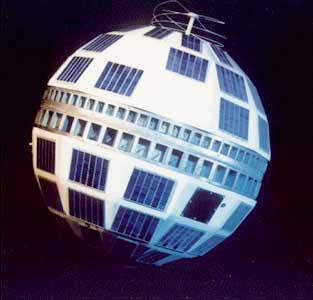
I wasn't sure why my Aunt wanted me. We'd had dinner; it was sometime after two and supper was usually at six. I'd learned during the summer that I stayed with them, that she and my Uncle Jack were very punctual folks.
She was drying her hands on her apron as I stepped up on the porch. “Come on in; there's going to be something on television we need to see.” This was a bit out of the ordinary. Usually, in the afternoon we might watch the “Channel 10 Matinee for an Afternoon” together, but that came on at two and the cat clock on the kitchen wall showed a few minutes until three.
“What's on?”
Her answer nonplussed me. “Pictures from Europe.” I raised an eyebrow (a bad habit for an eleven-year-old when dealing with adults). Reading my mind, she continued, “No, I don't mean pictures like we usually see. I mean live pictures, not on film. They're going to be showing pictures of what's going on right now, this minute. They're sending them through that satellite, Telstar.”
The two of us settled on the couch. At three sharp, we entered the world of real-time international TV. An American TV news anchorman (at this point, I frankly can't remember whether it was NBC's Chet Huntley or CBS's Walter Cronkite—or both) welcomed the viewers. I remember seeing an American Flag, the Statue of Liberty, and—I think—Mount Rushmore. This was replaced by a tweedy gentleman who said in a plummy BBC accent that he was speaking from Brussels. The picture switched to Paris and the Eiffel Tower. The broadcast closed, as I remember, with a shot of the huge white bubble that enclosed the antenna in Andover, Maine. Interestingly, the pictures from the American side were crystal-clear (at least as judged for that time), but the pictures from Europe rippled as if seen through heat waves or water. The pictures we watched were in living black and white—whether they were broadcast in color or not, I don't know; my aunt and uncle, like most at that time, owned a black and white set (it wasn't until 1964 that my father bought a RCA color console model—the local TV repairman had to study a week and a half before he could adjust the colors that had been scrambled on the trip from the store in Roanoke over the mountains into the wilds of West Virginia—he didn't charge us because of the learning opportunity). [If anyone reading this knows whether or not the broadcast was in color, I'd appreciate them leaving the answer in the “Comments.”]
*
Telstar 1 was owned by AT&T and developed by Bell Labs (part of the Bell Telephone System--”Ma Bell”). It was lofted by a NASA Delta rocket which limited its size to a 34.5 inch (87.6 cm) sphere. The satellite turned the scales at around 170 pounds (77kg). It was powered by solar cells producing a staggering 14 watts and was spin-stabilized.
Telstar first broadcast a picture on 11 July 1962, a nonpublic “Is this thing working?” broadcast. The first public broadcast, the one my aunt and I marveled over, was on 23 July 1962 at 15:00 EDT. As it was in a non-geostationary orbit, unlike the norm for communications satellites these days, Telstar 1 was only above the horizon for 20 minutes during each 150 minute orbit.
Telstar 1 established several firsts besides being the first rebroadcasting telecommunications satellite. It was also the first privately owned payload launched by NASA . It was the first satellite, to my knowledge, to have a song named for it (Joe Meek's instrumental which is on the first record I bought with my own money, “The Ventures Play Telstar and the Lonely Bull”--which I'm listening to as I write this). It's also the first satellite to have a soccer ball named for it, Adidas's design for the FIFA World Cups competitions—the black and white one that most of us in the U.S. think of when the word, “soccer ball,” is mentioned.
Telsar 1 continued in service routing TV, telephone, and fax and data traffic until a number of its transistors were fried by Van Allen Belt radiation excited by high-attitude detonations during both American and Soviet nuclear testing. It first went off the air in early December of 1962, was resuscitated a month later, and finally died on 21 February 1963. At last word, Telstar 1 is still orbiting the Earth, a victim of the Cold War.
From the Earth to the Moon, Ch 17: A TELEGRAPHIC DISPATCH
CHAPTER XVII --A TELEGRAPHIC DISPATCH
The great works undertaken by the Gun Club had now virtually come to an end; and two months still remained before the day for the discharge of the shot to the moon. To the general impatience these two months appeared as long as years! Hitherto the smallest details of the operation had been daily chronicled by the journals, which the public devoured with eager eyes.
Just at this moment a circumstance, the most unexpected, the most extraordinary and incredible, occurred to rouse afresh their panting spirits, and to throw every mind into a state of the most violent excitement.
One day, the 30th of September, at 3:47 P.M., a telegram, transmitted by cable from Valentia (Ireland) to Newfoundland and the American Mainland, arrived at the address of President Barbicane.
The president tore open the envelope, read the dispatch, and, despite his remarkable powers of self-control, his lips turned pale and his eyes grew dim, on reading the twenty words of this telegram.
Here is the text of the dispatch, which figures now in the archives of the Gun Club:
FRANCE, PARIS,
30 September, 4 A.M.
Barbicane, Tampa Town, Florida, United States.
Substitute for your spherical shell a cylindro-conical projectile.
I shall go inside. Shall arrive by steamer Atlanta.
MICHEL ARDAN.
The great works undertaken by the Gun Club had now virtually come to an end; and two months still remained before the day for the discharge of the shot to the moon. To the general impatience these two months appeared as long as years! Hitherto the smallest details of the operation had been daily chronicled by the journals, which the public devoured with eager eyes.
Just at this moment a circumstance, the most unexpected, the most extraordinary and incredible, occurred to rouse afresh their panting spirits, and to throw every mind into a state of the most violent excitement.
One day, the 30th of September, at 3:47 P.M., a telegram, transmitted by cable from Valentia (Ireland) to Newfoundland and the American Mainland, arrived at the address of President Barbicane.
The president tore open the envelope, read the dispatch, and, despite his remarkable powers of self-control, his lips turned pale and his eyes grew dim, on reading the twenty words of this telegram.
Here is the text of the dispatch, which figures now in the archives of the Gun Club:
FRANCE, PARIS,
30 September, 4 A.M.
Barbicane, Tampa Town, Florida, United States.
Substitute for your spherical shell a cylindro-conical projectile.
I shall go inside. Shall arrive by steamer Atlanta.
MICHEL ARDAN.
Langganan:
Komentar (Atom)
